
By Sheikh Omar
At last week’s UK-EU summit in Brussels, Britain secured new agreements designed to ease food trade, link the two carbon markets, and restore some opportunities for young people to spend time in Europe. The package has revived a question British politics once tried to settle: could the United Kingdom rejoin the European Union?
The agreements are a meaningful step towards closer cooperation. They are not a decision to rejoin the EU, and they are not even the first agreements Britain and the EU have reached since Brexit. Their importance lies in what they signal about the next phase of the relationship.
A reset, not a first agreement
Since leaving the EU, Britain has agreed a Withdrawal Agreement, a Trade and Cooperation Agreement, and changes to the Northern Ireland arrangements through the Windsor Framework. At the 2025 UK-EU summit, the two sides also agreed a new agenda for cooperation, including security and defence, trade, energy, and youth mobility. This week’s package builds on that work.
The 2025 summit helped move the relationship from managing separation towards negotiating practical cooperation again. The agreements are a tangible next step under that agenda. The two sides have concluded negotiations, but the agreements still need to pass through their legal processes. Most are expected to take effect from 2028.
British Prime Minister Andy Burnham has also opened a discussion about Britain’s long-term relationship with the EU. At the Labour Party conference in September, he said Brexit had done more harm than good and had failed to deliver the growth and “control” promised by its supporters. He said the country should consider a range of options, including closer ties and, ultimately, EU membership. After the summit, he said his government would discuss those options with European partners and present its assessment to inform decisions in the next Parliament.
That is a shift in the political conversation, but not yet a change in government policy. Burnham has said the government will not cross its manifesto red lines before the next general election. Labour’s 2024 manifesto ruled out returning to the EU single market, customs union, or freedom of movement. The new discussion leaves future choices open without settling them.
The new discussion leaves future choices open without settling them
The economic argument for closer ties
The argument for rebuilding relations is not that the UK has stopped trading with Europe. The EU remains a major market for British businesses. In 2025, around 41% of UK exports of goods and services went to the EU. The United States is the UK’s largest single-country trading partner, but the EU as a bloc remains central to British trade.
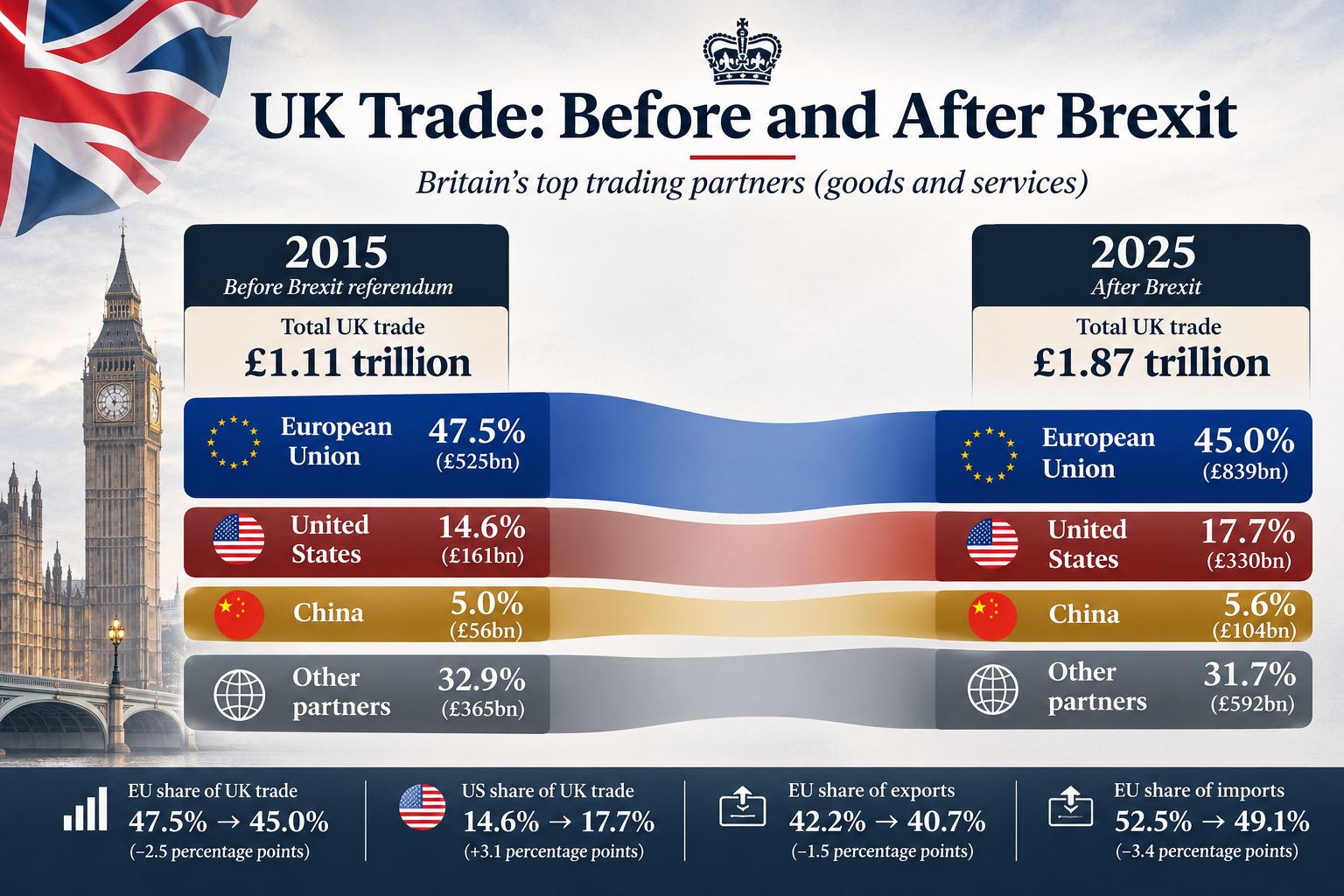
Brexit changed the terms of that relationship. British businesses trading with the EU face new checks, paperwork, and regulatory barriers. The food agreement is intended to remove many routine checks on products such as meat, fish, dairy, plants, and seeds. The emissions deal will link the UK and EU carbon markets and help British exporters avoid certain carbon border charges.
The UK economy has been struggling with several pressures, and Brexit is not the only cause of weak growth or low productivity. The Office for Budget Responsibility estimates that the post-Brexit trading relationship will eventually leave UK productivity about 4 percent lower than it would have been relative to remaining in the EU. This is a long-term forecast, not a measurement of how much the economy has already lost. It reflects the economic cost the OBR associates with higher barriers to trade.
The summit deals may reduce some of those barriers. They cannot recreate the full benefits of EU membership. Britain will also have to decide how much regulatory alignment it is willing to accept in return for easier access to European markets.
Europe has changed since 2016
The political setting is different from the one that produced the referendum. In 2016, many voters saw leaving the EU as a way to regain control over national decisions. Today, Russia’s war against Ukraine has made European security and cooperation more pressing. The UK and EU signed a security and defence partnership in 2025. Their latest joint statement again describes cooperation as a shared priority in the face of the threat from Russia.
The EU itself is also reconsidering its place in a more dangerous world. Its 2026 enlargement package describes enlargement as an investment in European security and reports progress in the accession paths of countries including Ukraine, Moldova, Montenegro, and Albania. Britain is not part of that process. But the wider shift shows that European cooperation is increasingly discussed in terms of economic strength and security, as well as rules and institutions.
Brexit separated the UK from the EU’s decision-making institutions. It did not remove Britain from Europe’s economic, security, or diplomatic realities. The current approach is an attempt to manage that interdependence from outside the Union.
Public support has shifted, but not settled the debate
Recent polls show that support for rejoining has grown. In an Ipsos survey conducted in October, 56% said they would vote for the UK to apply to join the EU in a new referendum, while 30 % said they would vote to stay out. A separate YouGov poll found that 22% of people who voted Leave in 2016 would now vote to rejoin.
Brexit separated the UK from the EU’s decision-making institutions. It did not remove Britain from Europe’s economic, security, or diplomatic realities.
Those figures suggest that some voters have changed their minds. They do not show that the country has reached a settled consensus. Support varies by age and party, and many voters remain concerned about sovereignty, immigration, and the terms Britain might have to accept. A YouGov survey found that even among people who favour closer relations, rejoining the EU is not necessarily an immediate priority.
Support for rejoining in principle is also conditional. Ipsos found that 39% would support joining without a referendum even if Labour won an election on a manifesto commitment to do so, while 35% would oppose it. The figures suggest an opening for debate, not a settled public mandate.
What rejoining would require
The UK cannot simply resume its old membership on its former terms. Under Article 49 of the Treaty on European Union, a country that has left and wants to rejoin must apply through the accession process. Membership terms would have to be negotiated, approved unanimously by EU member states, consented to by the European Parliament, and ratified by the parties.
That process could involve difficult questions about the single market, the customs union, free movement, the euro, and Britain’s ability to set an independent trade policy. The UK should not assume that it would automatically regain the special arrangements it held as a member before Brexit.
For now, sectoral cooperation offers a more likely path. Britain can seek lower trade barriers, wider security cooperation, and more opportunities for young people without returning to full membership. But each agreement brings its own choices. The food deal requires closer alignment with EU standards. The carbon-market agreement links British policy to common rules. A closer future relationship may bring further obligations and financial contributions, while the UK remains outside the institutions that make many of the relevant decisions.
That is the central trade-off Brexit left unresolved: Britain can preserve more formal distance from EU decision-making, or it can seek closer access and accept more shared rules. It cannot assume it will receive all the advantages of integration without the obligations that come with it.
The summit shows that both sides see value in practical cooperation. It also marks a change in British politics: the government is preparing to discuss long-term options that recent governments kept outside the debate.
For the coming years, the likeliest course is a series of sectoral agreements that reduce the costs of separation. The Brussels deal does not take Britain back into the EU. It makes the choice facing Britain clearer: how much closer to Europe does it want to move, and on what terms?
For further reading see our deep dive on the geopolitics of Britain