

How to Sell a Genocide – The Media’s Complicity in the Destruction of Gaza
Adam H. Johnson
April 2026
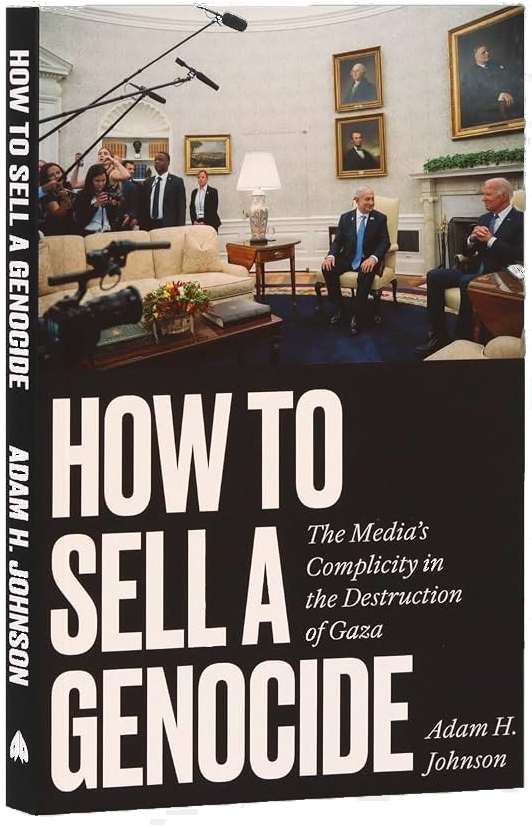
Wars are fought with bombs, missiles and soldiers, but they are also fought through words. Governments need populations to accept wars, tolerate their costs and, in extreme cases, become accustomed to enormous civilian casualties. Adam H. Johnson’s How to Sell a Genocide is about how this process works.
Its subject is Gaza, but its wider significance is the relationship between media, political power and public opinion. Johnson argues that the destruction of Gaza after 7 October 2023 could not have been politically sustained without a media environment that rationalised Israeli actions, privileged Israeli narratives, dehumanised Palestinians and insulated the Biden administration from responsibility for American support for Israel.
Johnson begins from a simple proposition: large-scale military campaigns require political legitimacy. The public does not necessarily need to enthusiastically support everything being done. It merely needs to be persuaded that violence is unavoidable, alternatives are unrealistic or responsibility lies elsewhere.
He calls these arguments the “Moats of Rationalization.” Rather than celebrating Palestinian deaths, liberal media offered audiences more respectable explanations: Hamas was responsible; Israel had the right to defend itself; civilian deaths were unfortunate but unavoidable; Washington was privately pressuring Israel; Biden supposedly had limited influence over Netanyahu; or Trump would be even worse.
This concept is probably the book’s most useful contribution. It shows that propaganda does not always work through blatant falsehoods. It can work through framing, omission, selective sympathy and narrowing the limits of acceptable debate.
What Makes the Book Different?
Johnson’s work stands apart because he tries to quantify his argument. The book examines more than 12,000 articles and 5,000 television clips across nine major media outlets, alongside interviews with people who worked within newsrooms. He compares vocabulary, headlines, framing and coverage between Palestinians and Israelis, and particularly between Gaza and Ukraine. The result is less a traditional history of the Gaza war and more a forensic examination of how news is constructed.
Some of the strongest sections concern seemingly insignificant choices of words. Johnson argues that Israeli victims were routinely individualised and humanised while Palestinians were more often converted into statistics.
One example concerns Israeli hostages and Palestinians held by Israel. Israeli captives might be described as “women and children”, while Palestinians in the same exchanges became “women and minors”. The difference seems minor, but repeated systematically it creates two different emotional responses.
Another example concerns agency. Johnson compares New York Times headlines covering Russia’s invasion of Ukraine with those covering Gaza. Russia “attacks”, “batters”, “bombards” and “strikes”. In Gaza, Palestinians often simply die; explosions happen and hospitals face catastrophe.
Johnson calls this the “Natural Disaster-izing of Israeli War Crimes” — reporting human decisions almost as though they were earthquakes or hurricanes.
For geopolitical analysis, this is a valuable lesson: it is not enough to ask whether something was reported. Ask who is given agency, who is humanised and whose explanation appears first.
Gaza Versus Ukraine
Perhaps the book’s most powerful technique is its comparison with Ukraine. During the first 100 days of Russia’s invasion, Johnson records 262 Ukrainian children killed compared with more than 10,000 Palestinian children in Gaza. Yet mentions of child deaths on CNN and MSNBC were actually higher for Ukraine. He calculates around 16.1 television mentions per Ukrainian child killed compared with 0.36 per Palestinian child.
A similar disparity existed with journalists. Seventy-seven journalists were killed in Gaza compared with eight during the first 100 days of Ukraine, yet coverage was roughly equal.
Johnson’s point is not that Ukraine received too much sympathy. It is that Gaza received too little. The comparison exposes the hierarchy through which Western media decides whose suffering deserves emotional identification.
The Power of the Initial Narrative
Another revealing section revisits the claim that Hamas had beheaded 40 babies. Johnson traces how the story travelled rapidly from Israeli sources through major media organisations and eventually reached President Joe Biden. He argues that its significance was not simply whether the claim was true, but how it helped place Hamas inside a familiar post-9/11 framework.
During the first month, Johnson records Hamas being equated with ISIS 149 times across major print and online outlets, with hundreds more comparisons on television. Once the conflict was framed as a civilisation confronting ISIS-style barbarism, the occupation, blockade, settlements and wider history became easier to push aside.
The broader lesson is: the framework established during the first days of a crisis can shape how everything afterwards is interpreted.
Media and Political Power
Johnson is equally interested in how media covered the Biden administration. One recurring narrative portrayed Biden as frustrated with Netanyahu, privately angry about civilian casualties and desperately trying to restrain Israel. Johnson labels this the “Helpless Biden” or “Fuming/Deeply Concerned Biden” narrative.
His challenge is straightforward: if Washington opposed what Israel was doing, why did it continue supplying the weapons and diplomatic support that allowed it to continue? This is one of the book’s most useful geopolitical lessons. What politicians privately “feel” can receive more attention than what governments actually do. Analysis should therefore follow capabilities, resources, policies and actions rather than rhetoric.
Context and Agenda-Setting
Johnson also examines resistance within newsrooms to providing wider historical context for 7 October. This matters because removing context does not create neutrality. If history begins on 7 October 2023, Israeli military action appears primarily as a response to an unprovoked attack. If the timeline includes occupation, blockade, settlements, previous wars and the Nakba, the picture changes considerably.
The book also looks at coverage of university protests, antisemitism and campus controversies. Johnson argues that agenda-setting shifted attention away from the underlying foreign-policy issue — continued US support for Israel — toward disputes over language, protest and university administrators.
The most valuable thing about How to Sell a Genocide is that it teaches readers how to read the news. Most people look for obvious factual errors when judging media bias. Johnson encourages harder questions: Why was this story selected? Why was another ignored? Who “kills” and who simply “dies”? Whose children receive names and photographs? Whose claims require verification? Where does the historical timeline begin?
The book shows that information power works through selection, language, context, humanisation, credibility and agenda-setting. That lesson extends far beyond Gaza.
Johnson’s deeper argument is that media institutions help establish the boundaries within which political reality is understood. Governments possess armies, intelligence agencies and diplomatic power, but sustaining foreign policy also requires narratives explaining why certain actions are necessary and why alternatives are supposedly impossible.
How to Sell a Genocide is informing you that you should never a read the news in the same way again.

One comment
Stephen Greene
18th August 2026 at 11:40 pm
So when did World War 2 start? According to this 1914?