

The Fall of the West: How They Really Lost It
Owen Jones
1st October 2026
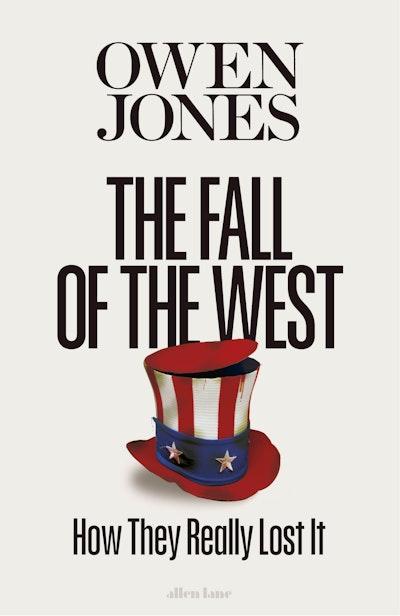 The West emerged from the Cold War convinced that history had ended, its economic model had triumphed and American supremacy would last indefinitely. Three decades later, its wars have failed, its economies are struggling and its global authority is increasingly contested. In The Fall of the West, Owen Jones argues that the greatest threat to Western dominance was never China, Russia or immigration, but the arrogance and disastrous decisions of its own ruling elites.
The decline of the West has become one of the defining geopolitical questions of our time. Yet explanations often focus on external threats: China’s economic rise, Russia’s military resurgence, immigration or the supposed erosion of Western values.
British journalist Owen Jones offers a fundamentally different explanation. In The Fall of the West: How They Really Lost It, he argues that Western decline is largely self-inflicted. The political and economic elites who celebrated their victory over communism proceeded to undermine the very foundations of their own power.
Jones, best known for Chavs and The Establishment, expands his analysis from British politics to the international order. His central argument is that Western governments pursued an economic ideology that hollowed out their societies while simultaneously embarking on military adventures that destroyed their credibility abroad.
In eight chapters from the graveyard of empires to Russia’s revenge, to the great reverse all the way to a livestreamed genocide, the result is a powerful indictment of Western triumphalism, tracing the journey from the optimism of the 1990s to today’s fractured international order.
The Arrogance of Victory
The book begins with the collapse of the Soviet Union, arguably the greatest geopolitical victory in modern Western history. With communism defeated, Western leaders increasingly believed liberal democracy and free-market capitalism represented the final stage of political development. American military supremacy appeared unchallengeable, while globalisation promised prosperity and stability.
But Jones argues that victory produced intellectual arrogance rather than strategic wisdom. Western governments assumed their economic model could be imposed universally, regardless of local political conditions, historical experiences or social consequences.
Russia provides an important example. The economic transformation following the Soviet collapse produced enormous social disruption, declining living standards and the concentration of wealth among a small oligarchic elite. Jones highlights warnings from officials who recognised that the policies being promoted could destabilise Russia and undermine the possibility of a durable post-Cold War settlement.
Instead, Western policymakers continued to pursue their preferred economic prescriptions, often dismissing dissenting assessments.
The broader lesson is that Western leaders confused their temporary geopolitical dominance with permanent historical superiority.
The Wars That Destroyed Western Credibility
Perhaps the book’s strongest material concerns the consequences of Western military intervention.
The invasions of Afghanistan and Iraq were supposed to demonstrate American power and establish a new international order. Instead, they exposed the limitations of military superiority. Afghanistan ended with the Taliban returning to power in 2021, following two decades of occupation and enormous expenditure.
Iraq proved equally disastrous. The overthrow of Saddam Hussein dismantled existing state institutions, fuelled sectarian conflict and contributed to regional instability.
For Jones, these were not isolated mistakes but consequences of a worldview that assumed Western military power could remake entire societies.
The contradiction between Western rhetoric and Western conduct became increasingly difficult to conceal. Governments that claimed to defend international law repeatedly violated or selectively applied its principles.
Jones extends this criticism to Gaza, where Western support for Israel has severely damaged claims that the international order operates according to universal standards.
The cumulative consequence is a profound loss of legitimacy. Western military power remains formidable, but the ability to persuade others of its moral authority has been substantially weakened.
Neoliberalism and the Destruction From Within
Jones connects these foreign-policy failures with economic developments inside Western societies.
The financial crisis of 2008 exposed fundamental weaknesses in the neoliberal economic model that had dominated Western policymaking since the 1980s. Financial institutions accumulated enormous profits during the boom years, only to require public intervention when their speculative activities threatened the wider economy.
Yet the political response frequently involved austerity, reductions in public expenditure and pressure on ordinary households. Rather than restructuring the economic system responsible for the crisis, governments largely protected its principal institutions.
Jones argues that the resulting inequality, insecurity and deterioration of public services weakened public confidence in democratic institutions.
The political consequences were profound. Communities that had experienced industrial decline, stagnant wages and diminishing economic prospects increasingly rejected established political parties. This created fertile ground for populist movements promising to overturn the existing order.
The Rise of the Right
One of Jones’s central arguments is that the political establishment created the conditions for the very movements it now fears. Rather than acknowledging the consequences of economic mismanagement, political elites increasingly permitted immigrants, minorities and progressive movements to become convenient scapegoats. The rise of Donald Trump, Brexit and European nationalist parties can therefore be understood partly as reactions to economic and political failures.
Jones challenges the argument that Western decline results primarily from cultural liberalism or excessive immigration. Instead, he locates its origins in the decisions of political and economic elites who prioritised private enrichment, market ideology and geopolitical dominance over long-term social stability.
This is an important distinction. The forces claiming to rescue Western civilisation may themselves be symptoms of its deeper crisis.
The book’s greatest strength is its ability to connect developments that are frequently examined separately. Military intervention, financial deregulation, austerity, populism and declining international legitimacy are presented as interconnected consequences of the same governing assumptions. Jones also challenges the tendency to attribute Western decline exclusively to the rise of rival powers.
Jones links ideological arrogance to policy and political decisions made after the Cold war ended. Whilst elites in the west tend to lay the blame to policy decisions or specific governments, Jones places the blame firmly upon the ideology that came to dominate the world after the fall of Communism.
The End of Western Exceptionalism?
The Fall of the West is a compelling account of how a powerful political and economic order undermined its own foundations.
Jones’s central achievement is to challenge the comforting assumption that Western decline must have been caused by hostile outsiders. His argument is that the West’s ruling elites were not merely incapable of preventing decline; their policies actively accelerated it.
The book ends with Jones raising a question: can the West reform its institutions and recover its legitimacy, or have the consequences of three decades of strategic overreach become irreversible?
For readers interested in the changing global balance of power, the book provides an important perspective on the internal contradictions of Western supremacy.
The central lesson is that great powers do not always fall because their enemies become stronger. Sometimes they decline because their elites become convinced that their power has no limits.