

Don’t Say Palestine: How the Media Manufactured Consent for Genocide
Assal Rad
September 2026
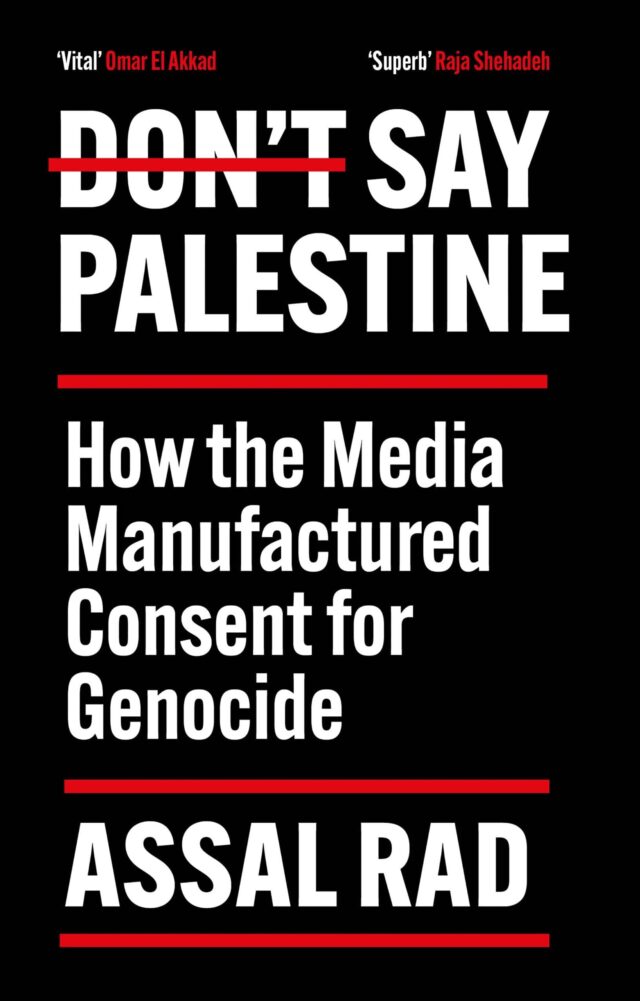 Assal Rad’s Don’t Say Palestine is not primarily a history of the Gaza war. It is a book about who gets to narrate war, how language distributes responsibility, and how journalism can shape the boundaries of what the public considers permissible.
The book grows out of Rad’s online work as a self-described “headline fixer,” where she rewrites mainstream headlines to make agency explicit. Her target is not only overtly pro-Israel commentary. She focuses particularly on supposedly neutral reporting by major Western outlets—including the BBC, CNN, AP, Reuters and The New York Times. Her argument is that apparently small editorial decisions—active versus passive voice, who is identified as the actor, whose claims require qualification, and even whether Palestinians are named—accumulate into a fundamentally different account of events.
The title encapsulates her thesis. You do not necessarily need to lie to distort reality. You can change how reality is understood through language.
Rad’s central contention is that Western coverage did not merely fail to describe Gaza adequately; she argues that it helped “manufacture consent” for what she characterizes as genocide by repeatedly presenting Palestinian suffering differently from Israeli suffering.
One of her recurring observations is deceptively simple: Israelis are more readily described as people to whom something was done, whereas Palestinians often appear as people to whom something simply happened. The contrast is Israelis being described as “children” and “civilians,” while Palestinians become “people under 18” or “collateral damage”; similarly, Israelis are “killed” while Palestinians “die.”
This distinction between agency and event runs through the book. For Rad, a headline such as “Palestinians die in Gaza strike” does something politically significant that “Israeli strike kills Palestinians” does not: the first records the deaths while obscuring who caused them.
The book’s strongest idea is therefore not that newspapers fabricate everything. It is that facts can individually be accurate while their presentation collectively produces a misleading narrative.
The book is compact—five main chapters plus a prologue—but the structure gradually widens the argument from individual headlines to the Western political and international system.
Rad explains the origins of her headline corrections. Her method is important because she frequently leaves the underlying event unchanged and instead changes its framing. This establishes a question that follows the reader throughout the book: How differently would we understand an event if every headline clearly identified who did what to whom?
The intellectual foundation of the book is “When Dehumanization Becomes Standard.” Rad examines the rationalisation of atrocities, selective justice, the language used for Palestinians and the ability of those controlling the narrative to define what an event means. Interestingly, she reaches backwards to Iraq. One section is explicitly titled “Iraq as a Precedent: The Death of Accountability.”
This matters because Rad sees Gaza not as an isolated journalistic failure but as part of a longer pattern in Western coverage of wars involving Western states and their allies.
She also attacks what she regards as an asymmetry in political language. Western governments routinely affirm Israel’s rights, while Palestinian rights are framed differently or subordinated.
The wider insight is powerful: the vocabulary available to describe a conflict can determine the conclusions audiences are capable of reaching about it.
Rad believes Gaza shattered the myth of the rules-based order. She contends that Gaza exposed a gap between Western rhetoric about international law and the way Western governments responded when an ally was accused of grave violations. That leads to one of the book’s broader geopolitical observations. Rad argues that Gaza is not merely damaging Israel’s reputation. It has damaged the credibility of the Western-led international order itself.
For Rad freedom of the Press Is a Slogan, not a Policy. She examines journalistic norms, censorship, Palestinian journalists and what she describes as the silence of Western media institutions toward their Palestinian colleagues.
Gaza has been one of the most intensely documented conflicts of the social-media era, while access for international journalists has been heavily constrained. Palestinian journalists therefore became crucial witnesses. This creates a battle over who gets to create the historical record. Rad’s concern isn’t simply today’s headline. It is tomorrow’s history. If one group controls the language through which an event is recorded, it potentially influences how future generations remember the event itself.
Rads core chapter is: “How the Media Manufactured Consent for Genocide.” Rad examines the construction of the Gaza narrative through specific subjects: starvation, aid workers, destruction of the healthcare system, the ceasefire and the representation of destruction.
Rad gives the example of two hypothetical headlines:
“Gaza hospital stops functioning.”
versus:
“Israeli attack forces Gaza hospital to stop functioning.”
Both might describe the same outcome. But they tell completely different stories about causation and responsibility. The first makes destruction resemble a natural disaster. The second identifies an actor. Rad’s critique is that too much reporting adopts the grammatical structure of the first.
The final chapter brings the argument together through three themes: “The Press as Power,” “Refusing to Call It What It Is: Genocide” and “Lessons from the Gaza Genocide.”
Here Rad rejects the idea that journalism is simply an observer of power. Media institutions possess power themselves. They decide which deaths lead the news, which images are shown, whose testimony is considered credible, when official claims require qualification, which historical context matters and what vocabulary audiences repeatedly encounter. Rad therefore treats journalism as part of the architecture through which political legitimacy is produced.
The value of Don’t Say Palestine extends beyond Gaza. Its real subject is information and power. Rad asks readers to stop consuming news solely for the facts contained within it and start examining the architecture surrounding those facts: Who is the subject of the sentence? Who disappears into passive voice? Whose claims appear without qualification? Who gets named? What historical context is supplied? Which stories receive prominence? And who benefits from the resulting narrative?
Once you begin reading journalism this way, it becomes difficult to stop. That is why the book is useful even for readers who disagree with Rad’s conclusions. It provides a framework for interrogating coverage not only of Gaza but of Iraq, Ukraine, Iran, China and future wars.
And perhaps that is the book’s most unsettling implication. Propaganda does not always look like propaganda. It does not necessarily require government censorship, invented stories or obvious lies. Sometimes it can consist of thousands of individually small editorial choices—a missing actor here, passive voice there, an omitted context, an unchallenged official statement—until one version of reality begins to look like simple common sense.
That is ultimately what Assal Rad wants the reader to notice.