

Across Europe, governments are urging citizens to prepare for emergencies by stockpiling food, drinking water, medicines and other essential supplies. Britain recommends households maintain enough provisions to survive at least three days, while some European countries advise preparing for considerably longer.
Officially, these warnings concern a range of potential disruptions, from extreme weather and cyberattacks to power failures and interruptions to supply chains. However, they come as European governments increasingly warn about the possibility of military confrontation with Russia and announce major increases in defence spending.
Europe is preparing for war in an environment where its societies are not resilient enough to withstand a major crisis.
Europe’s Military Revival
Russia’s invasion of Ukraine fundamentally altered Europe’s security calculations. After decades of relying on American military protection, European governments are rebuilding their armed forces, expanding weapons production and committing larger portions of national spending to defence.
Washington has accelerated this transformation. Donald Trump’s insistence that European NATO members shoulder more of their own security costs has reinforced the pressure to increase military expenditure.
Yet Europe’s military ambitions are colliding with economic realities. Growth remains weak across much of the continent, governments face substantial debt burdens, and public services are under increasing strain.
Every additional commitment to defence creates pressure and difficult choices elsewhere. When public finances are constrained, military expenditure will require cuts to healthcare or infrastructure as these priorities increasingly compete for the same resources.
Europe is therefore attempting to finance a military revival without resolving the economic weaknesses undermining its economies.
The Fragility Beneath Europe’s Prosperity
Britain provides a revealing example of this contradiction.
The government’s emergency preparedness campaign encourages households to prepare for interruptions to electricity, water and food supplies. Yet these vulnerabilities arise not from foreign threats but from decades of domestic cuts.
Britain’s water infrastructure faces mounting pressure from ageing networks and inadequate investment in storage capacity. Its hospitals carry enormous maintenance backlogs, while electricity infrastructure requires substantial modernisation.
These problems illustrate a wider European challenge. Infrastructure built during earlier periods of economic expansion increasingly requires expensive replacement, just as governments are redirecting resources towards defence.
The result is a troubling paradox: European states are investing in sophisticated weapons systems while struggling to maintain some of the basic infrastructure upon which their populations depend.
A country capable of deploying advanced fighter aircraft but unable to guarantee reliable electricity or water supplies possesses military capabilities without necessarily possessing national resilience.
The result is a troubling paradox: European states are investing in sophisticated weapons systems while struggling to maintain some of the basic infrastructure upon which their populations depend.
Globalisation Has Become a Strategic Vulnerability
Europe’s economic model has created another weakness: dependence on international supply chains.
For decades, European prosperity rested partly on affordable imported energy, access to global markets and highly efficient production systems.
Germany exemplified this model. Its industrial economy benefited from Russian energy, Chinese demand and access to international export markets. That arrangement is now under pressure.
The rupture with Russia increased Europe’s energy costs, while China’s industrial expansion has intensified competition against European manufacturers. Meanwhile, geopolitical tensions are threatening the trading routes upon which European economies depend.
The war involving Iran has exposed these vulnerabilities further. Disruptions around the Strait of Hormuz and Bab al-Mandab threaten energy shipments, fertiliser supplies and international shipping. These pressures feed into higher production costs, food prices and household bills.
Europe’s dependence on just-in-time distribution compounds the problem. Supermarkets and manufacturers maintain relatively limited stock, relying instead on uninterrupted deliveries.
Such systems are efficient during stable periods but become vulnerable when shipping routes close, energy prices surge or international trade is disrupted.
Europe has therefore discovered that economic efficiency and strategic resilience are not the same thing.
A country capable of deploying advanced fighter aircraft but unable to guarantee reliable electricity or water supplies possesses military capabilities without necessarily possessing national resilience.
The Domestic Political Consequences
These economic pressures are emerging at a particularly dangerous political moment.
Across Europe, public dissatisfaction has grown over housing costs, stagnant wages, deteriorating services and declining confidence in political institutions.
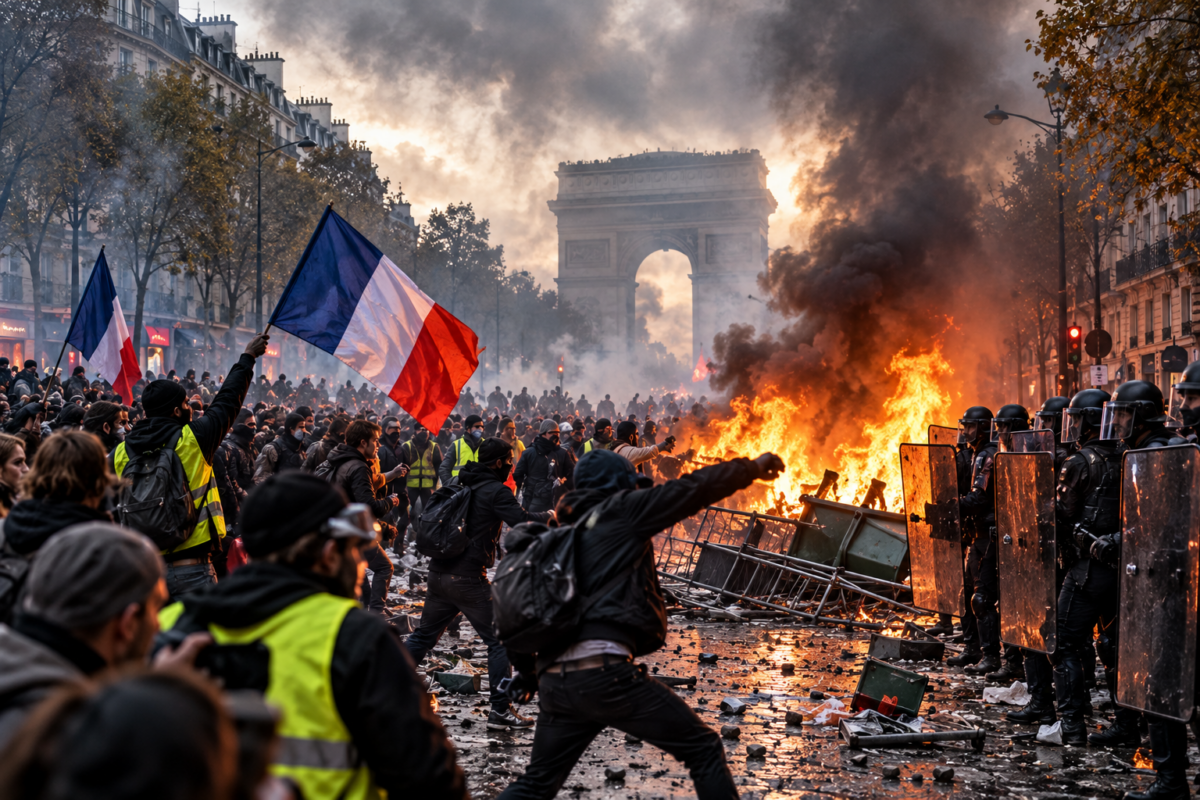
Demonstrations in France and other European countries reflect different national grievances, but they share an underlying concern: many citizens increasingly believe their living standards and future prospects are deteriorating.
Higher defence expenditure risks intensifying these tensions if populations conclude that governments are prioritising military ambitions over domestic welfare.
This presents European leaders with a difficult political challenge. They must convince voters that greater military spending is necessary while explaining why governments cannot adequately finance hospitals, housing, transport and other essential services.
The defence industry may benefit from expanding procurement budgets, but the wider population will judge governments by whether their lives become more secure and affordable.
Military preparedness cannot compensate for declining economic confidence indefinitely.
Higher defence expenditure risks intensifying these tensions if populations conclude that governments are prioritising military ambitions over domestic welfare.
Europe’s Real Strategic Challenge
The central question facing Europe is not simply whether it can deter Russia or reduce its dependence on American military protection.
It is whether Europe possesses the economic foundations necessary to sustain its strategic ambitions.
Military power ultimately rests on industrial capacity, energy security, technological capabilities, functioning infrastructure and a population willing to support the state.
If these foundations weaken, increasing defence budgets alone will not deliver lasting security.
Europe’s emergency stockpiling campaigns should therefore be understood as more than preparations for an uncertain future. They expose how vulnerable even wealthy societies have become to disruptions in essential services and international trade.
The continent faces a choice between treating security primarily as a military problem or recognising that national resilience begins at home.
In WW2 Stalin said that wars are not won on the battlefield but in the factories. Europe cannot rebuild its military power while allowing the economic and social foundations supporting that power to deteriorate. A continent preparing for war must first ensure that its societies are capable of withstanding a crisis. Otherwise, Europe’s greatest strategic vulnerability may not be the enemy it fears abroad, but the weaknesses it has neglected at home.