

|
Getting your Trinity Audio player ready...
|
Welcome to The Geopolity’s What We’re Watching (3W), our daily look at the interconnected worlds of Geopolitics, Economics and Energy. Curated from the world’s leading sources of information, our analysis and commentary is designed to help you make sense of the events driving the major developments in the world
3W previously noted that Israel has been undertaking active diplomacy to get the US to attack Iran again. Earlier this week we noted that Israeli prime minister Netanyahu had sent Mossad director Roman Gofman, one of his closest confidants, to Washington DC for discussions on this matter with US officials.
The New York Times writes that Israeli officials have been asserting that Iran continues to possess significant chemical and biological weapon capabilities that pose a regional threat, and that could be used in terrorist attacks against the US and Europe. They have also suggested that the Iranians are able to equip drones in the region with some of those weapons, and use them to strike Israel or its neighbors. The Israelis have also claimed that Iranians have plotted to use chemical agents against senior US officials. Specifically, Israel wants the US to launch a four-to-seven-day campaign of airstrikes against Iran. But, NYT notes, there are deep differences of opinion within the Trump administration about the reliability of the Israeli intelligence and the wisdom of assaulting Iran again. Those in favor of the attack have reminded Trump that following the arrival of the third aircraft carrier battle group in the Middle East region this week, he has a “unique opportunity” to strike Iran. In recent weeks, the US military has built up an especially vast arsenal in the Middle East region, with naval ships, fighter planes and bombers ready to launch a relatively short campaign of intense strikes against Iran’s drone and missile arsenal, as well as Iranian energy facilities.
At 3W we note this appears to be a replay of moves from July 2026, shortly after Trump signed the MOU with Iran. At that time too, Israel sent officials to the US to share “intelligence”, which included a claim that Iran was trying to assassinate Trump. We also noted at the time that when it comes to the Middle East, the US usually follows Israel: US policymakers either believe they are serving US interests by following Israeli plans, or they are pressured into selling Israeli interests as US interests to the US public.
Some of that dynamic is already visible again. First, Trump has been repeating the Israeli claims in front of reporters, writes Bloomberg. in a Fox News interview Thursday morning from Shenzhen, China, Trump was asked whether there was any indication those purported threats from the Islamic Republic were real. “Well, there is indication that Iran is looking at gases, looking at bio, because we’ve shut them out with the nuclear,” Trump said, Second, the director of US National Intelligence Jay Clayton told US lawmakers on Wednesday that “threats from Iran to Americans inside and outside the US have increased substantially,” writes Reuters. “There are a suite of threats that are that we refer to as, you know, civilian mass destruction threats or whatever you want, and they have been around for a long time,” Clayton said. At 3W we note that an Iranian terror attack on the US is difficult to imagine. It makes for interesting stories in Hollywood movies, through which the American public has been manipulated into believing such things could happen in reality. But in actual reality, Iran has been highly strategic in its strategic defense, consciously avoiding actions that could trigger US public support for the war Israel wants the US to wage on Iran. The outcome of the US midterm elections shows that Iran was successful in this, that the US – Israel Alliance failed to win over the US public for this war. In this situation it would not only be “out of character” for Iran to attack innocent civilians in the US, but even totally irrational as that would turn US public opinion to support the War on Iran. For that reason, we believe Irans official denial of Israel’s accusations is probably the most trustworthy statement on this subject. A spokesperson for Iran’s mission at the United Nations denied the dirty bomb report, saying the country considers the “use of chemical weapons under any circumstances to be wholly illegitimate,” according to CNN.
an Iranian terror attack on the US is difficult to imagine. It makes for interesting stories in Hollywood movies. But in actual reality, Iran has been highly strategic in its strategic defense, consciously avoiding actions that could trigger US public support for the war Israel wants the US to wage on Iran.
In conclusion, Israel’s diplomacy, and its influence in the US, leaves us at 3W with the belief that a restart of this War remains the most likely short-term outlook.
Government and security officials from the Arabian Gulf countries, as well as Pakistan and Turkey, appear to seeing things in similar manner, as they have also engaged in concerted diplomacy, including phone calls with senior US officials, in a bid to avert renewed war in the region, writes The Associated Press. The countries fear that Israel’s diplomacy with the US will indeed result in a renewed round of fighting, and that this round will be more devastating for them. Israel is pushing for attacks on Iran’s civilian infrastructure, including energy, water, as well as roads and bridges, and Iran has made it clear that it would respond in kind in the direction of the Arabian Gulf countries that support or enable such attacks.
Nevertheless, the commander of the U.S. military’s Central Command, admiral Brad Cooper, met on Wednesday in Tel Aviv with Israel’s military chief of staff, Eyal Zamir, and the head of Mossad, Roman Gofman, writes The Associated Press. Considering the context described above, 3W notes a meeting of military leaders provides further indication that war is coming.
As to when exactly, according to The Associated Press, the window of opportunity for the US to attack Iran again will only be open briefly, as one of the three aircraft carrier battle group in the Middle East region is scheduled to depart the region again. The USS Theodore Roosevelt arrived in the region this week, joining the USS George H.W. Bush and the USS George Washington. The latter, the US nay announced, will now be departing from the region.
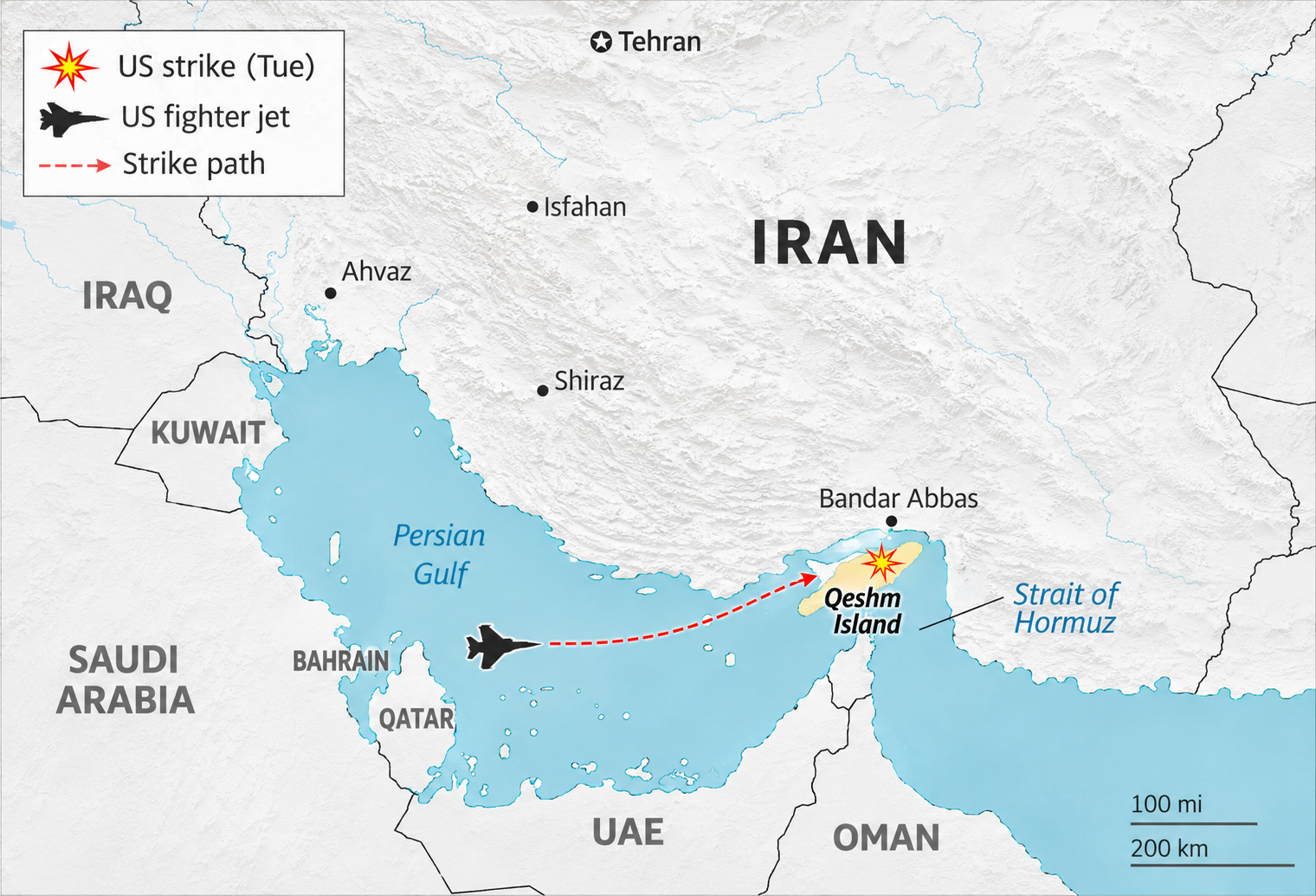
The low-intensity, tit-for-tat attacks between the US and Iran are also continuing. On Tuesday, a US fighter jet struck Iran’s on Qeshm Island in the Strait of Hormuz, reportedly in response to an Iranian attack on an American radar installation in Bahrain earlier that day. Iran launched this attack in response to earlier US attacks on its territory bordering the Strait of Hormuz, writes The Associated Press. On Wednesday, Iran then attacked the Ali Al Salem air base in Kuwait, as well as Bahrain, writes TWZ. TWZ notes that the attacks sparked unconfirmed speculation among open-source flight trackers that a C-17 Globemaster III transport jet, coded as a medical evacuation flight, may have been carrying wounded US troops. The flight left the Middle East headed for Ramstein Air Base in Germany, which is located near Landstuhl Regional Medical Center, where many wounded troops are first sent before heading home. All this means, 3W notes, that an excuse for a restart of major combat operations is readily available.
It is in this light that we at 3W see the cybersecurity incidents the US has been facing over recent days. These have hit every weekday between Thursday and Tuesday, including a nationwide halt to air travel, disruptions to banking services, a Microsoft outage that hit email services, a disruption at Apple, and a temporary disruption to the US National Security Agency’s network. This was not a coordinated, state-sponsored attack, Director of National Intelligence Jay Clayton said, according to Reuters. “Based on what we know today, after a great deal of diligence, these are separate service outages associated with maintenance and technical changes.” In the 3W view, this sounds convenient. But what are the odds of all that happening on consecutive days? We speculatively say that a foreign nation has succeeded in delivering the US an important warning: in the modern age, the US is less protected than it once was by the two oceans on its left and right, and hence it should think twice before launching an attack on the infrastructure of other countries, because other countries can take out US infrastructure even without bombs. The reason why the US would not like to admit this, is because the Trump administration has severely neglected cybersecurity, writes Futurism.
As to Yemen, Saudi officials told allies that the conflict in Yemen with AnsarAllah could last for another six months, writes The Associated Press. The kingdom is making the case that it must first inflict heavier losses on AnsarAllah, before credible talks can be started. At 3W, we are highly skeptical of this assessment. We noted earlier this week that after some four weeks, the Saudi’s major offensive to retake control over the Bab el Mandab from AnsarAllah has fallen apart and its troops are pulling back to defend Aden, the last stronghold of the Saudi-backed forces in Yemen of any significance.
The National writes the forces allied with Saudi Arabia also withdrew from positions around Taiz, Yemen’s third largest city, on the highway connecting the capital Sana’a with Aden. This leaves Aden within reach of AnsarAllah. It is now about 100km west of Aden, according to a Yemeni security official. Taking Aden would give AnsarAllah access to Socotra Island, giving them unfettered access to the Red Sea and the Horn of Africa. In other words, 3W notes, the momentum is not towards the Saudi’s “inflicting heavier losses” on AnsarAllah, but rather it is the other way around.