

|
Getting your Trinity Audio player ready...
|
Welcome to The Geopolity’s What We’re Watching (3W), our daily look at the interconnected worlds of Geopolitics, Economics and Energy. Curated from the world’s leading sources of information, our analysis and commentary is designed to help you make sense of the events driving the major developments in the world
In our most recent update 3W said a very dangerous situation is developing in the Middle East. On the one hand, because preparations by the US – Israel Alliance for another War on Iran are continuing, a war the Alliance cannot decisively win. On the other hand, because Saudi Arabia is making the same strategic mistake when it comes to Yemen as the Alliance is making when it comes to Iran, which is believing that it can secure its interests via war. The ultimate outcome of all this could be, we said, a Middle East on fire, with the different Middle Eastern countries fighting each other: some on behalf of the US – Israel Alliance, and others opposing it.
Today, we start with Yemen.
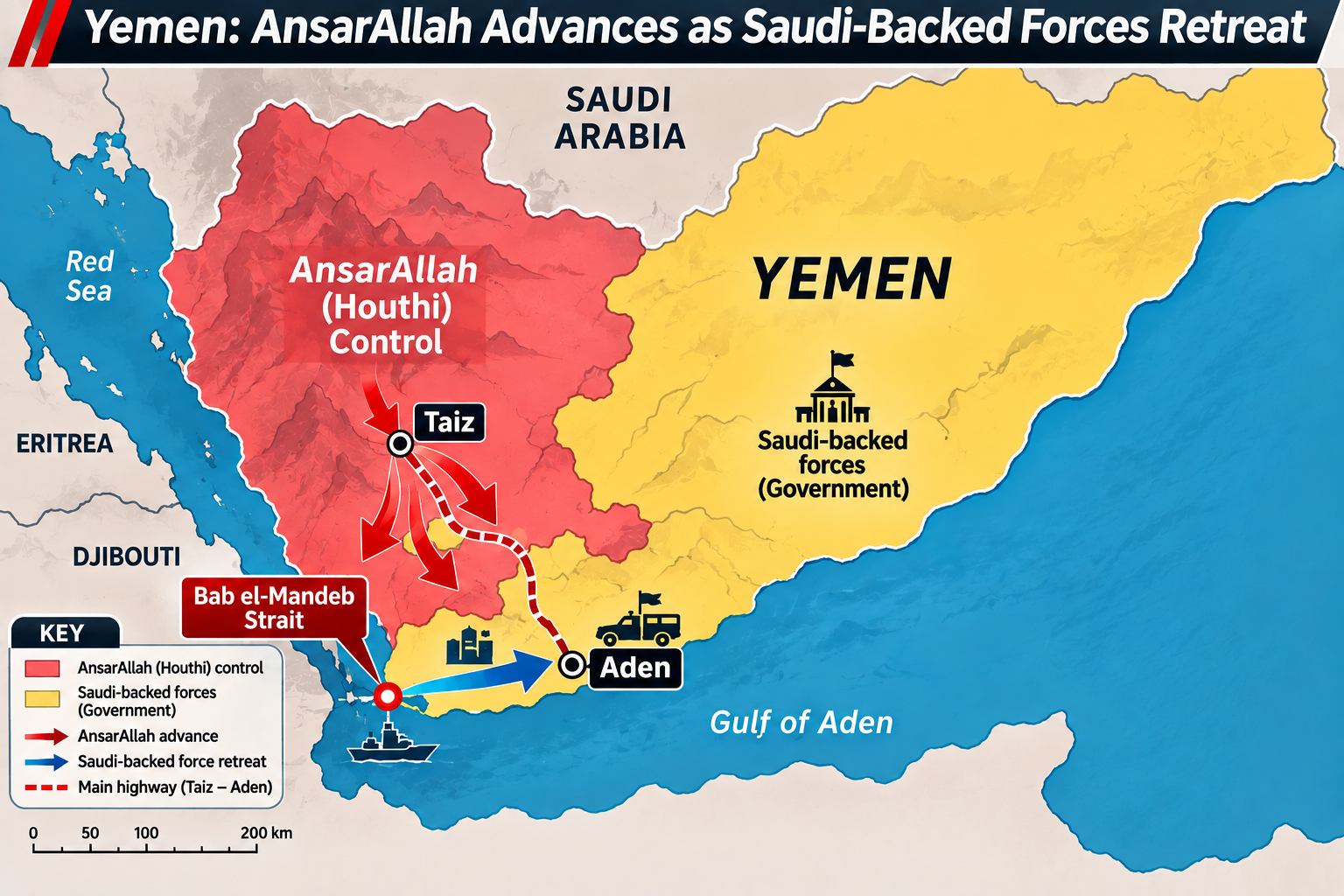
On Sunday, the Saudi-backed force retreated from the Bab el-Mandeb Strait, to defend their temporary capital Aden on the southern coast against the advancing forces of AnsarAllah, writes Reuters. This effectively ends the Saudi’s attempt to wrestle control over the Bab el Mandab away from AnsarAllah. Reuters separately explains that AnsarAllah is threatening to cut the Saudi-backed force around the Bab el Mandab off from its headquarters in Aden, as AnsarAllah continues to advance around the central city of Taiz along the highway that connects the two regions. 3W notes this confirms the expectation we expressed earlier, which was that by trying to militarily defeat AnsarAllah, Saudi Arabia is just creating more problems for itself. It will not win the battle, but in the process severely damage both Yemen and itself.
Then to Iran.
US president Trump said on Thursday that he had pulled vice president JD Vance back from engaging in peace talks with Iran, saying that his time would be better spent investigating fraud in Democratic-run jurisdictions, writes The New York Times. “I have asked Vice President Vance to focus his complete and total attention on the Massive Corruption and Crime taking place in Democrat run Cities and States throughout the U.S.,” he wrote on social media. “We don’t need a deal with Iran,” Trump added. 3W notes that this move increases the likelihood of another US – Israel War on Iran. Trump has now officially closed the door to diplomacy with Iran. At the same time, however, the current status quo in the Strait of Hormuz is unacceptable and unsustainable for the US.
It is unacceptable because Iran continues to attack vessels that try to cross the Strait without its permission. It is unsustainable because, firstly, the US cannot afford to continue the effort that enables at least some crude oil carriers to exit the Strait of Hormuz despite Iranian threats of attack; and because, secondly, this US effort is only looking at crude oil but is doing nothing for other critical commodities such as LNG, refined products, fertilizers, helium, and Sulphur that normally come out of the Strait of Hormuz onto world markets.
The US cannot “simply walk away” for one more important reason, which is that Iran will simply not let it. Iran has made clear it is not willing to return to the status quo that existed before the US – Israel Alliance began their Wars on Iran. And for Iran the current situation is also not good enough. As the MOU also highlighted, Iran is now targeting an end to the decades of international sanctions on it, a return of the billions of Iranian assets seized by the US, and, to make up for lost time, formal Iranian control over the Strait of Hormuz which will allow it to levy “service fees” upon shipping through the Strait of Hormuz. Iran should therefore be expected to continue to create problems for the US, for example by continuing to attack ships that attempt to pass through the Strait of Hormuz even if the US tries to walk away, or by asking its ally in Yemen to also close the Bab el Mandab, until the US accepts these Iranian demands.
Trump now believes that sanctions and a blockade will destroy the Iranian economy, and in that way bring Iran to its knees, writes The New York Times. But at 3W we note that as long as Iran is supported by China and Russia, it will be resupplied and its economy will not collapse. Diplomacy is underway to ensure this, with the Arab Weekly reporting on recent meetings between Iranian officials and Chinese officials, while Russian president Putin earlier met Iran’s Mohsen Rezhaei, as reported by Al Jazeera.
Therefore, in the absence of diplomacy, the future for the conflict around the Straif of Hormuz can only be war. It is a matter of when, not if.
in the absence of diplomacy, the future for the conflict around the Straif of Hormuz can only be war. It is a matter of when, not if.
Signs are that the US and Iran are indeed edging towards war. Last week, the US attacked Iranian radar installations, in response to which Iran then attacked US radar installations in Bahrain. On Sunday, Iran again attacked these installations writes Reuters. Two days ago the Revolutionary Guards said they had attacked a US early-warning radar facility in Bahrain. On Sunday the target was a US air defence radar at the Al-Rifaa helicopter base in Bahrain.
Meanwhile, the USS Theodore Roosevelt aircraft carrier battle group has arrived in the Gulf region, making it the third carrier battle group the US has amassed there, writes Al Jazeera. The USS George Washington and the USS George HW Bush are the other two aircraft carriers currently deployed in the region.
And then there is Israel, for whom war in the Middle East is the ideal outcome. Israeli prime minister Netanyahu is pressing US president Trump to resume the war against Iran, writes Axios. For this purpose, Netanyahu has sent Mossad director Roman Gofman, one of his closest confidants, to Washington DC for discussions with his CIA counterpart Jim Ratcliff.
One of the ways through which Israel is trying to convince Trump is by telling him that Iran is conspiring to kill him, writes Israel Hayom. 3W notes that after Iran and the US agreed the MOU during June of 2026, Israel used the exact same tactic to get the US to restart the war again. At that time, the Israeli psyop worked. “I saw this morning I’m on every single one of their lists”, Trump said in response then, writes CNN. “These are evil, sick people. And we have to root out that cancer. That cancer. You know what you do? You’ve got to cut out cancer early. And that’s the way I feel.”
In short, even if the US wanted to get out of the War on Iran, which is a questionable assertion, it can’t get out, nor will Israel let it out…