

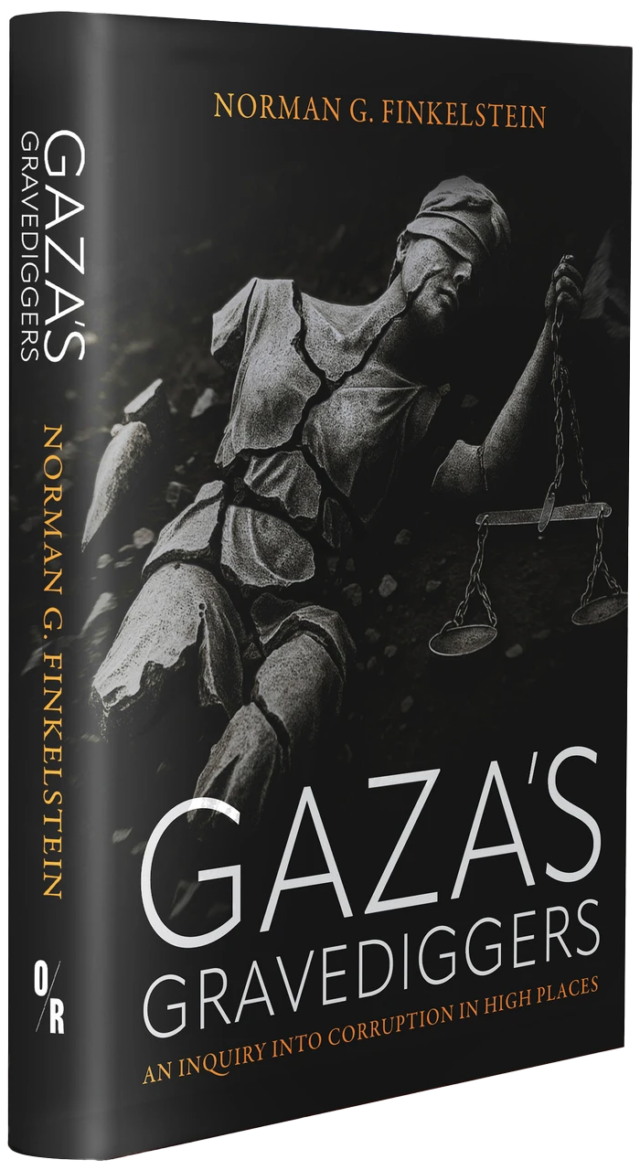
Gaza’s Gravediggers: An Inquiry into Corruption in High Places
Norman G. Finkelstein
September 2026
Norman Finkelstein’s Gaza’s Gravediggers is not a history of the Gaza war. It is an indictment of the institutions and individuals that were supposed to uphold international law and establish the truth, but instead helped obscure, minimise or legitimise what was happening in Gaza.
Finkelstein’s latest book continues themes he has pursued for decades: Israel-Palestine, the politics surrounding human rights, and the gulf between international law in theory and its application when powerful states and their allies are involved. The book explicitly describes itself as an act of remembrance—not principally of Gaza’s destruction, which Finkelstein considers extensively documented, but of the conduct of officials occupying positions of public trust.
This distinction makes Gaza’s Gravediggers particularly interesting from a geopolitical perspective. Finkelstein examines four major institutional interventions surrounding Gaza: allegations of sexual violence on 7 October; a UN Human Rights Council-commissioned investigation into the conflict; opinions emanating from the International Court of Justice (ICJ); and claims about what the ICJ actually decided in South Africa’s genocide case. An extensive appendix also revisits the International Criminal Court’s handling of earlier allegations concerning Israel.
Finkelstein’s method is forensic. He takes official reports, legal judgments, interviews and footnotes and works through their claims, often line by line. This produces the book’s greatest strength and occasionally its greatest weakness. The accumulation of detail can become exhausting, while Finkelstein’s polemical language sometimes risks distracting from the documentary evidence he has assembled.
But his argument is powerful.
Finkelstein finds that the UN helped give institutional credibility to the mass-rape narrative even though its own documentation exposed major evidentiary gaps. The mission led by UN Special Representative Pramila Patten had a remarkable contradiction when the mission explicitly said it was not “investigative in nature”, acknowledged limitations of time and evidence, yet nevertheless concluded there were “reasonable grounds to believe” rape and gang rape occurred.
Finkelstein found, despite the mountain of photographs and videos produced there is “no tangible indications of rape.” Finkelstein notes the absence of rape imagery in the enormous amount of digital material generated on October 7, were a very long way from establishing the much broader claim that Hamas had systematically deployed mass rape as a weapon of war.
The UN Commission’s great error, according to Finkelstein, was calling Gaza a war. This is probably the book’s most interesting conceptual argument. Finkelstein says the UN Human Rights Council’s Commission of Inquiry committed a “category error.” Rather than simply arguing that the Commission was too sympathetic to Israel, he says its entire analytical framework was wrong.
His formulation is striking: the Commission treated Gaza as a war in which Israel occasionally committed crimes, whereas Finkelstein argues it should have understood it as a genocide in which Israel occasionally engaged in combat.
That distinction matters. If Gaza is fundamentally a conventional war, the central questions become whether particular attacks were proportionate, whether a target had military value, and whether sufficient precautions were taken. If the overarching operation is genocidal, Finkelstein argues, analysing thousands of individual attacks as discrete applications of the laws of war risks missing the purpose of the overall campaign.
The most shocking revelation in the book is that that an ICJ judge’s opinion was extensively plagiarised—including material from openly pro-Israel sources.
Finkelstein devotes considerable attention to ICJ Judge Julia Sebutinde. He argues that substantial portions of one of her dissenting opinions were plagiarised. His appendix claims that at least 6,984 of its 20,646 words—33.8%—were plagiarised, overwhelmingly from sources advocating Israel’s position. He even identifies material that apparently retained hyperlinks originating from Wikipedia. One example Finkelstein presents is especially extraordinary, he says a substantial historical passage was reproduced word-for-word from an op-ed written by another Ugandan lawyer. Sebutinde was serving on the world’s highest international court and was a prominent dissenting voice on Israel-Palestine.
Finkelstein’s treatment of former ICJ president Joan Donoghue is also remarkable. In April 2024, Donoghue told the BBC that the ICJ had not decided that the claim Israel was committing genocide was plausible. Rather, she said it had determined that Palestinians possessed a plausible right to protection from genocide.
Finkelstein argues this wasn’t merely an academic difference. The reinterpretation migrated into politics. In September 2025, then-UK Foreign Secretary David Lammy stated that the ICJ had not ruled on the plausibility of Israel committing genocide. Finkelstein contrasts this with subsequent descriptions by the International Association of Genocide Scholars and the UN Commission of Inquiry, both of which characterized the ICJ as having put states on notice of the plausibility of genocide.
Finkelstein’s broader argument is that international institutions derive their authority from the assumption that they apply rules consistently. Finkelstein argues that Gaza demonstrates what happens when those institutions encounter geopolitical power. He contends that officials sometimes diluted conclusions, employed questionable reasoning or publicly interpreted legal decisions in ways that reduced their implications for Israel.
The book consequently raises a question much larger than Gaza: what is international law worth if its application ultimately depends upon geopolitical power?
Finkelstein does not portray every international institution as uniformly complicit. Indeed, his narrative acknowledges officials who challenged Israel and presents South Africa’s case before the ICJ with considerable admiration. But his overarching conclusion is bleak: institutional mechanisms repeatedly proved incapable of translating legal findings and humanitarian warnings into meaningful restraint.
Gaza’s Gravediggers is ultimately a study of power masquerading as rules. The post-1945 international system claims universal principles, yet Finkelstein argues that those principles become negotiable when they collide with the interests of powerful states.
Readers do not have to accept every inference—or Finkelstein’s often uncompromising rhetoric—to appreciate the importance of the challenge he poses. The book forces you to ask whether institutions such as the UN, ICJ and ICC genuinely constrain great powers and their allies, or whether their authority ultimately ends where geopolitical interests begin.
For anyone seeking to understand Gaza not simply as a war, but as a test of the Western-led international order, Gaza’s Gravediggers is an important, provocative and deeply troubling book.