

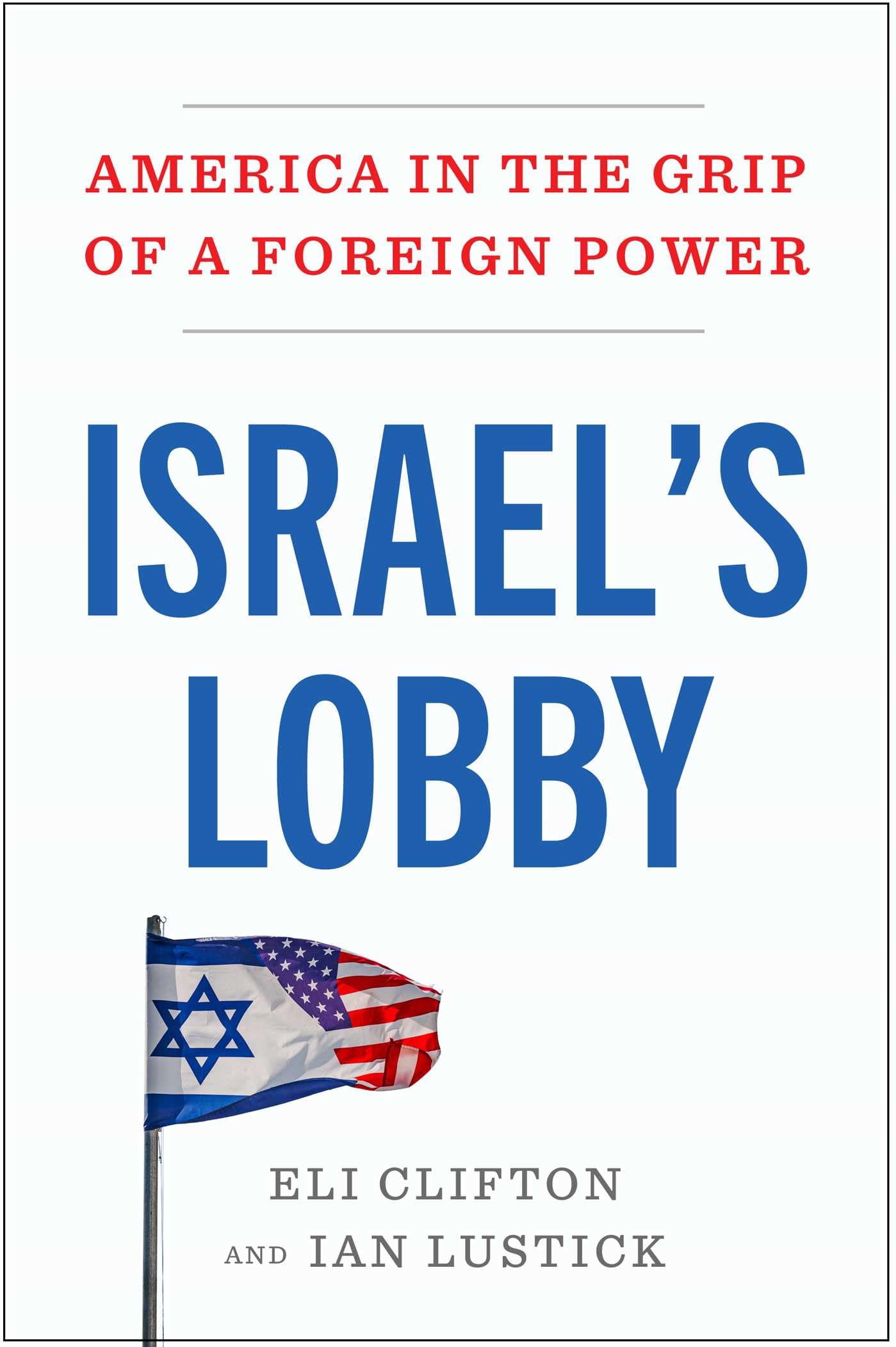
Israel’s Lobby – America in the Grip of a Foreign Power
Eli Clifton and Ian Lustick,
August 2026
 Few relationships in contemporary geopolitics are as unusual as that between the US and Israel. Washington has allies across the world, but none receives quite the same combination of military assistance, diplomatic protection and domestic political support. Why?
That question sits at the centre of Eli Clifton and Ian Lustick’s provocative new book, Israel’s Lobby: America in the Grip of a Foreign Power. It arrives as the US-Israel relationship is under greater scrutiny than at any point in decades.
20 years ago political realists John Mearsheimer and Stephen Walt’s The Israel Lobby and U.S. Foreign Policy created huge controversy as they proclaimed pro-israel lobbies influenced US foreign policy. Clifton and Lustick focus on how the machinery sustaining that relationship actually operates in contemporary America.
Clifton is an investigative journalist specialising in money and foreign policy, while Lustick is a political scientist and former State Department expert on Israel-Palestine. Together they argue that American policy towards Israel can no longer be explained by strategic interests alone. A powerful domestic political network has emerged that can shape elections, Congress, presidential administrations, think tanks and the boundaries of acceptable debate. The authors call this network “Israel’s Lobby.”
One of the book’s most important distinctions is that the authors explicitly reject the idea of a monolithic “Jewish lobby.” They point out that most American Jews do not vote primarily on the basis of Israel and remain politically diverse. In the 2024 election, Israel ranked only ninth among eleven issues considered important by Jewish voters, while 69% supported Kamala Harris and only 26% Donald Trump. Instead, Clifton and Lustick define the lobby as a loose coalition of organisations and individuals seeking to push US policy in a pro-Israel direction. It includes Jewish and non-Jewish donors, Christian Zionists, evangelical organisations, think tanks, political action committees and activists.
Their argument is therefore not that Jews control US politics. It is that a highly organised political movement has developed powerful mechanisms for rewarding politicians who support Israel and punishing those who challenge it. That distinction is at the centre of their analysis.
A Lobby Like No Other
The book begins with George Washington’s 1796 warning against “passionate attachments” to foreign powers. Washington feared that domestic factions emotionally attached to another state could eventually confuse that state’s interests with America’s own. Clifton and Lustick use this as the intellectual framework for the entire book.
For them, the modern US-Israel relationship is close to what Washington feared. Between 1948 and 2024, Israel received more than $300 billion in inflation-adjusted American loans and grants. Since the 1970s it has been the largest recipient of US aid, while the Obama administration’s 2016 agreement committed another $38 billion in military assistance over ten years. Congressional support has been equally remarkable. Israeli leaders have addressed joint sessions of Congress more often than leaders from any other country. Benjamin Netanyahu alone has done so four times. His 2024 speech received 53 standing ovations during a 53-minute address.
At the centre of this machinery is AIPAC. The authors trace its rise from the 1950s into one of Washington’s most influential lobbying organisations. Former Secretary of State George Shultz described himself as “astonished and disheartened” by its power in Congress, while a 1997 survey of Washington insiders ranked AIPAC as America’s second most influential lobby.
Its power is not simply lobbying access. Politicians understand that support can bring campaign financing, while opposition can invite a well-funded challenger. In 2024, AIPAC-affiliated groups spent a record $45 million on congressional races, including efforts against Cori Bush and Jamaal Bowman, both early advocates of a Gaza ceasefire.
One of the strongest parts of the book is its argument that the lobby itself has changed. Chapter Four is titled “America on the Way to Plutocracy.” The turning point was the transformation of US campaign finance, particularly after the Supreme Court’s 2010 Citizens United decision.
The traditional lobby depended heavily on organisation, activists and congressional relationships. The modern version increasingly depends on billionaires. Sheldon and Miriam Adelson are central to this story. In 2012 they spent close to $100 million on American elections and openly identified support for Israel as a major political motivation. Clifton and Lustick argue that this established a model later followed by pro-Israel megadonors in both parties.
The phenomenon is bipartisan. Democratic donor Haim Saban is also examined, alongside Larry Ellison and Jan Koum. The authors argue that wealthy donors increasingly fund not only politicians but think tanks and advocacy organisations that shape the ideas politicians encounter.
This creates an echo chamber. Money finances campaigns. Money finances lobbying. Money finances research. The same political network then supplies politicians with policy recommendations. This is where the book becomes broader than Israel. Its deeper argument is that Israel’s influence is partly a symptom of America’s growing plutocracy.
Its deeper argument is that Israel’s influence is partly a symptom of America’s growing plutocracy.
When American and Israeli Interests Diverge
Supporters of the US-Israel relationship argue that Washington supports Israel because it is strategically valuable: a powerful military state, intelligence partner and dependable regional ally. Clifton and Lustick do not deny that Israel offers strategic benefits. Their argument is that strategy alone cannot explain the scale and unconditional nature of American support. The end of the Cold War is one of their strongest examples.
During the Cold War, Israel’s value could be explained partly by competition with the Soviet Union. Yet when the USSR collapsed in 1991, US military aid to Israel did not fall significantly. It remained remarkably stable throughout the decade. For the authors, this shows that the relationship had become politically institutionalised beyond its original strategic logic. The Iraq War provides a more controversial case.
The authors do not claim Israel alone caused the 2003 invasion. But they argue that Israeli leaders and pro-Israel neoconservatives strongly encouraged regime change. They highlight Netanyahu’s 2002 testimony supporting action against Saddam Hussein and AIPAC material circulating claims about Iraq and terrorism that were later shown to be false.
The lobby is presented less as an all-powerful force than as an amplifier capable of pushing American policy in directions already favoured by influential factions inside Washington.
The second major transformation identified by the authors is Israel itself. Chapter Three carries the deliberately provocative title “Israel as a ‘Crazy State’.” Their argument is that the Israel around which the special relationship was built is no longer the same political entity. Israeli politics has moved steadily to the right, particularly since the collapse of the Oslo process.
Settlements expanded. The two-state solution became increasingly implausible. Religious nationalism grew. Politicians once considered beyond the political fringe entered government. This creates a geopolitical problem for Washington.
The more Israeli policy diverges from American interests, the more costly unconditional support becomes. Yet the lobby continues to pressure Washington to maintain the principle that there should be little or “no daylight” between the two governments. That contradiction lies at the heart of the book.
The most contentious chapter concerns antisemitism. Chapter Six, “The Antisemitism Witch Hunt,” argues that parts of the pro-Israel movement increasingly seek to redefine criticism of Israel as antisemitism and then use political and legal mechanisms to suppress it. Particular attention is given to the International Holocaust Remembrance Alliance definition of antisemitism.
The authors argue that its application blurs the distinction between hatred of Jews and criticism of Zionism or Israeli policy. Significantly, Kenneth Stern, one of the original authors of the formulation, later warned that it was being weaponised to restrict free expression, especially on university campuses.
This section is important because it moves the story from foreign policy into US domestic politics. If criticism of a foreign government can become professionally or legally dangerous, lobbying has moved beyond persuasion and into policing the limits of permissible debate.
At the same time, the authors stress that antisemitism is real and that sweeping accusations against Jews are both wrong and analytically useless. Their argument is that documenting actual lobbying mechanisms is the best antidote to conspiracy theory.
Israel’s Lobby – America in the Grip of a Foreign Power follows the money. Campaign donations, PACs, congressional races, lobbying networks and think-tank financing provide concrete mechanisms through which political influence can be demonstrated.
The authors try to prove that America’s support for Israel cannot simply be reduced to strategic necessity. If strategy alone determined policy, the relationship should have changed more dramatically after the Cold War, as Washington shifted its attention towards Asia and Israeli politics moved further from America’s stated support for a Palestinian state.
Ultimately, Israel’s Lobby is not really a book about Israel. It is a book about American power. For much of the post-Cold War era, Washington possessed enough power to absorb the costs of dysfunctional policies. It could fight wars in the Middle East, finance Israel, confront Iran and maintain enormous commitments elsewhere. That world is disappearing.
The US now faces China, Russia and a more multipolar international system while carrying huge fiscal and military commitments. Resources devoted to one theatre inevitably reduce those available elsewhere. This makes the US-Israel relationship more consequential than it was thirty years ago.
The authors conclude that three transformations — the changing international system, the radicalisation of Israeli politics and the plutocratic transformation of American elections — have produced an increasingly unsustainable gap between public opinion and official policy.
That is probably the book’s most important insight. The question is no longer simply whether Israel’s Lobby is powerful. It clearly is.
The more important question is whether the American political system remains capable of recalibrating a foreign relationship when geopolitical circumstances change. For Clifton and Lustick, that is increasingly a test of American democracy itself. Their conclusion is unexpectedly optimistic: declining public support for unconditional backing of Israel may eventually overwhelm the ability of wealthy donors and lobbying organisations to preserve the status quo.
The book’s central question is a fundamental one: why does the world’s most powerful country provide extraordinary diplomatic, financial and military support to a much smaller state, even when doing so appears to complicate its own strategic objectives? Clifton and Lustick’s answer is that foreign policy cannot be understood simply by looking at armies, alliances and national interests. Sometimes you also have to follow the money.