
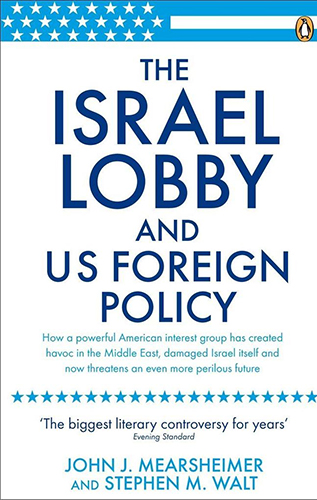
The Israel Lobby and US Foreign Policy
John Mearsheimer and Stephen Walt
2007
 Israel’s influence over US foreign policy in the Middle East is now receiving significant mainstream attention, particularly as the war in Gaza has forced many Americans to reassess the nature of Washington’s support for Israel. But it was not always this way.
When John Mearsheimer and Stephen Walt—both prominent political scientists and international relations scholars—first published their essay The Israel Lobby in 2006, it was nothing short of explosive. Their work triggered a firestorm of criticism, with prominent individuals and organisations denouncing them as anti-Semitic. Yet the publication also revealed something important: thoughtful observers were beginning to question whether the American Israel Public Affairs Committee (AIPAC) and other hard-line pro-Israel groups—including some vocal Christian Zionists—truly represented mainstream opinion within either the American Jewish community or the United States more broadly.
By 2007, Mearsheimer and Walt expanded their original essay into a full-length book, allowing them to fully develop their arguments, respond to critics, and provide further empirical support for their central thesis.
Their argument is straightforward: the extraordinary level of material, diplomatic, and political support the United States provides to Israel cannot be adequately explained by either strategic logic or moral reasoning alone. Instead, they argue, it is largely the result of the political influence of the Israel lobby—a loose coalition of individuals and organisations that work to shape American foreign policy in ways favourable to Israel.
In addition to encouraging Washington to back Israel in near-unconditional terms, the authors argue that pro-Israel lobbying groups played significant roles in shaping American policy toward the Israeli-Palestinian conflict, the Iraq War, and confrontations with Syria and Iran. Their conclusion is stark: many of these policies were not in America’s national interest and, in some cases, were not even in Israel’s long-term interests.
The Privileged Beneficiary
The authors describe Israel as a uniquely privileged beneficiary of American support, receiving levels of economic and military assistance unmatched by any other nation. This support has often remained largely unconditional, regardless of Israeli conduct, including settlement expansion or military operations that drew international criticism.
The authors cite former Israeli Prime Minister Yitzhak Rabin, who described America’s generosity toward Israel as being “beyond compare in modern history.” What began modestly evolved into a strategic relationship unlike any other. As Mitchell Bard and Daniel Pipes once observed, “From a comparative perspective, the United States and Israel may well have the most extraordinary tie in international politics.”
Mearsheimer and Walt acknowledge that the United States has derived some benefits from its relationship with Israel. But they argue that America has ultimately given far more than it has received.
Such generosity would be easier to explain if Israel were an indispensable strategic asset whose survival materially enhanced American security. It would also make more sense if there were a compelling moral rationale requiring such extensive and consistent backing. But the authors argue that neither explanation holds up under scrutiny.
From Strategic Asset to Strategic Liability
Mearsheimer and Walt systematically dismantle the argument that Israel deserves extraordinary American support because it serves as a vital strategic asset. They do not dispute that Israel once held significant strategic value, particularly during the Cold War, when the Middle East formed a central arena in the broader contest between Washington and Moscow.
But with the collapse of the Soviet Union, that geopolitical rationale weakened dramatically.
According to the authors, America’s continued unconditional embrace of Israel is no longer making the United States safer or more prosperous. Instead, they argue, it has complicated relations with other allies, damaged America’s international credibility, fuelled anti-American sentiment across the Arab and Islamic worlds, and made regional diplomacy significantly more difficult. In their view, the “special relationship” is no longer defensible on strategic grounds.
The Moral Case for Support
If the strategic argument is weak, what about the moral one?
Supporters of Israel often justify America’s relationship with the Jewish state through a series of moral claims.
These include the idea that Israel deserves unconditional support because:
- it is a small state surrounded by hostile enemies;
- it is a democracy sharing core Western values;
- the Jewish people suffered immense historical persecution, particularly through the Holocaust;
- Israel’s conduct has been morally superior to that of its adversaries;
- the Palestinians rejected viable peace opportunities, particularly at Camp David in 2000;
- and, for some Christian Zionists, Israel’s existence reflects divine will.
Mearsheimer and Walt argue that these claims deserve scrutiny—not because they harbour hostility toward Israel, but because these arguments are repeatedly used to justify exceptional levels of American backing.
Their conclusion is that while there is a compelling moral case for Israel’s continued existence and security, that does not automatically justify unconditional American support for all Israeli policies.
Viewed objectively, they argue, Israel’s historical and contemporary conduct does not provide a sufficient moral basis for privileging its interests above all others in the region, particularly where doing so undermines American strategic interests.
The authors also challenge what they describe as long-standing myths surrounding Israel’s creation, its conduct toward Palestinians, and its regional behaviour—arguing that Israeli historians themselves have challenged many of the conventional narratives.
Thus, if neither strategic logic nor moral necessity fully explains the relationship, the authors ask an obvious question: What does?
Enter the Israel Lobby
Mearsheimer and Walt’s answer is the Israel lobby.
They describe it as a broad coalition of individuals and organisations that actively work to shape
US foreign policy in a pro-Israel direction. Importantly, they stress that this is not some secretive conspiracy or shadowy cabal. The lobby operates openly, publicly, and through the same broad mechanisms used by many other interest groups in American politics.
The term itself, however, can be misleading. Many of those involved do not engage in traditional lobbying in the narrow sense of directly pressuring elected officials. Instead, influence is exerted through multiple channels—political advocacy, think tanks, public messaging, media influence, academia, donor networks, and electoral pressure.
For that reason, the authors suggest that terms like pro-Israel community or help Israel movement might be more accurate, though “Israel lobby” remains the shorthand they adopt.
The lobby is not centrally organised, nor does it have formal membership structures. Rather, it consists of a loose but highly effective network of organisations and influential individuals united by a common goal: ensuring that American foreign policy advances what they see as Israel’s interests.
At its core sit organisations such as:
- AIPAC
- Washington Institute for Near East Policy (WINEP)
- Anti-Defamation League (ADL)
- Christians United for Israel (CUFI)
The authors argue that what distinguishes this network is not secrecy, but extraordinary effectiveness.
How the Lobby Shapes American Policy
The authors argue that the Israel lobby’s power lies not merely in its existence, but in the breadth and sophistication of its influence. This influence operates across two principal fronts.
First, the lobby exerts significant influence over policymaking in Washington. Second, it works to shape the broader public discourse surrounding Israel and the Middle East, ensuring that support for Israel remains politically safe, morally framed, and strategically unquestioned.
The political dimension is perhaps the most visible. Central to this effort is the American Israel Public Affairs Committee (AIPAC), which the authors identify as one of the most powerful lobbying organisations in Washington. AIPAC’s effectiveness stems from its ability to reward politicians who support its agenda and punish those who do not. Because American elections are extraordinarily expensive, access to donor networks and campaign financing carries immense political weight. The authors argue that AIPAC has mastered this system, ensuring allies receive support while critics understand the political costs of dissent. But influence extends far beyond Capitol Hill.
The authors argue that the Israel lobby has worked extensively to shape public understanding of the Middle East, ensuring mainstream narratives remain broadly favourable to Israel. This includes influence within media institutions, policy debate, and elite intellectual circles.
Over recent decades, pro-Israel voices have also established a commanding presence across influential American think tanks. Institutions such as the American Enterprise Institute, the Heritage Foundation, the Hudson Institute, the Foreign Policy Research Institute, and the Jewish Institute for National Security Affairs have all maintained strongly pro-Israel positions, with relatively little internal dissent regarding the fundamentals of US support.
Academia, too, features in the authors’ analysis. They argue that since the 1970s, pro-Israel advocacy groups have increasingly monitored campus debate, trained student advocates, and sought to shape academic discourse surrounding the Middle East.
Another controversial claim made by the authors concerns accusations of anti-Semitism.
They argue that, in some cases, allegations of anti-Semitism have been used not merely to challenge genuine prejudice, but also to discourage criticism of Israeli policy or constrain open debate.
The authors’ central point is that, while many interest groups seek to shape American policy, few possess the same combination of institutional reach, political access, narrative influence, and policy effectiveness.
Has This Influence Served American Interests?
This is where the book makes its most consequential argument. Mearsheimer and Walt do not merely seek to demonstrate that the Israel lobby is powerful. They seek to determine whether that power has pushed American foreign policy in directions contrary to US national interests.
Their answer is unequivocal.
They argue that Washington’s reflexive support for Israel has damaged America’s standing across the Arab and Islamic worlds, fuelled anti-American sentiment, and weakened the country’s ability to present itself as a principled international actor. America’s unwillingness to pressure Israel, they argue, prolonged the Israeli-Palestinian conflict and created fertile political ground for radical movements that framed the United States as complicit in Palestinian suffering. This, in turn, became a potent recruitment narrative for extremist groups.
The authors also contend that American double standards have undermined Washington’s credibility. Turning a blind eye to Israel’s undeclared nuclear capability while aggressively confronting other states over proliferation, or criticising human rights abuses elsewhere while defending Israeli actions, created a perception of hypocrisy that damaged US diplomatic legitimacy.
The book’s most controversial geopolitical claim concerns Iraq. Mearsheimer and Walt argue that pro-Israel lobbying forces played an important role in pushing the United States toward the 2003 invasion, alongside other ideological and strategic actors. They further argue that similar lobbying pressure complicated US approaches toward Syria and Iran, narrowing Washington’s policy options and increasing confrontation. The authors also point to America’s backing of Israel’s 2006 war in Lebanon, which they argue ultimately strengthened Hezbollah, pushed Syria and Iran closer together, and further damaged America’s regional standing.
Their broader conclusion is stark: The Israel lobby has, in their view, encouraged policies that have harmed both the United States and Israel. Had the lobby been less influential, they argue, American policymakers may have pursued more flexible, pragmatic, and strategically coherent alternatives.
Final Assessment
Nearly two decades after its publication, The Israel Lobby and US Foreign Policy remains one of the most provocative and consequential books written on American grand strategy in the Middle East.
One does not need to agree with every conclusion Mearsheimer and Walt advance to recognise the significance of their contribution: they forced a debate that much of the foreign policy establishment had long treated as politically untouchable.
What makes this book especially valuable for students of geopolitics is not simply its critique of US-Israel relations, but the broader analytical lens it offers into how power actually functions inside great powers.
States do not always act in neat accordance with abstract national interests. Foreign policy is shaped by domestic coalitions, lobbying networks, ideological commitments, institutional inertia, public narratives, donor influence, and political constraints that can pull strategy away from classical realist logic.
For anyone interested in geopolitics, this makes the book essential reading.