
The War That Made the Middle East: World War I and the End of the Ottoman Empire
Mustafa Aksakal
2026
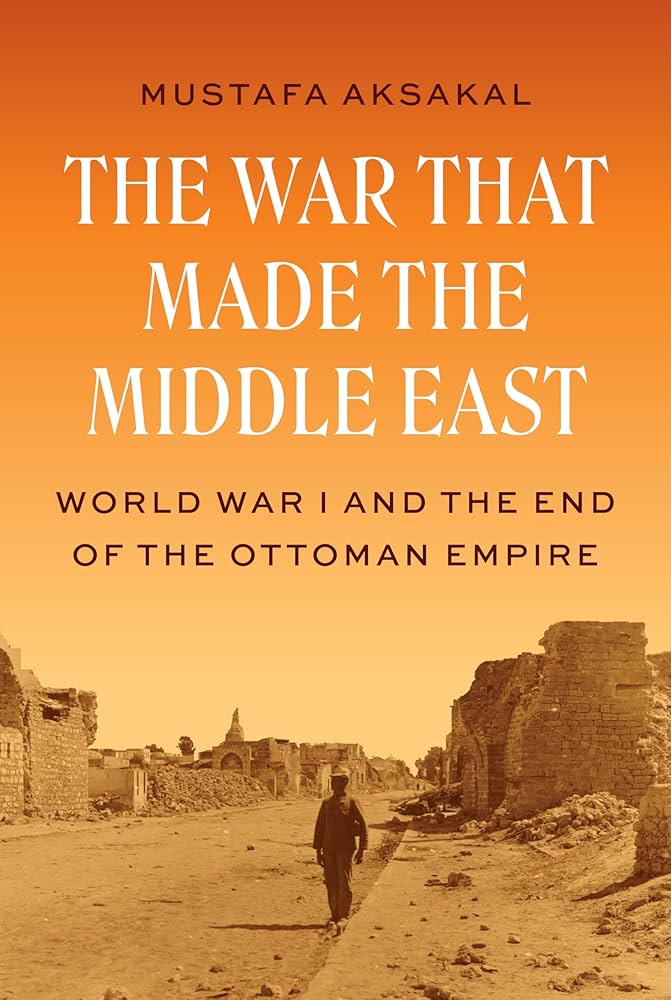 Mustafa Aksakal’s book is a timely intervention into one of the most misunderstood episodes in modern geopolitical history. At its core, the book challenges a deeply entrenched assumption: that the Ottoman Empire was destined to collapse. Instead, Aksakal reframes the First World War not as the inevitable end of a “sick man,” but as the decisive conflict that actively destroyed a still-viable multi-ethnic system
This is not merely a historical revision—it is a geopolitical reorientation.
Aksakal’s most compelling argument is that, on the eve of World War I, the Ottoman Empire was not the decaying relic it is often portrayed to be. Rather, it remained a functioning, multiethnic and multireligious polity, with relatively stable coexistence among Muslims, Christians, and Jews.
This is a crucial departure from traditional narratives. The implication is profound: the fragmentation of the Middle East was not the natural outcome of internal decay, but the product of deliberate choices—both internal and external.
Aksakal points to two decisive forces:
- European imperial ambition, particularly from Britain and France, who sought to dismantle Ottoman control over strategic territories
- Ottoman wartime decision-making, especially by the Committee of Union and Progress, which radicalised policy and turned the war inward
The empire, in this telling, was not simply defeated—it was dismembered.
Where the book truly distinguishes itself is in shifting the focus away from familiar military campaigns—Gallipoli, Mesopotamia, the Caucasus—and instead examining the internal consequences of total war.
Aksakal highlights three interconnected dynamics:
- Economic Devastation – Mass conscription stripped the countryside of labour, requisitioning destroyed agricultural capacity, and blockades led to famine across the empire.
- Social Breakdown – War intensified suspicion toward minorities, culminating in catastrophic policies, including the Armenian genocide and widespread displacement.
- Political Radicalisation – The Ottoman state increasingly turned coercive, prioritising survival over coexistence—ultimately alienating its own population.
The result was a paradox: the empire effectively destroyed itself from within while fighting external enemies.
Aksakal draws a direct line from the Ottoman collapse to today’s geopolitical landscape. The carving up of Ottoman territories by European powers—and the rise of new nationalist elites—laid the foundation for a region defined by fragmentation and contestation.
What emerges is a powerful thesis: The modern Middle East is not the product of ancient divisions, but of a 20th-century geopolitical rupture.
This aligns with a broader revisionist trend but is executed here with clarity and depth. The book underscores that identities hardened during war, not before it, and that the post-war order imposed artificial political boundaries on a previously integrated imperial system.
Unlike many works on the period, Aksakal avoids retelling battlefield narratives. Instead, he constructs a structural history of collapse, examining State capacity under wartime stress, the interaction between ideology and survival and the relationship between empire and modern nationalism.
This makes the book especially valuable for geopolitics readers. It is less about “what happened” and more about why the region looks the way it does today.
However, by concentrating heavily on internal Ottoman dynamics, Aksakal somewhat underplays the complexity of great power rivalry and military developments. Readers expecting detailed accounts of campaigns or diplomatic maneuvering may find the treatment uneven.
Aksakal’s work is not just a history of the Ottoman Empire—it is a history of how modern geopolitical disorder was created.
For readers of geopolitics, the book offers some key takeaways:
- The Middle East’s instability is rooted in modern geopolitical decisions, not ancient inevitabilities
- Empires do not simply collapse—they are often destroyed by the interaction of internal choices and external pressures
- World War I in the Middle East was not peripheral—it was foundational
In an era where the region remains fractured—from Gaza to Iraq to Syria—the book’s central argument resonates strongly: the upheavals of the early 20th century are not settled history, but an unfinished geopolitical process.