

|
Getting your Trinity Audio player ready...
|
Welcome to The Geopolity’s What We’re Watching (3W), our daily look at the interconnected worlds of Geopolitics, Economics and Energy. Curated from the world’s leading sources of information, our analysis and commentary is designed to help you make sense of the events driving the major developments in the world.
Earlier this week, at 3W we noted that the US – Israel Alliance is quite clearly preparing for another attack Iran.
Today, we note that the Alliance is not making these preparations in secret. Journalists of The Wall Street Journal were invited to visit the USS George Washington aircraft carrier, stationed in the Middle East, just as it was being resupplied with offensive weaponry. At the same time, the US publicly announced that it is withdrawing non-essential diplomatic staff from the region, and that Americans should avoid travel to the Middle East, writes The National.
At 3W we note that usually, one tries to hide his military plans, so as to give them the biggest chances of maximum impact. So why does the US – Israel Alliance appear to be operating in the opposite manner?
One possible explanation hubris or arrogance. In this case, the Alliance breaking with military tradition because people like Trump believe they don’t need secrecy or surprise – they are just too powerful. If this is the case, there will still be surprises, but in this case the US – Israel Alliance will be the surprised agent, following Iran’s defense and counterstrike movement.
Another is military tactics. As we noted last week, Iran knows an attack is coming, so its guard is up. By fainting attacks, the Alliance pushes Iran up and down the preparation ladder. This exhausts its people, and can even lead to preparations levels reducing as people begin to doubt that the Alliance will indeed attack. The actual Alliance plan is to attack exactly at that moment. If this is the case, it would mean the actual Alliance is most likely still a few weeks off. This would align with reports that the Trump plan is to strike again after the Israel elections and US mid-terms, such as by Bloomberg.
A third possible explanation, however, is leverage. The Alliance wants to strike fear in the hearts of the Iranian leaders, such that become willing to make the compromises the US and Israel want at the negotiating table.
This third possibility is supported by reports that the US is successfully tightening its economic blockade on Iran, closing land routes into the country as well. In our previous update we noted that Iraq was in the process of closing its border with Iran. The Wall Street Journal writes that Pakistan is also closing its borders, severing economic ties with Tehran. Further raising the likelihood of this possibility are US president Trump’s remarks on Friday, when, writes The National, he said, “We may do another little Epic Fury”. He then added, “If they’re smart, they’ll just say, ‘Let’s get down to business,” which, 3W notes that there certainly is hope in US circles that Iran will capitulate out of fear.
It is highly, highly unlikely that Iran will capitulate, we at 3W note. As we have said throughout the months that we have monitored this conflict closely, Iran understands this is an existential war. The US and Israel have publicly stated their ultimate aim is to destroy Iran’s political system, to turn it into a client state akin Venezuela (and the GCC countries…), and have on occasion threatened genocide against the Iranian nation if it refuses submit. Iran, having a civilization and history, naturally has rejected all this, and communicated a willingness to fight to the last man” in opposition to this colonial project. No amount of “saber rattling” will change its mind, we at 3W believe.
In the Iranian mind, there is also no reason to consider capitulation. Iran has cards to play, this much has become clear since February 2026. That is why in public remarks, senior Iranian officials have threatened to respond to US – Israel Alliance attacks with an in-kind targeting of civilian infrastructure, energy sites and underwater fiber optic cables that carry internet and other communications traffic, across the Arabian Gulf, writes The New York Times. (In an otherwise silly article that tries to argue Iran is preparing “terror attacks” in the US via “sleeper cells” – stupid propaganda that western audiences have been made susceptible to through movies and television shows, we at 3W note. The Financial Times also covers the planted propaganda story, as does Reuters, after it was originally presented as a “scoop” by Axios.)
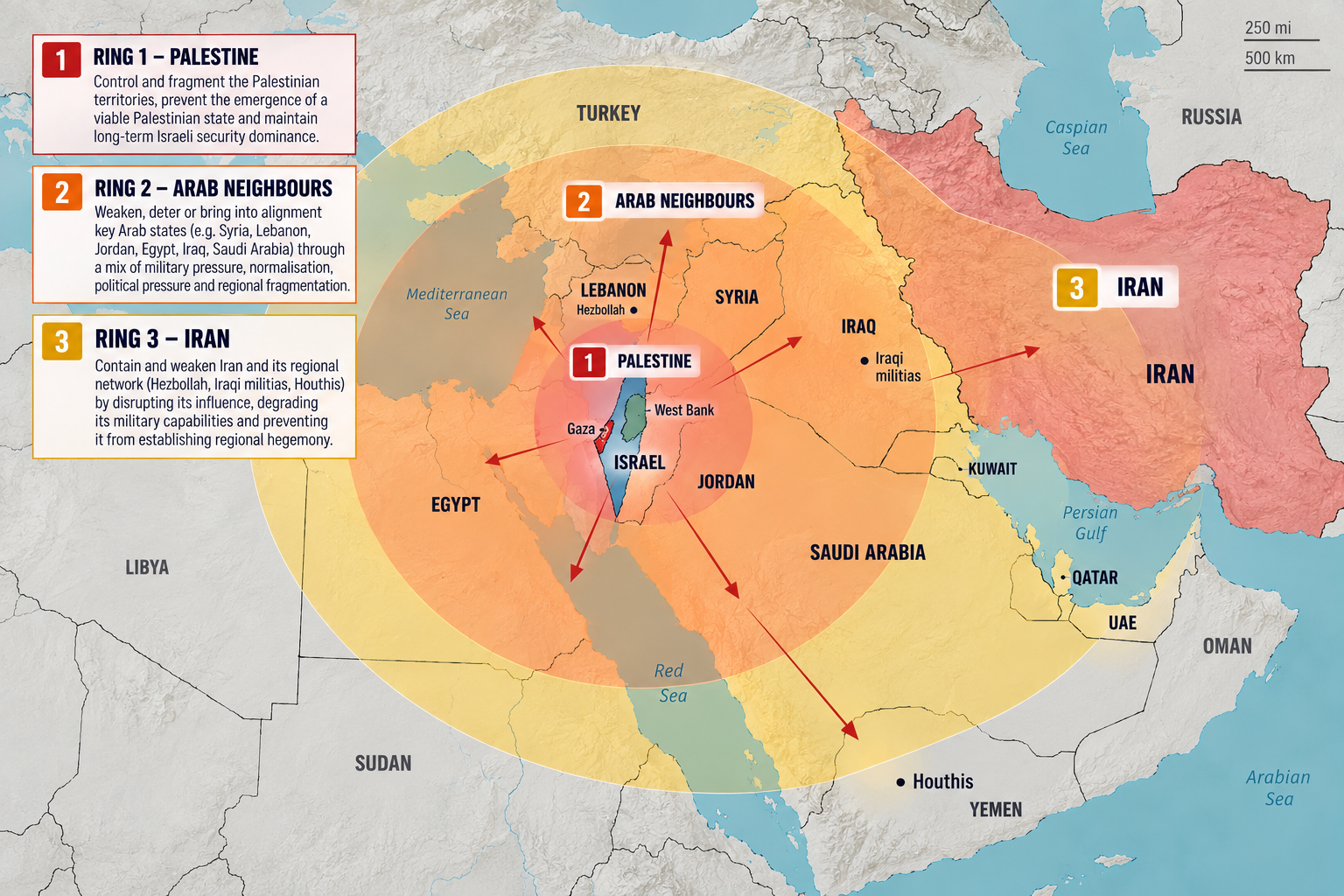
In our 3W view, war is essentially inevitable. For the simple reason that, as we wrote last week, Israel desires war with Iran. Its strategic objective is not to deal with Iran, let alone to find a solution for political differences with Iran’s leadership. It simply wants to see the second and third ring of countries bordering it destroyed through war.
Therefore, Iran’s threats to annihilate the Arabian Gulf’s infrastructure in response to a new attack by the US – Israel Alliance, does not cause “second thoughts” in Tel Aviv. To the contrary, it is music to the ears of people like Netanyahu, Katz and also Eisenkot. An incentive, really, to push the US to renewed fighting – because destruction on both sides of the Gulf would be a perfect outcome from the Israeli perspective, notes Trita Parsi also in an interview with Glenn Diesen.
Not only when it comes to Iran, part of the “third ring” in Israeli security thinking, are things developing in accordance with Israel’s strategy. In the first ring, the lands Israel wants to annex, things are similarly progressing “well”.
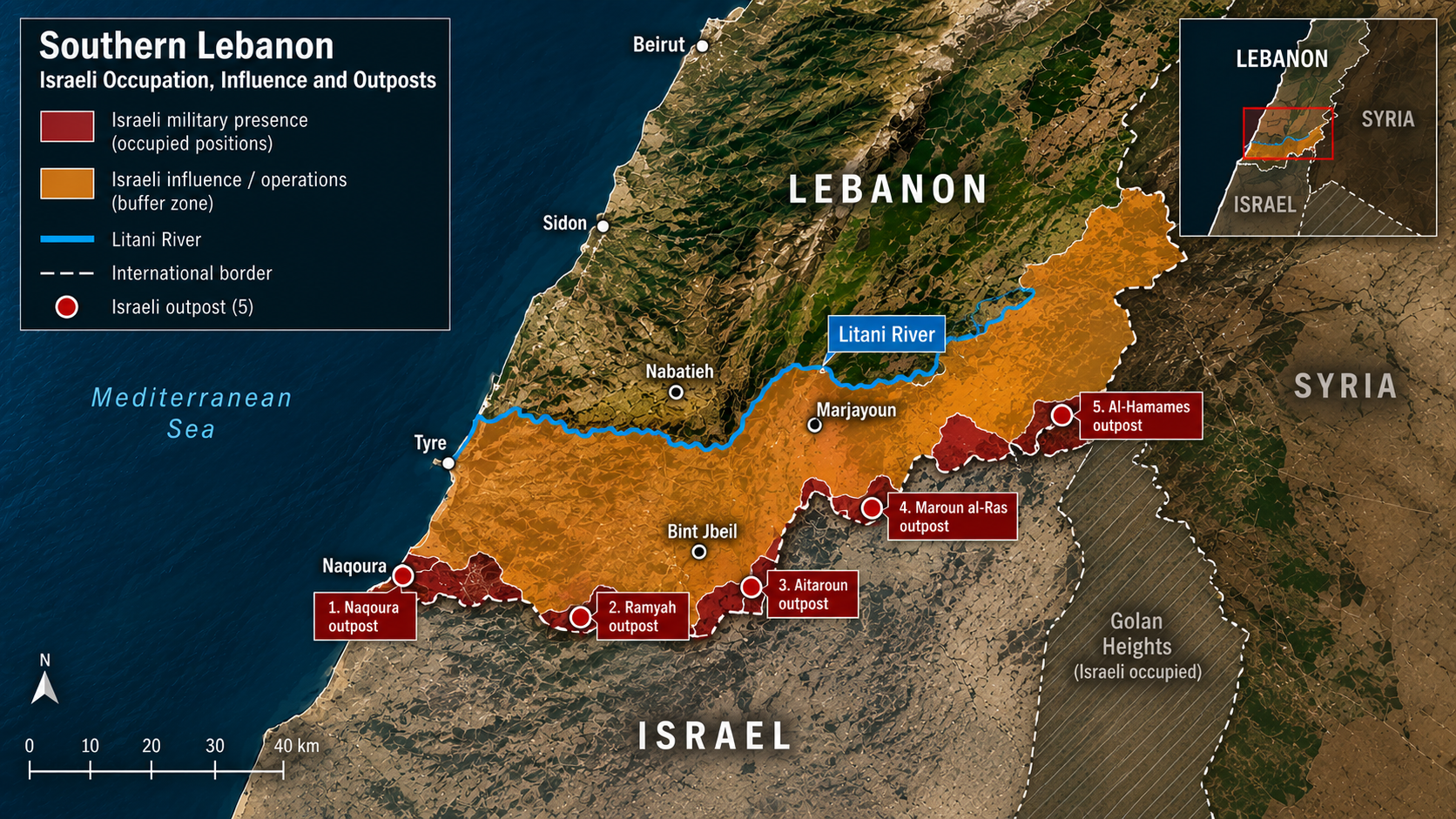
In Lebanon there is no progress in the talks that, supposedly, are designed to enable an Israeli withdrawal. The National writes this appears by Israeli design. Firstly, Israel accepted negotiations with Lebanon for two primary reasons: to placate the administration of US President Donald Trump, which pushed for such a process; and to have on paper an agreement with Lebanon that would justify Israel’s continued presence in Lebanon. The agreement that resulted from the negotiations, in June of 2026, imposed all conditions on the Lebanese side, above all to ensure Hezbollah’s disarmament, without requiring Israel to fulfil any of its conditions. Indeed, the term “withdrawal” is not even in the document, and there is no timetable for what the text describes as a “progressive [Israeli] redeployment out of Lebanese territory”. This was by design as Israel doesn’t expect Lebanon’s government to disarm Hezbollah by force, so it now has a formal excuse to remain in the south of Lebanon indefinitely. Since the agreement, Israel has therefore focused on making the South uninhabitable, as it has done in Gaza, Israel has razed dozens of mainly Shiite villages, burned large swathes of agricultural fields and olive groves and bombed land using white phosphorous, thereby making it impossible to grow fruits and vegetables.
In Palestine, meanwhile, the West Bank is currently undergoing the “Gaza treatment” as well. After months of violent siege, an attack on a military checkpoint near Hebron has given Israel a justification to expel large numbers of Palestinians from their homes and to destroy entire neighbourhoods, writes The Guardian. After the attack Israeli prime minister Netanyahu said Israel would “act to destroy this place”. Israel’s finance minister Bezalel Smotrich called for “a comprehensive military campaign … exactly like in Gaza and Lebanon”. Since then, 35 hectares (86 acres) of land have been completely destroyed or marked for destruction, and about 1,500 people have been evicted from their homes. The Israeli Defense Forces (IDF) said in a written statement that approximately 2,000 residents of the target area belonged to a clan which the IDF said was “associated with Hamas and from which the terrorists who carried out yesterday’s attack originated”. “As part of the operation, civilians who wished to evacuate were permitted to temporarily leave the area through designated screening points staffed by the ISA and IDF soldiers,” the statement said.
Adding further insight into what Israel aims to do now in Hebron, defence minister Israel Katz said “The Jenin refugee camp model arrives in Hebron,” he wrote, referring to the now-destroyed camp in the north of the West Bank, writes The National.
Next, in addition to Iran, at 3W we expect a development that enables further Israeli control over south-west Syria…