

Iran’s Revolutionary Guards said on Tuesday that their naval mines halted three tankers attempting to travel the Strait of Hormuz via routes considered illegal by Tehran, writes Arab News. “Two violating oil tankers were set ablaze and halted due to the explosion of mines”. A third oil tanker “exploded and caught fire after striking a naval mine south of the Strait of Hormuz.”
Meanwhile, three people were killed in two attacks by AnsarAllah on Saudi Arabia’s Shaybah oil field, and one attack on the Dammam airport in Saudi Arabia’s Eastern Province, writes Bloomberg.
Meanwhile, Israeli prime minister Benjamin Netanyahu is pushing to resume large-scale strikes against Iran, and earlier this month instructed his military to plan for a major new offensive, writes The Financial Times. The Israeli military had prepared for a multi-day bombing campaign to take place on the weekend of October 10 that would have targeted civilian infrastructure such as electricity plants, as well as nuclear facilities and regime targets. The mission ultimately did not go ahead, with the people familiar citing President Donald Trump’s opposition to restarting the conflict before the US midterm elections on November 3.
This does not mean that Trump disagrees with Netanyahu’s vision. Netanyahu said he spoke with Trump last Sunday about the importance of eliminating Iran’s regime, and Trump agreed, writes Al Arabiya.
The day after, on Monday, the US secretary of defense Pete Hegseth then flew to Israel for an unplanned visit, writes The New York Times. Hegseth met with Netanyahu and Israel Katz, Israel’s defense minister, at the Ovda Israeli air force base in the south of the country.
The same day, dozens of Israeli Air Force fighter jets flew to the Iranian border to train attacks on the country, writes Axios. The exercise involved dozens of fighter jets and refueling aircraft. It followed a flight path consistent with a potential strike against Iran, passing through Syrian and Iraqi airspace. As the aircraft approached the Iranian border, they turned around and returned to Israel. How this should be understood, in the 3W view, is that through these fake attacks the Alliance is testing Iranian defenses and trying wear down the Iranians manning these systems.
Around the same time, the US ordered non-essential employees and their families out of Saudi Arabia, writes The National. The US mission in the UAE, meanwhile, warned on Sunday that hostilities “have the potential to escalate rapidly beyond that immediate area”. A diplomatic source told AFP that families in the UAE, Jordan, Qatar and Bahrain had also been told to leave.
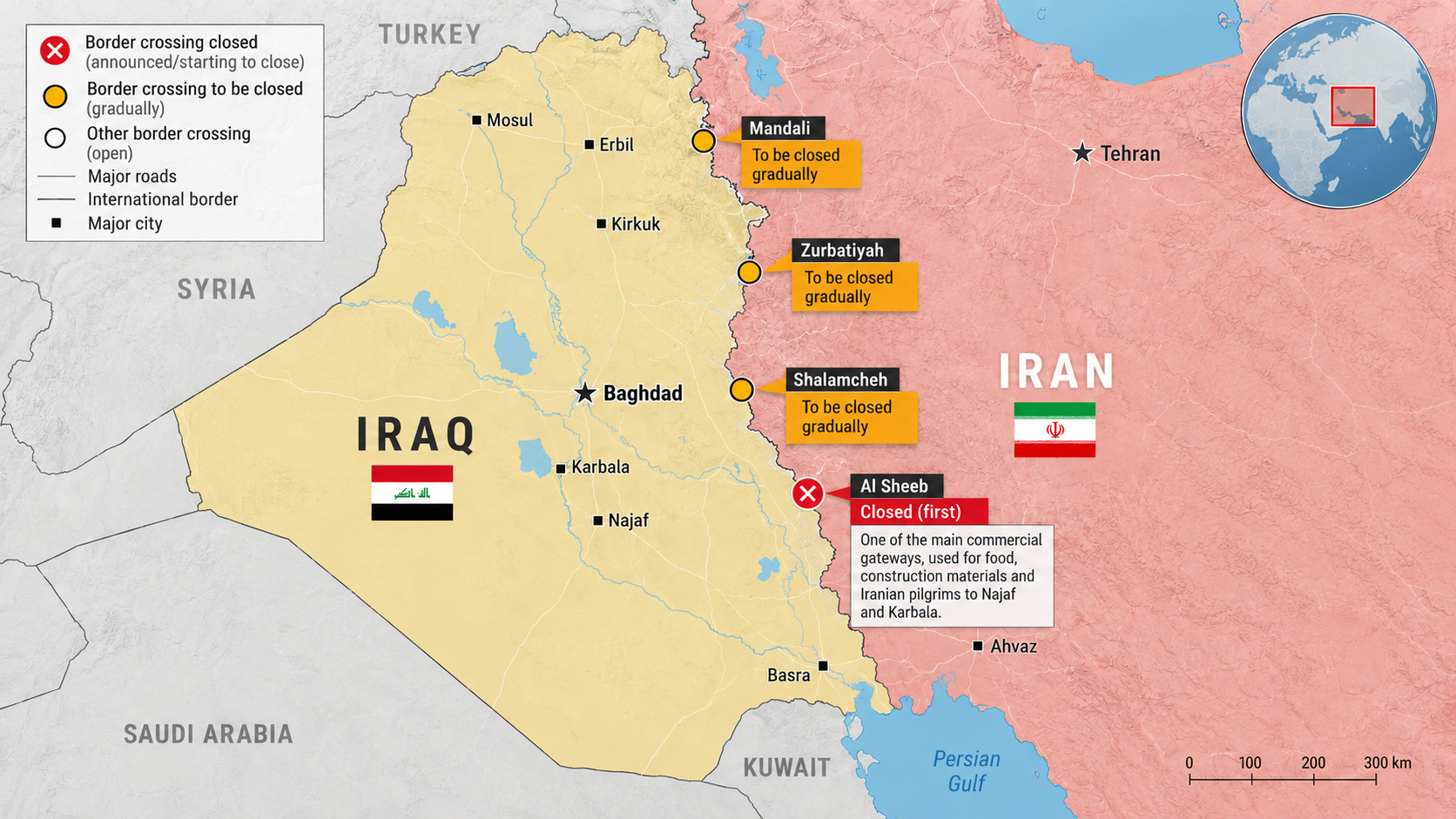
Iraq on Wednesday then announced it is closing its border with Iran, The National writes. The decision was supposedly taken to “reconsider the security arrangements inside the crossing”. The Al Sheeb crossing in the south-eastern province of Maysan, one of the main commercial gateways between the two countries, used for transporting food and construction materials, as well as by Iranian pilgrims heading to holy sites in Najaf and Karbala, has been closed first. Other border crossings with Iran, such as Shalamcheh, Zurbatiyah and Mandali, will be closed gradually. Iranian state media reported that Tehran was not given advance notice. Pro-Iranian groups within Iraq have argue that closing commercial crossings is not about safety, but about enforces US sanctions.
According to The New York Times, the above all adds up to preparations for a new US – Israel Alliance attack on Iran. The Alliance hope is that this time, the attacks will devastate Iran’s civilian infrastructure to the point that its economy will collapse, after which Iran’s political leadership will feel compelled to accept Alliance demands in negotiations. NYT says there are reasons to be skeptical, and at 3W we fully agree.
Firstly, for Iran and its people this is an existential war. It is “win or die”. Such a war cannot be won by airpower alone. If anything, a bombing campaign will further increase the resolve of Iranians to defend their country against aggression.
In an open letter for the Financial Times, Iran’s foreign minister Abbas Araghchi says Iran is firmly committed to seeking a dignified peaceful resolution to the conflict, but also fully prepared to defend itself. In the current situation, Aragchi says, “we have no trust whatsoever in the sincerity of the US administration’s professed desire for peace with Iran.” Therefore, for diplomacy to succeed, “the White House must demonstrate seriousness and a genuine will to permanently end its aggression”, Aragchi says. Aragchi also says he is “duty-bound to warn that any further escalation around the Strait of Hormuz or elsewhere in the region will put civilian lives and the wellbeing of all regional states and the global economy at great risk.” And that brings us to our second reason as to why we believe one should be skeptical of the US – Israel Alliance plans and ideas – fantasies, rather! – of how another attack on Iran can deliver a decisive victory.
This second reason is that Iran should not be expected to just sit back and accept another pounding. Over recent weeks 3W has discussed at lengths the evidences of Iran’s new found confidence, following its successes in the 40-day “Ramadan War”. And it has announced what it will do if it is attacked again – strike all the US military and economic interests across the Arabian Gulf region.
What that would do would be nothing short of apocalyptic. Even in the current situation, the outlook for the world economy is dire. The Iran war and the Ukraine-Russia conflict are creating a “multidirectional squeeze on world agriculture” that could spiral into a crisis, writes Axios. The wars are colliding with an extreme El Nino effect to threaten global food supplies and drive up prices, especially in vulnerable economies. Food producers need steady supplies of natural gas and sulfur for fertilizer, diesel for farm machinery and food transport, and open sea lanes for trade. “Conflict is now testing all of them at once, just as El Niño tests the harvest,” states a report from the research and consulting firm S&P Global. Middle Eastern prices for exported sulfur, a fertilizer ingredient, reached a record $1,000 per metric ton in July, after starting the year at a historically high $500 per metric ton. “The risk is increasing, especially for low-income countries, where food costs amount to about half of household spending,” it states.
Even in the current situation, the outlook for the world economy is dire
The outlook for the Middle East region, and the world, is bleak due to the US – Israel Alliance arrogance and aggression, in other words. The Alliance is “hellbent” on destroying Iran, and so it will try again. The preparations for this attack are quite clearly underway, in our view. As to when this attack will take place, at 3W we do not believe Israeli elections or US midterms feature in the decision-making. The ultimate objective will be to surprise Iran.
Lastly, 3W wishes to bring to its readers’ attention the “performance” by Tom Barrack, the US ambassador to Turkey and special envoy for Syria and Iraq, at the Global Security Forum in Doha, Qatar, on Tuesday. Barrack said the “grand bargains with the US” that have underpinned global security for decades are undergoing major transformation, and countries in the Middle East and elsewhere should focus on securing themselves via regional partnerships, writes The Wall Street Journal. “America as the guarantor to the world, for the last 80 years, it is no longer there,” Barrack said. Arrangements forged in the wake of World War II—essentially a quid pro quo whereby the US provided security in exchange for oil—no longer fit Washington’s imperatives, Barrack said. Americans don’t want to sacrifice their lives for the Middle East, and Gulf states know the US can’t assure their security, he said. He said the region is right to pivot toward smaller and more diversified alliances like the new defense pact between Saudi Arabia, Pakistan and Turkey. Barrack’s message came as the Gulf states worry the US will abandon them after having poked Iran, but unable to decisively defeat it. Barrack said the war launched by the US and Israel in late February was a mistake, likening it to the invasions of Afghanistan and Iraq. “Every time we try and intervene and change the person or the regime, it seems to have been a mistake,” he said, pointing to Iraq, Libya and Afghanistan.
As if he wanted to calm the worries of the Gulf states, Barrack also said Iran’s government is “not an evil regime”, writes The National. “It’s a theocracy,” he said of Tehran’s government. “It’s not an evil regime, that has nothing to do with it. That’s a religious content and practice that we all respect.” Barrack also said the US should pursue a negotiated settlement rather than seek to impose regime change, saying Washington’s previous attempts to change governments in the region had repeatedly failed. We’ve had 23 regime changes and none of them have worked,” he said. “Every time we try and intervene and change the person or the regime, it seems to have been a mistake.” These remarks drove Mark Levin, one the most prominent Israeli mouthpieces in the US, nearly insane. In a post on X he wrote, “Tom Barrack has gone rogue again, pushing his own insane agenda and giving aid and comfort to genocidal maniacs, This has to be one of the most outrageous statements yet, about the mass killing, nuclear-obsessed Islamist terrorist Iranian regime.”
In the 3W view, Barrack’s statements, which contradict “the US – Israel Alliance narrative” on a number of critical points, indicates on the one hand the absolute dysfunction that characterizes the Trump administration which is staffed by amateur diplomats, Barrack among them; and on the other hand the resistance in certain sections of the US political and economic elite to the Middle East policy direction Israel is pushing the US in.
In other words, more chaos to come…