

|
Getting your Trinity Audio player ready...
|
Welcome to The Geopolity’s What We’re Watching (3W), our daily look at the interconnected worlds of Geopolitics, Economics and Energy. Curated from the world’s leading sources of information, our analysis and commentary is designed to help you make sense of the events driving the major developments in the world.
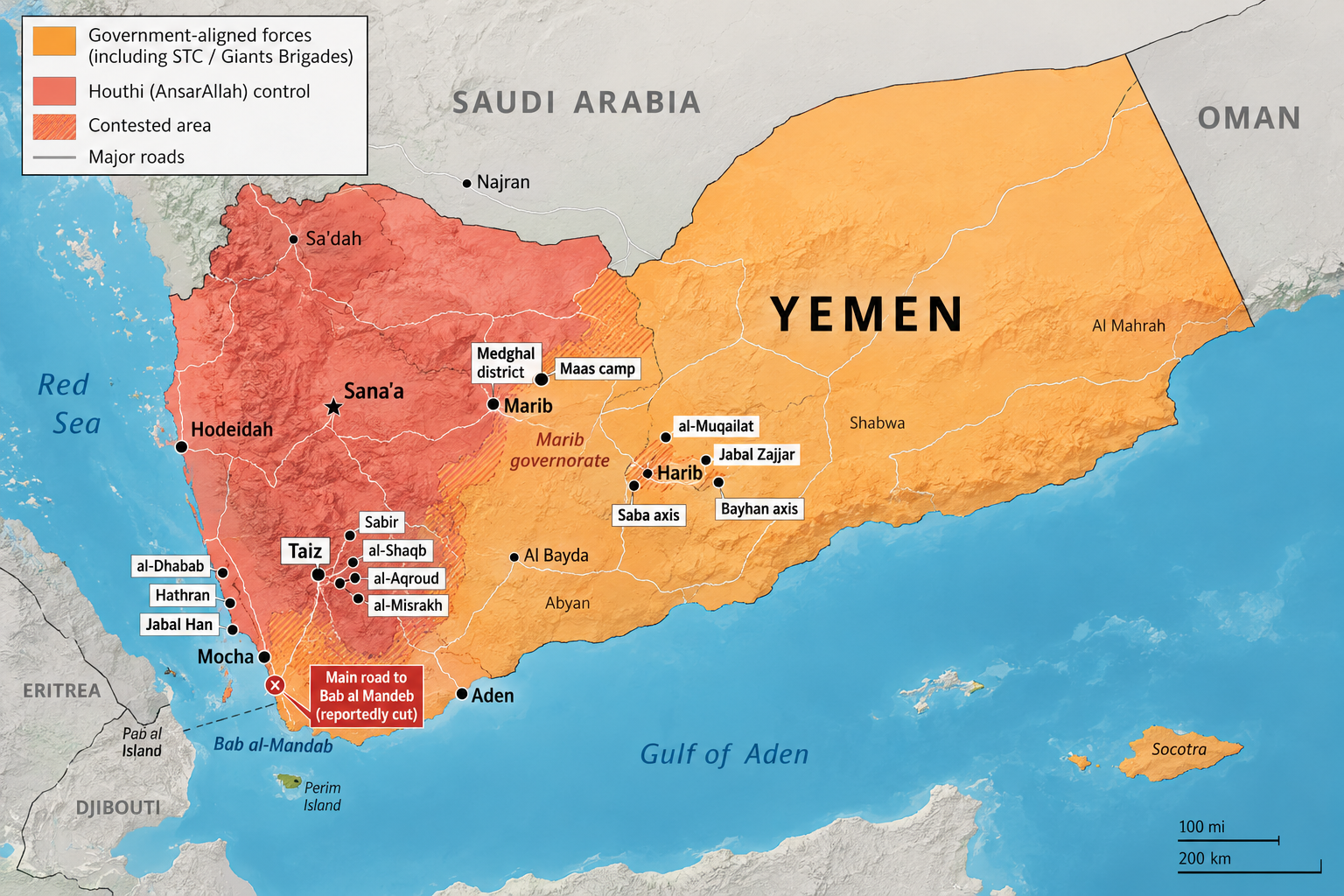
Fighting continues to rage in Yemen. On Monday, the Southern Transitional Council (STC) in Yemen, associated with Saudi Arabia said they had managed to cut off the main road linking the Red Sea port city of Mocha with the Bab al Mandeb, writes Al Jazeera. Key in the fight is the presence of the Giants Brigades, AJ adds. The Brigades have their roots in the southern separatist movement, is formed largely by Salafi fighters, and has been funded and armed by the UAE.
Meanwhile, in the northwest of Marib governorate, a military source told Al Jazeera that STC associated troops have taken control of strategic, commanding heights surrounding the Maas camp facility in the Medghal district. The source noted this followed intensive attacks that had breached the Houthi group’s fortifications. On the southern front, forces from the Saba and Bayhan axes announced the capture of the al-Muqailat and Jabal Zajjar positions north of the Harib district. Government forces claimed the fierce clashes resulted in the Houthis retreating and suffering human and material losses. Around the strategically important city of Taiz on the road connecting the Yemeni capital of Sana’a with the port city of Aden, fighting continues. On the western fronts, heavy fighting has flared in al-Dhabab, Hathran and Jabal Han as government troops have sought to thwart infiltration attempts and repel AnsarAllah attacks. In the southern and southwestern countryside, battles have intensified in the al-Shaqb, al-Aqroud and al-Misrakh areas. A field military source told Al Jazeera that government forces are involved in fierce clashes from all directions in the al-Shaqb area of Taiz, with confrontations extending to areas AnsarAllah seized on Monday in Sabir.
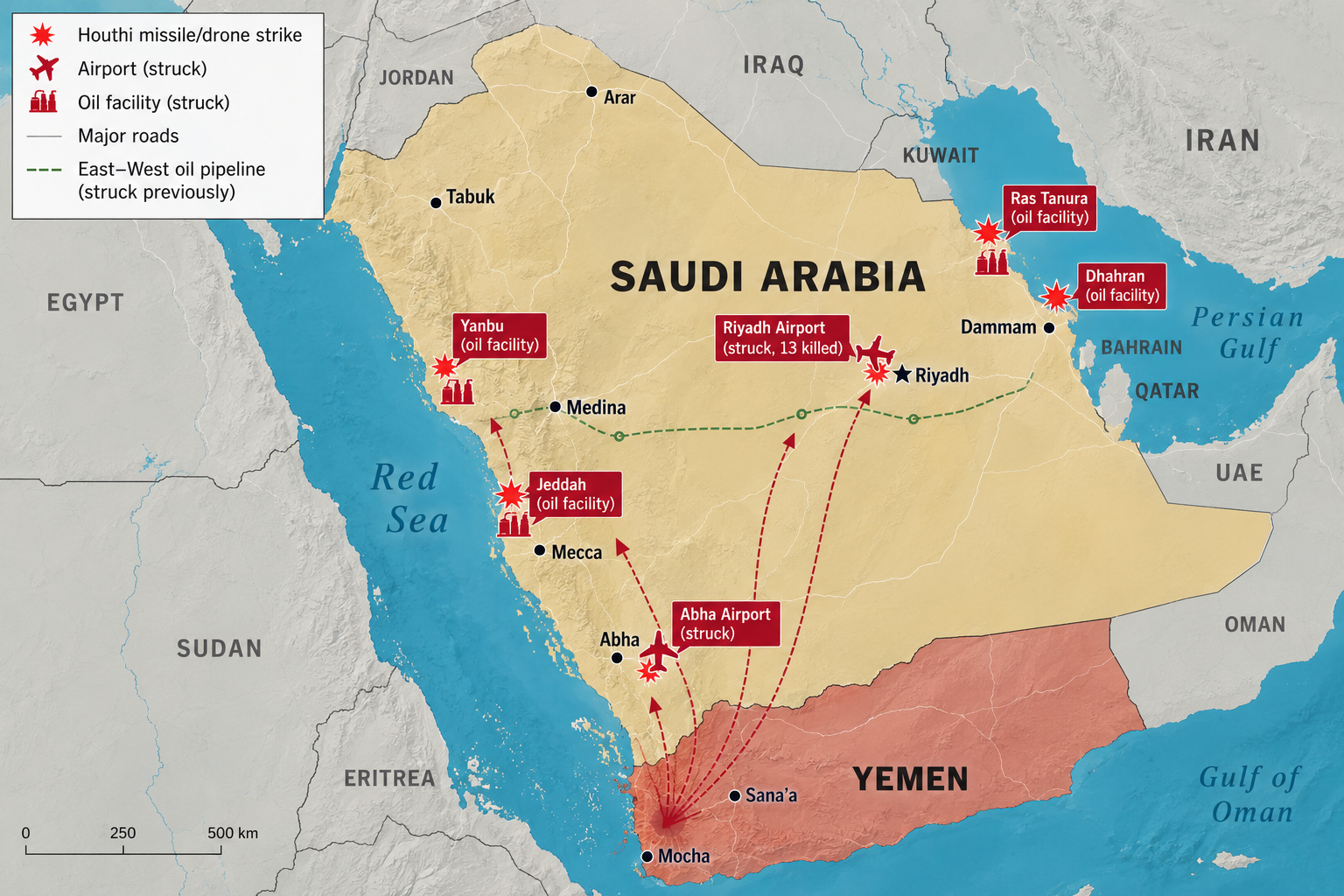
Amidst this fighting, Saudi Arabia remains under attack from AnsarAllah missiles and drones. At least 13 people were killed when AnsarAllah struck an airport in the Saudi capital, Riyadh, on Saturday, writes The New York Times. On Sunday, another person was killed in an attack on the airport, and since then, Saudi Arabia has been fending off a steady stream drones and cruise missiles targeting it from Yemen. “The events of recent weeks are serious,” Prince Abdul Aziz bin Salman, the Saudi energy minister, told delegates at an oil conference on Monday. “Our response must be equally serious.”
Iranian Foreign Minister Abbas Araghchi told his Saudi counterpart Prince Faisal bin Farhan that Tehran was ready to “provide assistance” to start talks between Saudi Arabia and the Houthis to reach a “political solution”, writes The National. Araghchi also advised the Saudi’s not to seek their solutions in military confrontation. “The Foreign Minister of our country, expressing concern over the escalation of tensions, emphasised that insisting on a military approach and ignoring political solutions would complicate the existing situation,” Iranian state media said.
At 3W we see the development in the following manner. Iran wants to achieve a new inclusive security arrangement in the Gulf. It wants the Gulf countries to come together with Iran and Yemen to collectively devise this new inclusive security architecture, to enable a new era of shared stability and economic prosperity. For this reason, the timing of AnsarAllah’s push forward in Yemen is perfect. Saudi Arabia’s response was predictable, also because this response is what the US and Israel were predictably advising it. But, this response is strategically flawed as Saudi Arabia does not have the capability to defeat AnsarAllah. And so, its militaristic response does create more problems for it, sucking it deeper into a conflict that it cannot win. In this situation Iran hopes to convince Saudi Arabia of its vision for the Gulf. We add, however, that the architects of the current security architecture which excludes Iran and Yemen, i.e. the US and Israel, will not accept such a development. And as we mentioned before, that, we suspect, is really why Saudi Arabia is not being supported by the US, while Israel offers its support, in the midst of unexplained attacks on Saudi Arabia’s critical oil pipeline.
Beyond Yemen, to Iran. In our previous update we noted that Iran stepped up its attacks on oil tankers passing through the Strait of Hormuz after the US declined its ceasefire offer. Bloomberg writes a growing number of empty supertankers are now turning away from the Persian Gulf empty. At least 10 very large crude carriers and several Suezmax vessels approaching the port of Fujairah in the United Arab Emirates have stopped or reversed course in recent days, according to tanker-tracking data compiled by Bloomberg. This, in 3W’s view, leaves little doubt that Iran has re-established full control over the Strait, despite the massive US naval operation designed to break it open.
Then, last Saturday at 3W we noted that the US appears to be readying a new attack on Iran. On Sunday, Iran’s national security adviser, Mohsen Rezaei, threatened that if fighting were to resume, Iranian forces would target digital infrastructure in the Gulf, including data centers, cables, and artificial intelligence facilities, writes The New York Times.
The Wall Street Journal writes Iran is fortifying its defenses, rallying loyalists and threatening a wider, harsher response against the US and its Gulf allies as it prepares for potential American attacks. Some Iranian officials have hinted that their forces could conduct land incursions into neighboring countries, writes WSJ. But at 3W we do need to note here that WSJ is very much an Israel-aligned media publication, so take the latter assertion with a healthy dose of skepticism – without ruling it out.
As to where all this fighting is leaving the world, the IMF and the World Bank released the World Economic Outlook as their top economic policymakers gathered in Bangkok this week for the annual meetings of the “Washington Consensus” duo. The New York Times writes the WEO forecasts lackluster but stable growth of 3.1 percent this year and 3.4 percent in 2027. In the US, the fund is forecasting growth of 2.3 percent this year and next. Among countries that use the euro, growth is expected to reach only half that level. In China, growth is expected to slow this year to 4.5 percent. India is among the fastest-growing major economies, with growth projected to reach 7 percent this year. Other Southeast Asian countries are getting a boost from growth in data centers and other technology-related investment. In the Middle East, Bahrain, Iraq, Kuwait and Qatar have all been gut-punched by the interruption of their oil and gas trade, and are expected to suffer double-digit drops in their total output this year. But, growth will be amid high inflation, 4.7 percent this year and 4.1 percent next year. And… “A prolonged conflict in the Middle East could put additional pressures on inflation and slow down growth,” said Silvana Tenreyro, the fund’s chief economist. “The economy has been resilient, but that resilience is reaching its limits,” she added.
To us at 3W, it seems inevitable that the conflict in the Middle East will not end any day soon, and is more like to expand and intensify.