

Welcome to The Geopolity’s What We’re Watching (3W), our daily look at the interconnected worlds of Geopolitics, Economics and Energy. Curated from the world’s leading sources of information, our analysis and commentary is designed to help you make sense of the events driving the major developments in the world.
In yesterday’s update, we discussed the reports that the Southern Transitional Council (STC) forces in Yemen allied with Saudi Arabia are making progress against AnsarAllah on the battlefield. Challenging the assertions by the STC, AnsarAllah continues to make progress in its efforts to take the strategically import city of Taiz in central Yemen, writes The Associated Press.
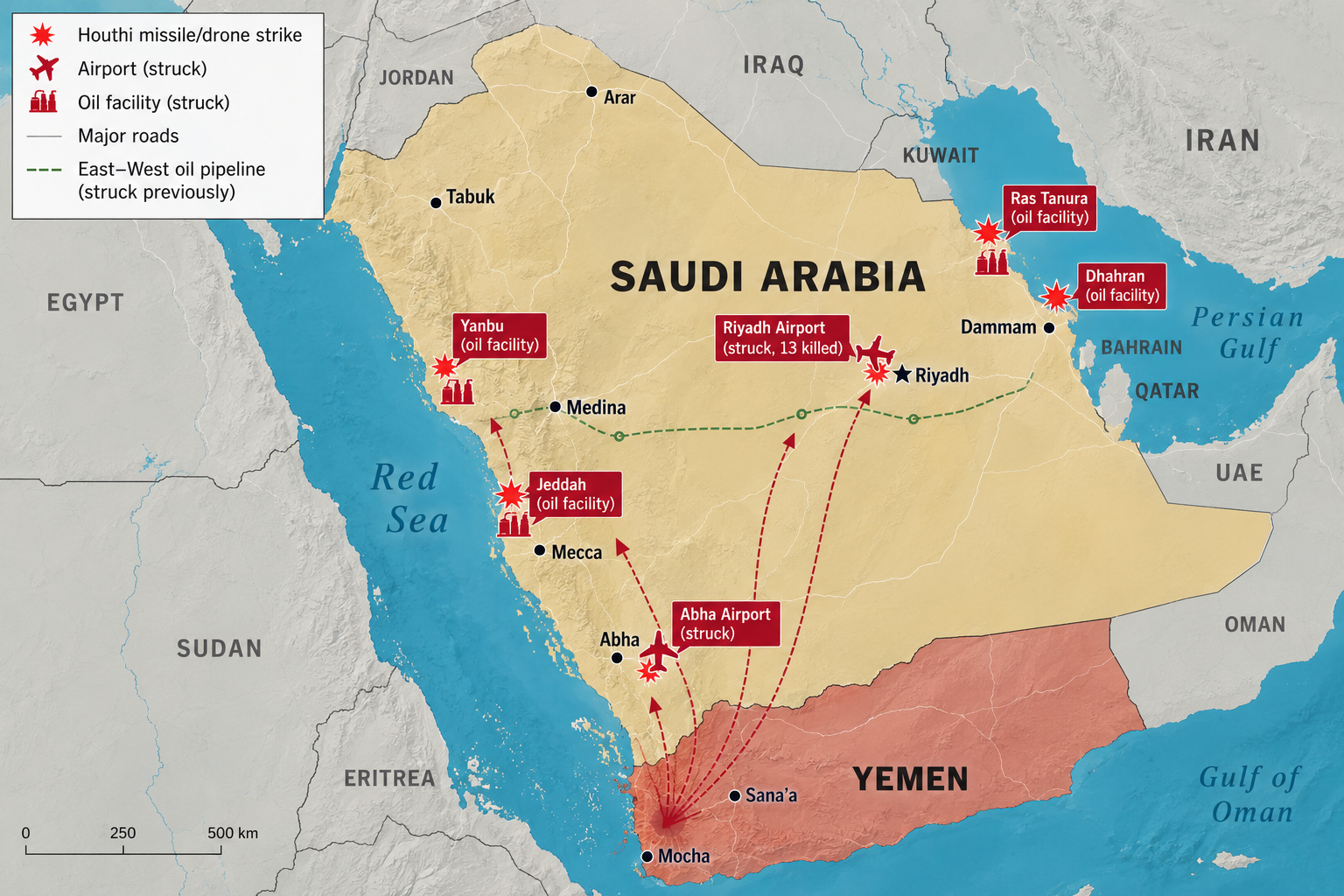
Also, on Tuesday it became clear that despite the assertions of the STC, AnsarAllah maintains a significant ability to launch missiles and drones against enemy targets. It struck targets across Saudi Arabia on Tuesday evening, hitting several cities, including Riyadh and oil giant Saudi Aramco’s headquarters in Dhahran in the east of the Kingdom, writes Bloomberg.
AnsarAllah had warned in a post on social media that if Saudi forces were to attack Yemeni oil facilities, the militia would retaliate against Aramco’s headquarters, the company’s refinery in Riyadh and King Khalid International Airport, also in Riyadh, writes The New York Times. When Saudi Arabia ignored the threat and on Tuesday afternoon and struck the Sana’a, AnsarAllah executed what it said it would. AnsarAllah on Wednesday vowed to press on with attacks on airports and oil facilities in Saudi Arabia, writes Reuters.
According to The Associated Press, Saudi Arabia is at a distinct disadvantage in the battle with AnsarAllah. Vulnerable energy, civilian and military assets are scattered across the country’s sparsely populated territory roughly three times the size of Texas, making aerial defense an almost impossible task. In addition, Saudi Arabia is running low on interceptors. Pakistan and Turkey, meanwhile, appear to be largely staying on the sidelines or limiting their support, despite their pledges under the Mecca Accord.
That does not explain why critical Saudi infrastructure continues to be hit, notes The Financial Times. This reflects the continued progression in AnsarAllah’s tactics and capabilities, as well a failure of missile defence system co-ordination on the part of the Saudis, it writes. Saudi air defences are extensive and include Patriot and Thaad systems, surface-to-air missiles, interceptor drones, radar networks, electronic warfare equipment and even Sky Shield, a Chinese-made, counter-drone, fibre-optic laser weapon. But AnsarAllah has used drones to map out the ranges of interceptors, and then used cruise missiles that fly lower, slower and can change trajectory, making them hard to detect.
As to the latter point, DropSite News, referencing Kenneth M. Polland’s book “Armies of Sand: The Past, Present, and Future of Arab Military Effectiveness”, notes that despite a multi-billion dollar budget annually, Saudi Arabia’s military is not designed to effectively protect the country. The ruling House of Saud was brought to power by the British and has ruled at the expense of the other leading tribes in the region. This caused structural resentment among traditional tribal elites. In order to protect itself against coups, the House of Saud therefore organized the army in such a way that it cannot effectively deploy force. In other words, it purposely created a well-equipped paper tiger. 3W notes this is important to consider when reflecting on how the War over Yemen is likely to develop.
The only structural military solution for Saudi Arabia, The Financial Times writes, is to find the drone and missile launchers and destroy them. But like Iran, AnsarAllah are thought to have cave and tunnel networks — natural and man-made — throughout the mountainous north of Yemen. Consequently, the threat can only be destroyed by Saudi Arabia invading and occupying the territories held by AnsarAllah, or by organizing masses of support for the forces allied with it to enable them to defeat AnsarAllah. 3W notes that the prior is impossible, something Saudi Arabia cannot and will not do, while the latter has been tried for over 10 years now. In our view, a really structural solution, therefore, can only come from diplomacy: negotiations and compromise.
the war in the Persian Gulf is morphing from an attempt by the US – Israel Alliance to destroy the Iranian state, into a battle over empire, with Iran pushing to end the Alliance’s influence in the Arabian Gulf
In this regard, over at the Mario Naufal podcast, AnsarAllah set out its conditions. Saudi Arabia is to end its blockade of Yemen and its interference in internal Yemeni affairs, and pay reparations for the damage it has caused in Yemen through its thousands of airstrikes. In addition, AnsarAllah says, if Saudi Arabia is willing to end its partnership with the Evil Empire that is the US – Israel Alliance, AnsarAllah offers to become part of Saudi Arabia’s military and defend it against external threats.
At 3W we note this brings into focus what we wrote about yesterday, which is that the war in the Persian Gulf is morphing from an attempt by the US – Israel Alliance to destroy the Iranian state, into a battle over empire, with Iran pushing to end the Alliance’s influence in the Arabian Gulf. In this, AnsarAllah is clearly on Iran’s side.
And this brings into focus the fact that the War on Iran remains at the center of the current conflict. In this regard, Reuters writes about Iran’s current tactics. It has re-established control over the Strait of Hormuz over the past two weeks, in part by using low-tech means: spotters. Iran is sending men in small vessels into the Strait at night, with the task to identify ships that under the cover of darkness, and with transponders turned off, try to sail through the Strait. “The aim is to frustrate efforts by the United States and its allies to bring down global oil prices,” one of the two Iranian officials said. Next, Tehran will expand the geographical scope of its operations beyond the Strait of Hormuz to the Gulf of Oman and waters further afield, the officials also said. Analysis by maritime security sources based on attacks reported to UKMTO and maritime security companies in the region suggest this may already be happening, writes Reuters. They show Iran targeting ships in areas beyond the Strait of Hormuz, including waters off the coast of Qatar and the United Arab Emirates, in recent days.
Meanwhile, the US and Israel are discussing whether the attack Iran again before or after the upcoming elections in both countries, writes Axios. Israel is pushing for a new attack, sooner rather than later, with Netanyahu telling Trump his usually story of “according to our intelligence Iran is actively working on development of a nuclear bomb and very close to achieving it!”. Trump has been going back and forth on the issue, writes Axios, as Defense Secretary Pete Hegseth and the leadership of US Central Command are pushing him to follow Israel’s advice, while the others in his surrounding are urging him to maintain the current focus on the naval blockade and sanctions.
3W notes that the fact Netanyahu’s story is still be taken serious, after having been repeated again and again over a period of 30 years, highlights two things. First, that Netanyahu is an essential liar. Second, that Israel has near total control over US elite politics and media. Otherwise, namely, the repeated lies by a bold-faced liar would not receive the serious coverage by US politics and media as they continue to do.
A related insight is that because Israel dominates US politics and media, while it desires continued war across the Middle East, a new attack on Iran is essentially guaranteed, in our view. With Iran being clear about how it will respond, and a history of effectively living up to its threats, just as AnsarAllah this promises little good for the region and its people.
Professor Robert Pape notes on his substack that in the past four days, roughly 20 more American aerial refueling tankers have flown toward the Middle East, according to open-source flight trackers. The last surge like this came in February, days before the United States and Israel struck Iran on February 28.