

|
Getting your Trinity Audio player ready...
|
With today being October 7, we start our update with a roundup of the latest developments in geopolitics what we at 3W have learned from the War on Gaza.
We can honestly say, this period fundamentally changed our worldview. As it made us realize that what we had rejected for a good two decades, was in fact correct. Let us explain.
During the 1980s, Israel as an ally of the US was punished regularly by then president Ronald Reagan for operating across the Middle East without US agreement. After Israel bombed an Iraqi nuclear reactor in the summer of 1981, Reagan held up delivery of fourteen F-16’s and two F-15’s, informing Congress that Israel might have violated US law by using the American weapons for offensive military operations, wrote The New York Times. In 1983, Reagan had grown so upset with Israel’s behaviour in Lebanon, that he threatened to withhold another delivery of F-16s, if Tel Aviv did not withdraw its forces from the country.
In those days, things were “normal”, in other words. The US was a global superpower, much stronger than Israel. And as such, it used Israel for its interests. Israeli prime minister Benjamin Netanyahu referred to this era when, in 2017, he likened Israel to a “mighty aircraft carrier” of the US. “We are here on a mighty aircraft carrier of the United States [the USS George H.W. Bush] and a few miles from here, there is another mighty aircraft carrier of our common civilization – it’s called the State of Israel,” Netanyahu said, according to Defense News.
In between these two events, in 2006 two American professors by the names of John Mearsheimer and Stephen Walt had written an article for the Harvard Kennedy School of Business arguing that Israel, through a dedicated lobby in the US, had taken control of US foreign policy. This article, which in 2007 was turned into a book entitled “The Israel Lobby and U.S. Foreign Policy”, essentially argued that the “Israel Lobby” (which we reviewed here) formed US foreign policy for the Middle East by presenting Israeli interests as aligned with US interests. In that way, “The Lobby”, as Mearsheimer would become used to saying, would effectively set US policy for the Middle East; Tel Aviv would make its policy, and then create a narrative under which the Israeli policy would be framed as “a policy that would be good for the US considering its interests”.
Considering the events of the 1980s, and other similar events thereafter such as when US president Obama restrained Israel over the period 2011 and 2012 when Tel Aviv wanted to attack Iran, when Mearsheimer and Walt published their work, we did not believe it. How could it be that a small, powerless state like Israel dominates the thinking of a major powerful state like the US, we asked? Something like that never happened in the history of humanity, to our knowledge at least and with ample past evidence that the US was controlling Israel, we decided not to accept the thesis of Mearsheimer and Walt.
But then came October 7, 2023.
In the first weeks after the event, then US president Biden urged Israel to restrain itself in its response, and to ensure its response would prevent civilian casualties, despite others in elite US political circles arguing that Israel should be given a free hand, wrote NBC News.
Over the weeks and months that followed, Israel showed no signs of listening to Biden, as a result of which the then US president upped his tone. Following his 2024 State of the Union address, Biden admitted that he had put significant pressure on Netanyahu to make Israel change its course on Gaza. Biden said he would give Netanyahu a “come to Jesus moment” to make him change Israel’s tactics, wrote The Associated Press. Biden also opened conversations with Israel where the possibility was raised that the US would slow down weapons deliveries if Israel did not listen to the US, wrote NBC News.
As this did not do anything to change Israel’s behaviour, Biden grew further frustrated over February and March 2024. In the end, this led to Chuck Schumer, the first Jewish majority leader in the Senate, the highest-ranking Jewish official in the US, and a Democrat like Biden, to strongly criticize Netanyahu in a speech, wrote The Associated Press. Netanyahu had “been too willing to tolerate the civilian toll in Gaza, which is pushing support for Israel worldwide to historic lows”, Schumer said, warning that “Israel cannot survive if it becomes a pariah”.
In May of that year, Biden then publicly threatened to withhold weapons deliveries to Israel if it did not listen to him. “Civilians have been killed in Gaza as a consequence of those bombs and other ways in which they go after population centers,” Biden told CNN. “I made it clear that if they go into Rafah – they haven’t gone in Rafah yet – if they go into Rafah, I’m not supplying the weapons that have been used historically to deal with Rafah, to deal with the cities – that deal with that problem,” Biden said.
the US elites are no so profoundly pro-Israel, voluntarily or due to external pressures, that the US is placing Israel first in almost everything it does
Behind the scenes, however, Biden secretary of state Blinken continued to organize weapons deliveries, using a wide variety of “tricks” to avoid the kind of Congressional oversight that could trigger public scrutiny, wrote The Associated Press and The Wall Street Journal.
During May 0f 2024 Biden’s tune began to change. First he defended Israel against the criticism that it was committing a genocide in Gaza, as Reuters wrote then. Thereafter, he began promoting Israel’s ideas for how things should be managed, praising Israel’s ceasefire proposal and calling out Hamas as the only obstacle to peace, as NPR documented at the time.
As the War on Gaza progressed, Israel also became more aggressive towards Lebanon. A similar dynamic took place on this front, with the US first resisting the Israeli plan, then quietly acquiescing, to end up fully supporting it.
In June of 2024 US secretary of state Austin warned Israel against opening a “second front”, wrote France 24 at that time. But when Israel invaded Lebanon, the US supported it both diplomatically and militarily, as Al Jazeera noted at the time, with Austin saying “I made it clear that the United States supports Israel’s right to defend itself”. Then, while Israel attacked militarily, the US joined in diplomatically in an attempt to make Hezbollah lose its political influence in Lebanon, wrote PBS.
These histories give clear indications that Israel had an ability to influence policymaking.
This was again highlighted in the War on Iran of 2026. Joe Kent, director of the US National Counterterrorism Center, confirmed in his public resignation letter that the US had chosen to go to war against Iran because Israel proposed it, despite the fact that the US intelligence agencies all arguing against. In another admission of Israel leading the US, US secretary of state Marco Rubio said the US had attacked Iran because otherwise Israel would have done it independently, wrote Reuters – which was the exact same argument Israel had used in 2011 with then US president Obama, who had nevertheless refused to join in.
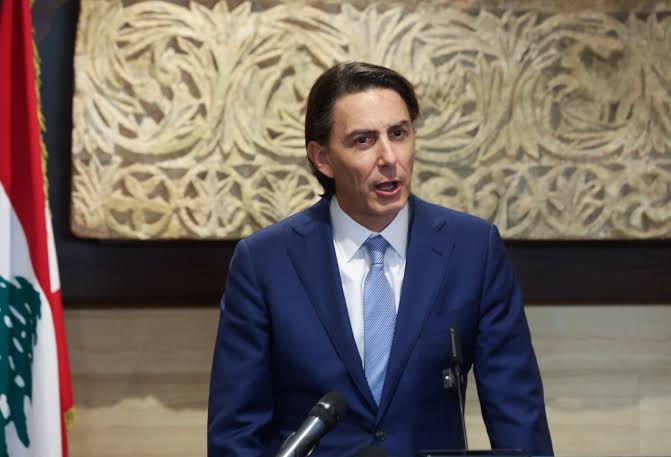 These indications of Israel leading US thinking, just as Mearsheimer and Walt had said, led us at 3W to look at the “Israel Lobby” thesis in more detail. Then we began to notice that people in critical US positions, below the radar screen almost, were of highly suspicious profiles. For example, the US appointed Amos Hochstein as special representative for Israel and Lebanon, despite the fact that Hochstein was born in Israel, is a dual Israeli-American citizen, and had served in the Israeli army. Similarly, the US appointed Merav Ceren, another dual Israeli-American citizen with previous experience in the Israeli defense ministry, as director for the Israel and Iran file at the National Security Council (NSC).
Also notable is the fact that the US president’s chief of staff very often is someone with a “special connection” to Israel. Obama relied on Rahm Emmanuel, of Jewish heritage and staunchly pro-Israel. Biden relied on Ron Klain and Jeff Zients, both Jewish and famously pro-Israel. Klain staunchly supported Israel’s response to October 7, leading the effort to harness support for the US support for this response while many across the US political spectrum were opposed to it. Zients similarly worked to prevent opposition to Israel’s genocide inside the American bureaucracy from affecting US policy. Trump relies on Susie Wiles, who previously worked for Netanyahu.
Then recently two Jewish American academics, Eli Clifton and Ian Lustick, published what can be seen as an update to Mearsheimer’s and Walt’s “Israel Lobby” analysis. In the book “Israel’s Lobby: America in the Grip of a Foreign Power” (which we reviewed here) they explain how exactly Israel has worked to get people for whom Israel is the priority, in the most important positions in US politics, not only at federal level but also at state level. The book argues that a small network of American and Israeli oligarchs have effectively captured the policymaking processes across successive US presidential administrations. It attributes over $1.2 billion in political contributions since 2012 to a core group of billionaires motivated primarily by Israel’s interests in US politics. Most recently, this network ensured that Republican senator James Massie lost his seat in the US Congress, since he is not an unquestioning supporter of Israel, wrote The Intercept.
The result of this is that the US elites are no so profoundly pro-Israel, voluntarily or due to external pressures, that the US is placing Israel first in almost everything it does.
For example, in Latin America the US is not only actively interfering in political affairs to ensure the region only has leaders that blindly follow the US, it now demands from these leaders that they make support for Israel a priority, writes The Jerusalem Post.
Meanwhile, domestically too Israel has become front-and-center for US politicians. The American Civil Liberties Union (ACLO) and Amnesty International recently released a report documenting how at both federal and state level the US has worked to suppress free speech and the freedom to protest, by Americans in America, over Israel’s genocide in Gaza. In other words, the US government is even turning authoritarian domestically in order to support Israel.
What all this means is the following.
The events following October 7 have changed the 3W perspective on Middle East politics. It is clear to us now that Israel leads the thinking, and that it has developed an ability to either convince or coerce the elite political circles in the US to go along with the plans it comes up with. These plans are always dressed in language of “why this is good for the US”, but they are developed using Israel’s interests as the starting point. In other words, we have come to the conclusion that Mearsheimer and Walt were correct. Mea Culpa.
Consequently, the way we analyse Middle Eastern politics is now different, since Israel interests lead, not American interests.
As to what the Israeli interests are, it is clear to us that Israel is operating on the basis of a “three rings” strategy.
The first ring are the territories that directly border Israel, such as Gaza, the West Bank, the Golan heights and southern Lebanon. These regions Israel is aiming to militarily occupy, depopulate, then colonize with Zionist settlers, before finally annexing.
The second ring are the Arab countries beyond the first ring, such as Jordan, Syria, Lebanon, Saudi Arabia, Iraq, Egypt. These regions Israel wants to bring into an Israel-dominated hemisphere via the Abraham Accords. To achieve this, these countries are to be weakened militarily, and politically destabilized, such that their ruling elites will accept an Abraham Accord on the basis of Israel’s terms, without there being any negotiation or compromise on the part of Israel. The outcome of this will be that Israel takes effective control of these countries, as in the case of the United Arab Emirates.
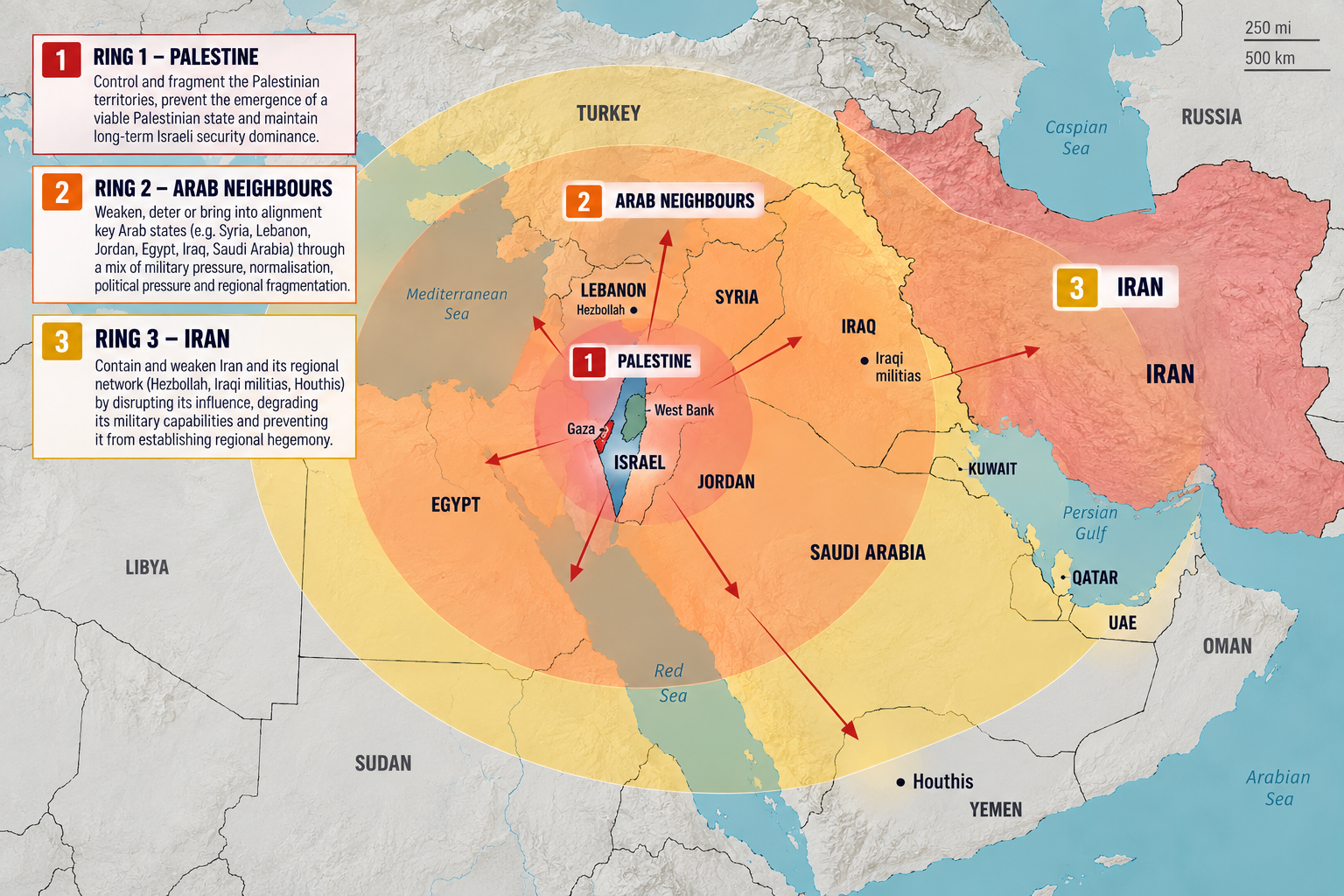
The third ring are the non-Arab Muslim countries Iran, Turkiye, and Pakistan. These countries Israel sees as its most dangerous enemies, since these countries have large populations, capable militaries, and majority citizens that are sympathetic to Palestine. These countries Israel therefore wants to see weakened by war and civil strife. This is why Trump speaks about annihilation of Iran all the time. And this is what it meant when on 17 February 2026, former Israeli prime minister Naftali Bennett, speaking at the Conference of Presidents of Major American Jewish Organizations, declared bluntly: “A new Turkish threat is emerging… Turkey is the new Iran.” And it is why Israel is promoting the idea that Tel Aviv and New Delhi should align, because they have a “common enemy”.
This thinking, we at 3W foresee, will drive US policy when it comes to the Middle East, and increasingly the world.