

|
Getting your Trinity Audio player ready...
|
Welcome to The Geopolity’s What We’re Watching (3W), our daily look at the interconnected worlds of Geopolitics, Economics and Energy. Curated from the world’s leading sources of information, our analysis and commentary is designed to help you make sense of the events driving the major developments in the world.
Yesterday, 3W explained that when it comes to Iran, the current course of action by the US – Israel Alliance is a self-defeating dead-end. All indications are Iran is winning. And, it has still bigger cards to play, such as closure of the Bab el Mandab. All the Alliance can do is retreat in defeat, we said, or escalate in dramatic fashion. But the window for the latter option is rapidly closing, and will require active support from the Arabian Gulf countries.
Since then, the Houthi’s appear to have acted upon their threat to close the Bab el Mandab for Saudi Arabia. Several tankers loaded with Saudi oil turned around in the Red Sea on Tuesday, writes The National. Shipping data showed the Xin Long Yang, a freighter which finished loading two million barrels of Saudi crude destined for China, turning towards Suez. The smaller tanker Rodos, which had loaded about 700,000 barrels for India, performed the same manoeuvre. A total of five tankers linked to Saudi Arabia had reversed course.
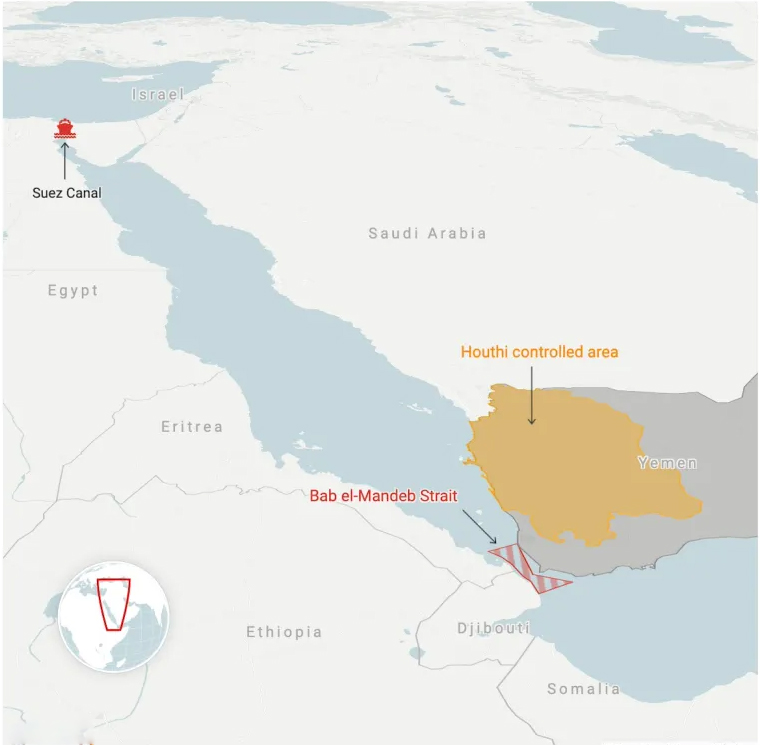 The consequences of the apparent closure of the Bab el Mandab will be significant. Shipping west toward Egypt from Saudi Arabia’s Red Sea port of Yanbu, and passing through the Suez Canal and rounding the Cape of Good Hope in Africa to get to Asia, will require as much as four additional weeks and raise freight and fuel costs, writes Reuters. Moreover, a fully loaded VLCC (2 million barrels) cannot traverse the Suez Canal due to its draft limit and shippers often lighten the vessel’s load on the Red Sea side before entering the canal by moving a portion of the oil on Egypt’s SUMED pipeline. The ship picks up the oil on the Mediterranean side after it passes the Suez Canal with a lighter load. 3W notes that the SUMED pipeline has a maximum operational capacity of 2.5 million barrels per day, which places a limit on the total amount of oil than can be shipped.
As to the 3W assessment that Iran appears to be successful in its effort to push the US out of the Gulf region, and that consequently the US military operation needs to pivot to bases further away from Iran, the new UK prime minister Andy Burnham has approved the use of British military bases by the US for what the UK calls “defensive strikes” against Iran, writes Bloomberg. The decision concerns the UK bases at Diego Garcia in the Indian Ocean and RAF Fairford in Gloucestershire, England.
Meanwhile, The Telegraph writes that there are strong rumours the Pentagon is hiding an acute missile shortage facing the US military. There are particular concerns about US stocks of Terminal High Altitude Area Defence (Thaad) interceptors and Patriot Advanced Capability-3 (Pac-3) missiles. The US military’s stockpile of offensive Tomahawk missiles has also plummeted.
In light of all this, combined with 3W’s assessment yesterday, the news that the Trump administration has reached a broad nuclear agreement with Saudi Arabia on the development of a nuclear industry in the Kingdom, takes on a whole new meaning. The type of deal that the Trump administration has reached with Saudi Arabia is called a 123 Agreement (pronounced 1-2-3), which establishes a legally binding framework between nations on nuclear cooperation. The obligations of such an agreement are aimed at ensuring non-proliferation of nuclear weapons. The US has 26 such agreements with 51 governments and the International Atomic Energy Agency. It appears that the US was very eager to get the deal with Saudi done. Trump made concessions to the Saudis on the terms of the nuclear deal that are significant, namely. Trump agrees to terms that limit international inspectors from going to any sites in the country that they think could be a pathway to diverting fuel to weapons projects, writes The New York Times. And he agreed that the Saudis may be allowed to enrich uranium or reprocess plutonium on their soil. When the United States entered into a similar agreement with the United Arab Emirates, which went into force in 2009, there were far more restrictive conditions. The UAE was forced to agree to stringent inspections by the International Atomic Energy Agency and to forgo the right to produce its own fuel, cutting off the possibility that it would have the infrastructure to produce a weapon. In the 3W assessment, this could potentially be the quid pro quo for Saudi agreeing to provide soldiers for the ground operation that the US has been preparing for over the past ten days.
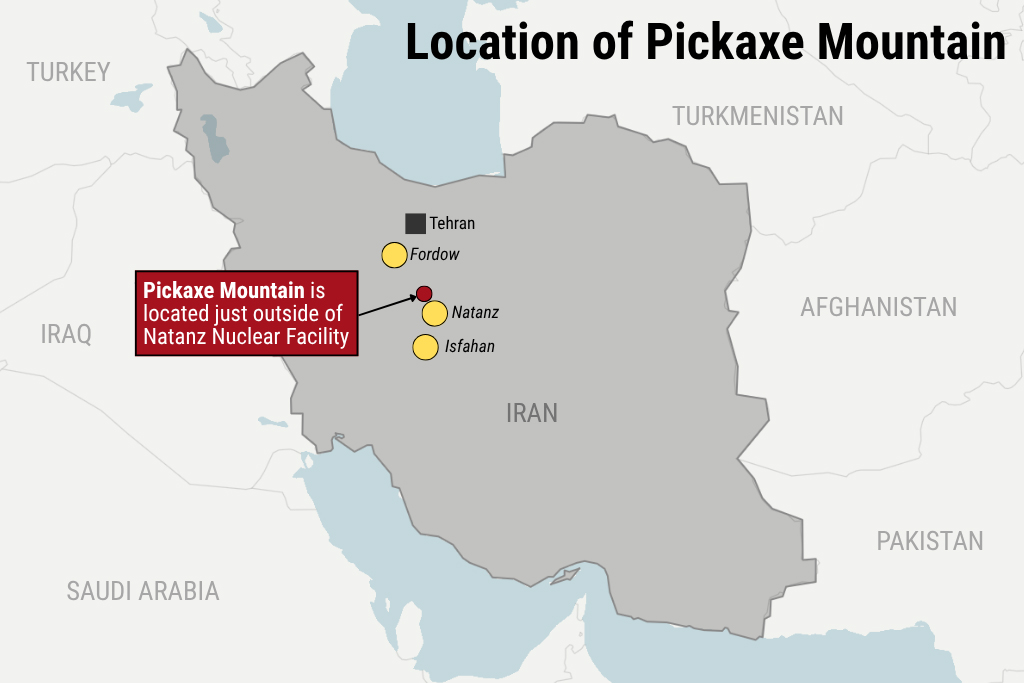 Trump has also started preparing the public for another way to escalate. The target he has in mind has been named Pickaxe Mountain, and Trump says he will soon bomb it, writes Axios. The narrative being pushed by Trump is that Pickaxe is central to Iran’s nuclear program, a view that has been promoted by Israeli intelligence, writes The Wall Street Journal. Trump on Tuesday therefore threatened to end the war with Iran in the same manner the US ended the 12 Day War of 2025, with a bunker-busting attack on Pickaxe, writes The New York Times. However, no nuclear expert believes it houses the kind of working equipment to enrich uranium, and convert that material to bomb fuel, notes NYT. At most, experts say, Pickaxe Mountain for now is a deep underground storage site. The Financial Times adds that the “Pickaxe” facility is a few kilometres south of Natanz, and is harder to hit than the target of the operation that ended the 12 Day War, Fordow, because it is deeper and better protected. It is also not as well mapped. Pickaxe also has at least four tunnels, compared with Fordow’s two, making it more difficult to bomb the entrances to close them. Their depth could put them out of reach of the 30,000lb “bunker-buster” bombs the US used against Fordow.
In the 3W assessment, this story is an effort to create a face-saving way out for the US – blow up something big, claim a big victory, and run for the exit. We note, for example, that this narrative has given a nice English name to an Iranian mountain, something which was not previously done, and is therefore consciously done to make the planned operation easier for Trump’s audience to remember. In the 3W assessment, therefore, this narrative too supports our analysis from yesterday, that the Alliance losing from Iran, badly, and rapidly. Otherwise, nonsense such as this would not even be discussed let alone presented as “the master stroke”.
Iran’s Khatam Al-Anbiya military command said it would consider an attack on the mountain now known as Pickaxe “as an expansion of war in the region”, writes the BBC. And, it has threatened to strike on “all the interests of America, the allies and supporters”, in response to any such attack.
This means, in the 3W view, that even a symbolic operation to enable a rush for the exit comes with significant risks for the US – Israel Alliance. At thjs stage, therefore, we do not see how things could end well for it…