


The Arctic is shifting from a remote frontier to a strategic arena. Rapid ice melt is unlocking seasonal sea lanes, revealing hydrocarbons and minerals, redrawing ecological patterns and shortening intercontinental routes by thousands of nautical miles. Those changes are inviting more ships, rigs, sensors and soldiers into one of the world’s harshest environments—where weather, distance and darkness punish even the best-equipped forces. The result is a crowded chessboard with rules that exist, but enforcement that is fragile.
Why the Arctic Matters Now
The Arctic is warming at least twice as fast as the global average (Arctic amplification). Summer sea ice is shrinking in extent and thickness; some scenarios now anticipate late-summer ice-free conditions for weeks within the 2030s–2050s. Melting exposes darker land and water, lowering albedo and reinforcing warming. Communities across Alaska, Canada and Russia are relocating as coasts erode; species ranges are reshuffling and fish stocks are moving north.
Seasonal openings on the Northern Sea Route (NSR) along Russia’s Siberian coast and the Northwest Passage (NWP) across the Canadian archipelago can shave about 40% off the Europe–Asia distance versus the Suez or Panama. The first unescorted cargo transit through the NWP occurred in 2014; traffic across the High North has grown steadily, with the NSR now open several months a year.
The US Geological Survey estimates vast Arctic endowments, from 90 billion barrels of oil, up to 1,670 trillion cubic feet (Tcf) of natural gas and around 44 billion barrels of Natural-gas liquids, plus critical minerals such as nickel, zinc and rare earths. As technology advances and ice retreats, exploration and production become more feasible.
The Arctic is governed primarily by UNCLOS (exclusive economic zones to 200 nm, shelf extensions up to 350 nm) and an intergovernmental forum, the Arctic Council that consists of Canada, Denmark/Greenland, Finland, Iceland, Norway, Russia, Sweden and the US. Disputes are meant to be handled legally and scientifically rather than by force. But Russia’s 2022 invasion of Ukraine froze most Council work which Moscow has yet to recover.
The High North is ideal for polar-orbit ground stations, ISR and missile-tracking. As more satellites are launched this will thicken coverage and provide advantages to the nations that get there first.
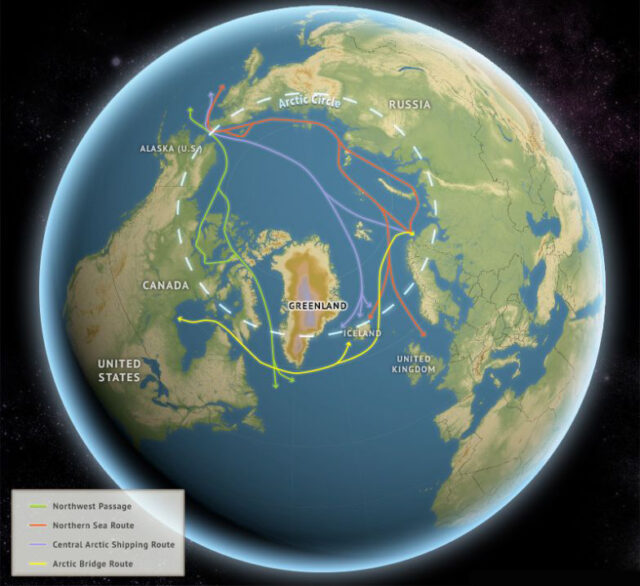
Russia: The Incumbent Arctic Superpower
Russia has the longest border with the Arctic and wants to dominate Arctic shipping and energy. It needs to do this to secure its frontier and secure its nuclear second-strike bastion on the Kola Peninsula.
Russia has for at least a decade been working to build the infrastructure in the north of Russia in order to consolidate its position in the Arctic. Russia has by far the largest icebreaker fleet (including multiple nuclear icebreakers like Arktika and Sibir) to achieve this. It has reopened or started dozens of new bases, airfields and radars and has an Arctic Command with specialised brigades and regular cold-weather exercises.
Russia has made legal arguments to the Arctic. Russia argues it has expansive shelf claims—especially the Lomonosov Ridge—bolstered by a 2023 UN scientific finding that supports much (not all) of Moscow’s submission. Russia treats portions of NSR straits as internal waters and requires foreign warships to seek permission, restricting transit to one at a time—directly challenging US views of international straits and innocent passage.
Russia currently has the mass, infrastructure and ice-class shipping to operate at scale. Its nuclear icebreakers can keep convoys moving when others pause; its bases and sensors provide domain awareness across the Barents–Kara–Laptev arc. Yet war losses in Ukraine, sanctions on technology and finance, and project delays pose constraints.
US: Re-Entering the High North
The US claims to the arctic are based around Alaska, the protection of undersea cables and domain awareness and to avoid ceding strategic advantage to Russia and China. For the US there are major security dimensions with the Arctic with renewed focus on the GIUK gap and North Atlantic reinforcement routes, missile warning and subsea surveillance.
Historically the US lacked icebreaker capacity in this area but now it’s seeking to scale with partners via an Ice Pact with Canada and Finland to co-produce dozens of modern polar vessels. The US has not ratified UNCLOS, complicating formal shelf claims, yet Washington asserted a large extended continental shelf in the Beaufort Sea in 2023—overlapping with Canada’s view.
Canada: Sovereignty First
For Canada the Arctic is important due to the Northwest Passage being its internal waters and ensuring access all year-round. Canada has developed a 25-year Arctic basing and logistics plan, and is building new remote airstrips and pre-positioned stocks. It’s also making major investments in maritime sensors for underwater threats. Ottawa disputes the US view that the NWP is an international strait; it also contests parts of the Beaufort shelf claim.
For Norway, the arctic is about confronting Russia on its frequent patrols. Whilst for Denmark/Greenland the Arctic is about Arctic access and careful management of Greenland’s autonomy and mineral interest. For Iceland, who has no standing military but critical geography, it’s wary of a security vacuum in the GIUK.
For Finland and Sweden, the Arctic is about NATO and Arctic Depth. Both nations bring ice-hardened fleets, infrastructure and cold-weather expertise. Their accession to NATO tightens the alliance arc from the Baltic to the Barents, complicating Russian planning and improving allied logistics and domain awareness.
The European Union, although not an Arctic littoral power (apart from member states) , shapes sanctions, climate policy, fisheries and tech standards, and funds northern infrastructure. European industry from Norwegian energy, Finnish shipyards, Swedish mining benefits from the Arctic and anchors allied capability.
China has become a near-arctic stakeholder in Science and Commerce. China is an observer to the Arctic Council. China has modern icebreaker capabilities and is working on nuclear platforms. Beijing courts access to logistics nodes and data while treading carefully to avoid overt militarisation that would alarm NATO.
The Arctic is not a lawless scramble, rules do exist and most actors prefer them. But the increasing ice melt will keep raising the value of routes and resources faster than governance adapts
Flashpoints and Friction Lines
As the Arctic is only now giving so many nations access a number of frictions are coming into view. A number of nations are using national laws over the law of the sea to make their claims. Russia requires prior notification and places limits on foreign warships, whilst the US and others push for freedom of navigation on the seas.
There are also disputes and claims over continental shelves and overlap claims. The Lomonosov Ridge, Beaufort Sea and the Barents are all disputed. Whilst scientific rulings provide guides, borders require state agreements, and this has been slow especially amid poor Russia-West relations.
The Arctic region and how it is used raises numerous security issues. Icebreakers, dual-use ports, radars and satellites are strategic signal platforms. Subsea cable security also becomes vital as traffic and data dependence grow.
The Arctic also has an agricultural element. Boundary disputes and quota issues already exist over mackerel, cod and capelin. Enforcement in darkness and ice is hard which makes illegal fishing and smuggling persistent risks.
As more ships traverse the northern Arctic route in harsher weather this will mean search-and-rescue and spill response, and this doesn’t exist at the scale currently needed. Salvage, nuclear and LNG liability regimes are untested at Arctic tempo. A single stricken cruise ship or LNG incident could reshape rules overnight.
Arctic Governance
The Arctic Council remains the essential forum for the growing importance of the Arctic. But the Russia–West rupture has driven work online and narrowed agendas. Meanwhile, UNCLOS keeps disputes in a legal lane, and this has been extremely slow.
As governance is expanding slowly and as traffic increases in the Arctic, states are leaning on alternative forums from coast Guard forums, SAR pacts, fisheries management bodies and insurance standards. This is leading to a fractured governance architecture in an area that’s opening to many nations and one of the last regions to be opened up.
Power Follows Presence
“When the icemen come, they will come in force” captures the Arctic’s central truth: capability under extreme conditions is expensive and slow to build, but decisive. Russia currently has the thickest stack of Arctic-specific assets and the most integrated concept of operations. NATO and its partners are re-learning the theatre and investing to close gaps. China will remain a consequential “near-Arctic” actor seeking reliable seasonal access without triggering a balancing coalition.
The Arctic is not a lawless scramble, rules do exist and most actors prefer them. But the increasing ice melt will keep raising the value of routes and resources faster than governance adapts. The states that can operate safely, year-round, and at scale—with icebreakers, logistics and sensors will write the next chapter.