

A year ago, US president Trump launched Liberation Day which aimed to restructure the global economy, which Trump believed was holding the US hostage. What Trump didn’t think through however, was China’s response. China responded by placing tariffs on Rare Earth Elements (REE), something that the whole world relies upon and who’s supply chain China’s controls. Trumps Liberation Day has failed to liberate the US economy and has proven the importance of these chemical elements.
For decades, rare-earth elements (REEs), comprising 17 chemical elements, were treated as commodities, and their significance was underestimated. But today they play a vital role in modern technologies from cell phones to windmill magnets. The complacency over REE ended abruptly in 2010, when China exploited its market dominance to cut off exports during a dispute with Japan. The episode served as a wake‑up call, revealing their importance in modern technology and the extent to which critical minerals could be weaponised in great‑power competition. Today, China’s dominance of REE mining and production is a central axis of strategic rivalry between Washington and Beijing.
At first glance, the term ‘rare earths’ is misleading. Elements such as neodymium, praseodymium, and cerium are relatively abundant in the earth’s crust. What makes them ‘rare’ is the geological reality that they seldom appear in concentrated, economically viable deposits, and that their extraction and separation is complex and environmentally taxing. It is not their scarcity that matters geopolitically, but their extraordinary properties (magnetic, luminescent, and electrical), which are impossible to replicate at scale with substitutes. These properties make rare earth materials indispensable to a wide range of civilian and military applications. In fact, they permeate everyday life. Rare earths are present in smartphones, laptops, and headphones. Also, in green tech, rare earths are indispensable.
An offshore wind turbine requires up to two metric tons of permanent magnets per megawatt of capacity, while electric vehicles contain significant critical minerals. The F‑35 fighter jet contains 400 kilograms of rare earths, distributed across its radar arrays, actuators, stealth coatings and electronic warfare systems. Each Virginia class submarine contains an estimated 417 kilograms of rare earths, crucial for sonar and weapons control. Similarly, Tomahawk missiles, air-defense radars, drones, and precision-guided munitions all depend on rare earth components to operate reliably. Innovations in the defence and military sectors are impossible to sustain without safe access to rare earth elements.
How did the US lose its lead
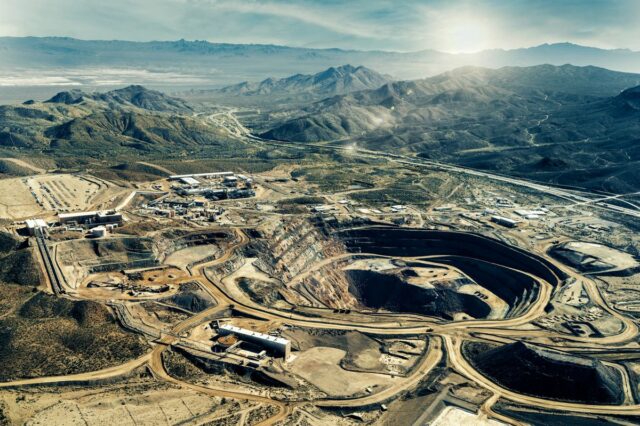
Historically, in the California desert, Mountain Pass was the one of the original rare earth elements mines the US used. It was discovered in 1949 by the Molybdenum Corporation of America, where its production peaked from the mid-1960s to the 1980s. At the time the US controlled the market. However, challenges appeared in the form of environmental movements, regulatory pressures and globalisation. This led companies to explore alternatives which saw many relocate their industries to China.
For most of the latter half of the 20th century, Mountain Pass in the US was the world’s main supplier of rare earth metals. When China’s open and reform era was launched in 1979 and took off in the 1980s, China was looking to become a dominant player in an industry, it was looking to corner a global industry, but it didn’t have the technology for any such global industry. Deng Xiaoping’s vision outlined in 1992 aimed for China to lead the world in the rare earth industry, famously saying that, “The Middle East has oil, China has rare earth.” Magnequench, a rare earth-specialised company and subsidiary of General Motors, was acquired by a Chinese state-owned enterprise during the late 1990s, with Deng Xiaoping’s son-in-law serving as the new leader of the company. China chose REEs as most facilities were already closing down around the world and the process, although dirty and costly, didn’t require particularly complex technology.
Deng Xiaoping’s vision outlined in 1992 aimed for China to lead the world in the rare earth industry, famously saying that, “The Middle East has oil, China has rare earth.”
What also allowed China to become the global master in REEs was at the same time, Japan closed some rare-earth facilities and transferred its technology to China, advancing Chinese dominance of the market further and increasing the reliance of other countries on Beijing for supply. This dependence on Chinese processors, coupled with environmental concerns, led to the halt of production at America’s Mountain Pass in 2002. China flooded the global market with low-priced REEs and the Chinese government provided low costs, subsidies and lax standards. This was the death knell for US domestic REE production.
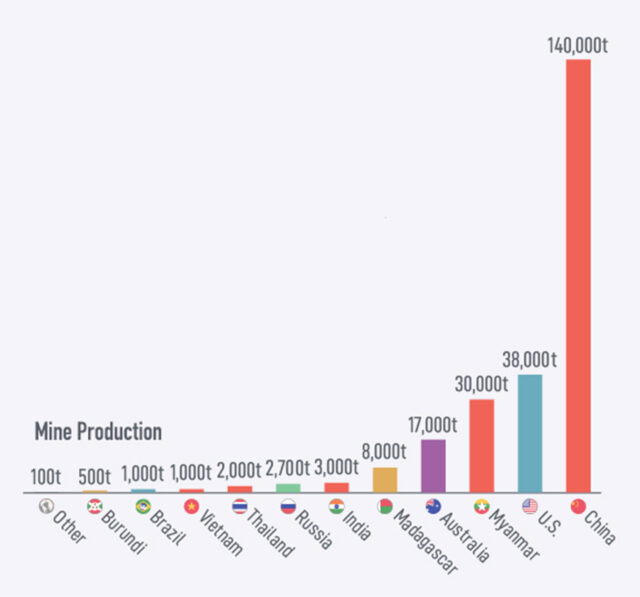
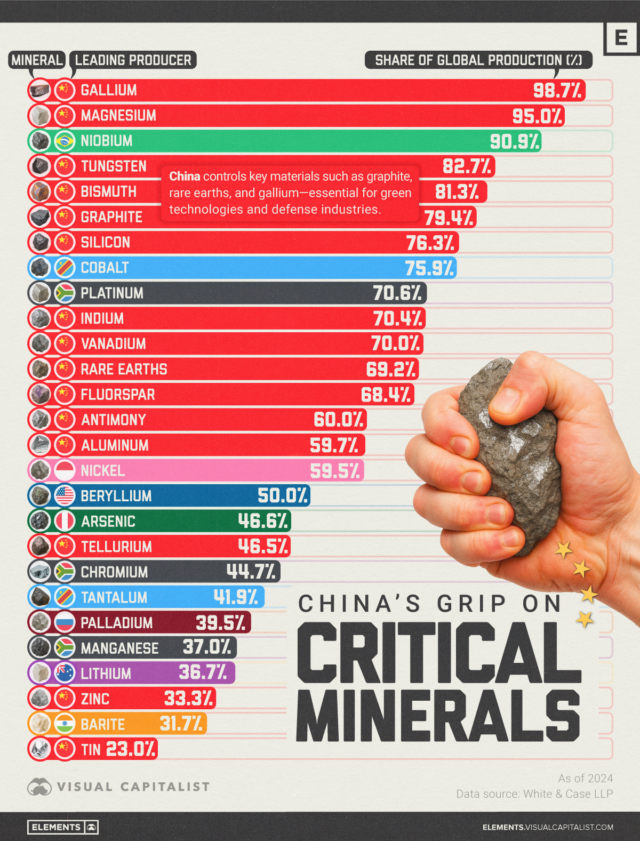
By the turn of the 21st century China had become the dominant force in rare earth production. Accounting for 95% of the global supply, and leveraging its abundant resources, China strategically utilised rare earths for technological innovation across sectors like space, defence and energy. By 2010 China accounted for 95% of the world’s rare earth oxides.
REE Politics
China’s restrictions on REE exports and their use by third parties in response to US tariffs and trade restrictions now means China can hold the world hostage as a policy tool. This is not the first time China has done this. In 2010 a Chinese fishing trawler collided with two Japanese Coast Guard vessels near the disputed Senkaku Islands. Following the collision, the Japanese Coast Guard detained the Chinese captain, accusing him of intentionally hitting the Japanese ships, and China vehemently protested the captain’s arrest and demanded his immediate release. The clash escalated diplomatic tensions between China and Japan, leading to a series of protests and strong rhetoric from both sides. As part of the backlash, China temporarily halted its rare earth exports to Japan, using its dominance in the rare earth market as a diplomatic tool.
The incident caused prices to surge by up to 500% in 2011 and 2012, driven by speculation, and this propelled heightened awareness in the West about Chinese dominance, resulting in the start of over 200 new projects globally to diversify the supply chain. The USA’s Mountain Pass mine was revived in 2012 as a result.
Supply Chains
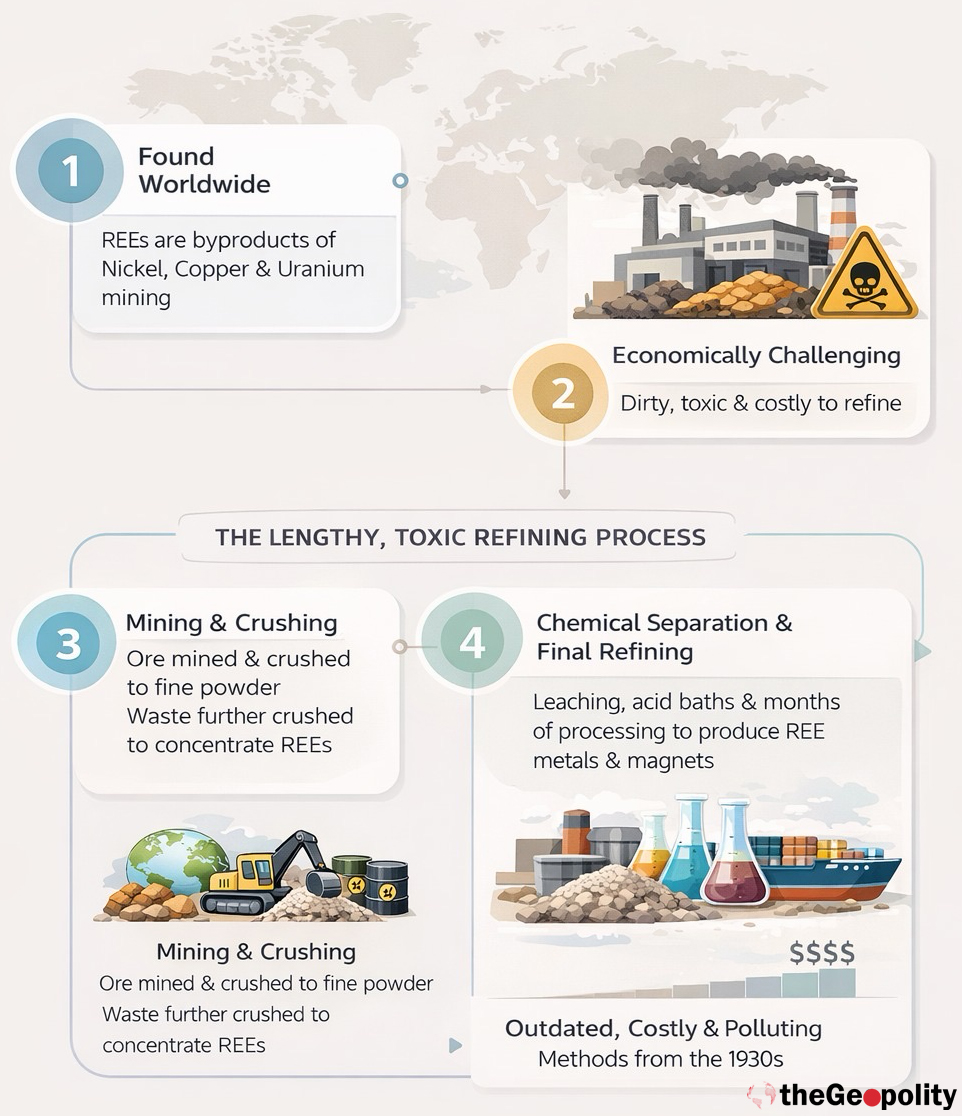
Although called REE’s they are not rare and are found in the earth’s crust across the world. REEs are by-products of mining for other metals such as nickel, copper and uranium. While not rare on Earth, they are rarely found in sufficient abundance in a single location for their mining to be economically viable. The real challenging aspect lies in the refining process, which is dirty and toxic, time-consuming, and costly. The process is also not particularly complex, and many nations could start their own REE industry if they wanted to do so.
Going from the raw ore found in mines to magnet is a multi-step process and today the technology and process used are from the 1930’s. The first stage involves mining the raw material, crushing it at a mill to form a fine powder. Once you have the main metal you’re after, you have a lot of waste left over, where another run of crushing is undertaken to concentrate the material further, getting you closer to REE.
During the second stage— the concentrate is run through a process of roasting, leaching and chemical separation that purifies the high-value minerals. This process is dirty, very polluting and takes a long time. Here the Australian and Brazilian mines would ship their individual oxides in the form of a fine powder to China for them to complete the final stage
In the final stage of the process the oxides are converted to the metals, alloys and finished magnets by dissolving them in large tanks of acid and the remnants of this are repeated multiple times, over months until your tons of oxides become an ounce of rare earth.
China was able to corner this market as no one across the world wanted to undertake this toxic process. Those that were doing it during the 1990’s closed their plants. Today no US facilities do this work. This is why China currently controls more than 85% of global rare earth processing capacity and over 90% of permanent magnet production, China accounts for 92% of metal, alloy and magnetics conversion. The rare earth alloys and magnets that China controls are critical components in missiles, firearms, radars and stealth aircraft.
China’s Dominance
China’s dominance of mining, processing and exports of REE is overwhelming. Whilst China has used non-market tactics to achieve this, ultimately Chinese domestic needs have been its priority and this is likely to continue. Even much of Chinese rare earths exports return to China at some point as components for electronics and advanced machinery that China needs to keep its other export sectors going and especially to continue its climb up the manufacturing value chain.
Chinese domestic demand for rare earths is already extremely high. China has grand plans for many technological developments from making the vast majority of its vehicle fleet electric by 2035, reaching 1,000 gigawatts of wind power generation by 2050, and building out the missile, submarine and air power capabilities needed to reach military parity with the US. China’s demand for REE is only going to increase.
For the US rare earths and other critical minerals are indispensable to the US military‑industrial base. Washington imports the vast majority of its critical materials, exposing its supply chains to foreign coercion. The US Department of Defense has announced a landmark agreement with MP Materials, which owns the only rare earth mine in the United States, at Mountain Pass, California. The deal, unveiled on July 10th, 2025, represents the largest US government investment ever made in the rare earths sector, underscoring Washington’s growing recognition of the strategic vulnerabilities posed by reliance on Chinese suppliers.