

|
Getting your Trinity Audio player ready...
|
Welcome to The Geopolity’s What We’re Watching (3W), our daily look at the interconnected worlds of Geopolitics, Economics and Energy. Curated from the world’s leading sources of information, our analysis and commentary is designed to help you make sense of the events driving the major developments in the world
In our most recent update, we highlighted the clear sign of an internal power struggle in the US. And we said, such a power struggle causes flipflopping on policy, which, in turn, will weaken the US in its geopolitical competition with China. Recent examples of the flipflopping are the War on Iran, where there is clear disagreement between the Zionist lobby that wants more war and others in Trump’s inner circle who want to avoid it.
With Iran, the conflict appears to be in in a “painful impasse”. While the Zionist Lobby continues to push for war, others are whispering in Trump’s ear saying that a little bit more blockading will be enough. During the resulting US inaction, Iran continues to strike against vessels that attempt to move through the Strait of Hormuz. On Wednesday alone a further three vessels were struck, writes Reuters.
Gulf officials still expect the US – Israel Alliance to restart their War on Iran, writes The National, because although the midterms elections made clear where the US public stands on the war, this has not translated into significant action by the Democratic Party to actually prevent a return to war.
Then on to Yemen, our thesis has been that the Saudi’s do not have a realistic plan for victory. Earlier in November we said:
“Saudi Arabia simply cannot win a ‘quick and easy victory’ in Yemen, we at 3W note. It could potentially win a war in Yemen, but only if it is willing to throw everything it has into the fighting, i.e. a Total War that completely absorbs the Saudi economy while tens of thousands of Saudis are killed on the front lines. Short of that, Saudi’s efforts to control Yemen will fail, with devastating impact on life and wellbeing both sides of the border, a ‘slow burning disaster’. This is the direction Saudi is heading.”
Since then, AnsarAllah has struck the headquarters of Saudi Arabia’s all powerful PIF sovereign wealth fund in Riyadh’s financial district, twice, as well as a tower there belonging to the country’s national oil company, Aramco. But it doesn’t stop there. Yesterday, AnsarAllah attacked Saudi Arabia’s largest oil refinery, Ras Tanura, which sits alongside one of the world’s largest crude export terminals, writes Reuters. Satellite images showed thick black smoke over the installation, indicating the success of the attack. Ras Tanura, which has a refining capacity of 550,000 barrels per day, has previously been hit during the conflict with the Houthis as well as during the broader Iran war.
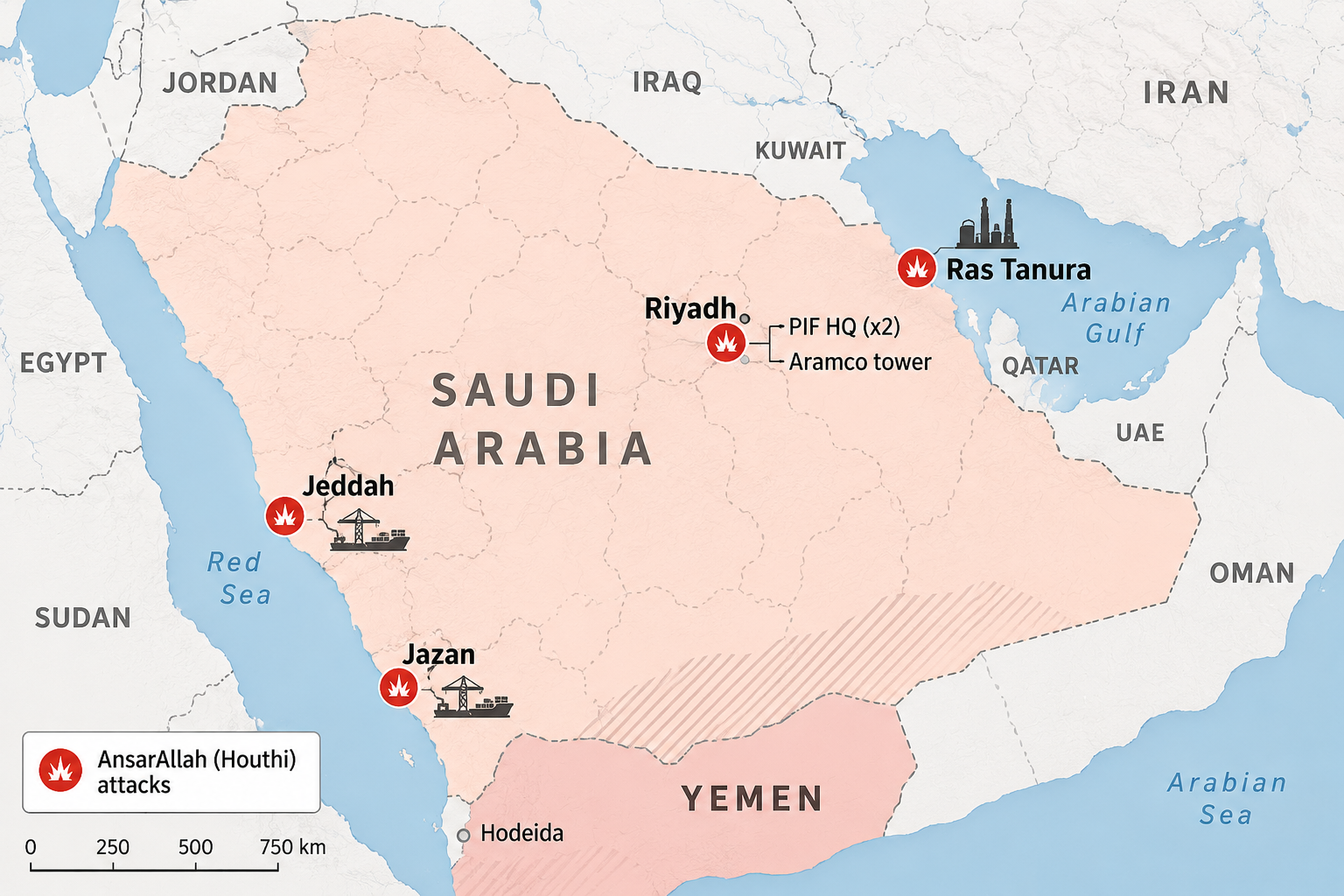
Also struck were Saudi Arabia’s Red Sea ports of Jeddah and Jazan on Wednesday, in retaliation for Saudi assaults on the port of Hodeida in Yemen, writes Bloomberg.
Furthermore, the New York Times acknowledges that the Saudi’s offensive against AnsarAllah has failed. Even after the Yemeni government declared a major counteroffensive last month — aided by Saudi warplanes dropping bombs across the country — the Houthi fighters have continued to gain ground, NYT says. AnsarAllah have by now gained control of Yemen’s entire Red Sea coast, including territory overlooking the Bab al-Mandab Strait, surrounded and besieged the major city of Taiz and advanced within a few dozen kilometers of Aden. At the same time, the forces allied to the Saudi’s have all but disintegrated into a motley coalition of warlords that has proved ill-equipped to hold the AnsarAllah back.
Now, after having to significantly tone down a major energy conference in Riyadh, and canceling the “Davos in the Dessert” investment conference, Saudi Arabia is now also looking at delaying a flagship mining conference due to the current circumstances, writes The Financial Times.
At 3W we see all this as evidence our assessment is correct. The longer the Saudi’s seek to “solve” their issues with AnsarAllah through war, the deeper the whole will be that it is digging for itself.
Then on to Ukraine, where in our previous update we noted that Russian vessels had been attacked in the Baltic Sea and in the Mediterranean. At 3W we noted these attacks were an obvious escalation, also because Ukraine could only have pulled this off through active involvement of western NATO countries such as the US and the UK. Despite this being obvious, on Wednesday US President Donald Trump and NATO chief Mark Rutte issued a joint statement saying that Russia should avoid actions that expand its war in Ukraine, writes Reuters. To us at 3W, the hypocrisy in this is mind-blowing. To Russia, no doubt, it must be infuriating. We speculate that this could well be the intent of it all – whoever in the US was behind the attacks on Russian ships in international waters, far away from the frontlines in Ukraine, is probably hoping this will make Russia escalate, such that thereafter, the US through the European countries can escalate further in the direction of Russia while claiming self-defense.
Then, lastly, 3W returns to the internal power struggle in the US. US president Trump launched his Tariff War shortly after coming to power, which is over 18 months ago now. This effort at securing US interests through economic warfare went on the backburner after China clearly communicated it would not play ball in any shape or form, while the US allies EU, Japan and South Korea all signed surrender documents. Then the US turned attention to Iran. Now that the midterms are over, and Trump appointed a new Chief of Staf, promoting Stephen Miller to the position previously held by Susie Wiles, and now the Tariff War has become the priority again. On Wednesday Trump announced new tariffs on 14 countries including China, Japan and the European Union, writes Reuters. A new maximum potential rate of 20% to 40% will be introduced to “counter excess industrial capacity” in these countries.
The proposed new duties will affect 14 US trading partners, including China, Japan, South Korea, the EU, India, Indonesia, Malaysia, Singapore, Switzerland, Taiwan, Thailand, Vietnam, Bangladesh and Cambodia, writes The Financial Times. Cambodia, Indonesia, Malaysia, Thailand and Bangladesh all received proposed tariffs of 18 per cent. Taiwan, Korea, Japan and the EU will be hit with 15 per cent, and Singapore with 10 per cent.
3W notes a few points in response.
First, the point about “excess capacity” is of course just a cover for the true US motive. After all, how about the US “excess capacity” in the IT world, where its companies such as Microsoft, Amazon, Oracle NVIDIA etc, dominate the globe? Will Trump ask them to reign in and create room for players from other countries? Of course not…
Second, as to the real US motive, 3W noted back in 2025 that the Trump Tariff Wars as part of a broader geopolitical strategy. By weaponizing tariffs, sanctions and investment rules, he has turned trade policy into a tool of coercive statecraft — one that seeks to realign global power relationships in favour of America’s short-term geopolitical goals. The objective is to force countries through economic means to align with the US. And this means against China.
Third, as the Financial Times notes, Trump’s original tariffs were struck down by US courts as unlawful. The new tariffs are an attempt to nevertheless restore them using a different justification. The original tariff achieved little to nothing, however. China’s exports continued to grow, and the US manufacturing sector continued to decline. Why would things be different now?
Fourth, at best this announcement will be seen as another flipflop by the Trump administration, from a policy focused on war (Venezuela, Iran) to maintain US hegemony, back to a policy focused on economic coercion. At worst, however, the announcement will be seen as another act of betrayal by China, since it comes just a week after the Shenzhen Trilateral Meeting which was supposed to breathe new life into the US – China relationship!
And that takes us back to what we at 3W wrote in our analysis of the Trump Tariff War in 2025:
“Overtly coercive and transactional trade relationships breed resentment and erode the trust that sustains long-term cooperation. Allies begin to see engagement with Washington not as an expression of shared interests but as participation in a protection racket: pay the tribute or face economic retribution. The inevitable consequence is blowback.”
In other words, by flipflopping between policies based on coercion – military war and trade war – the US is only accelerating its own decline.