

|
Getting your Trinity Audio player ready...
|
Welcome to The Geopolity’s What We’re Watching (3W), our daily look at the interconnected worlds of Geopolitics, Economics and Energy. Curated from the world’s leading sources of information, our analysis and commentary is designed to help you make sense of the events driving the major developments in the world.
In our most recent analysis of the developments in the Middle East, we focused on how Saudi Arabia is finding itself squeezed as a result of the US – Israel Alliance War on Iran. With AnsarAllah taking control of Yemen’s coastline, Saudi Arabia’s ability to export (or import) via the Bab al Mandab has been reduced to zero due the attacks on the East West Pipeline which according to official reports originated from Iraq. This temporarily halted Saudi’s ability to get oil to the Red Sea port city Yanbu. At 3W we asked the question, is this Iran turning the thumbscrews on Saudi Arabia, or is this the US – Israel Alliance punishing Riyadh for not supporting their War on Iran sufficiently?
Responsible Statecraft provides an extensive analysis of how AnsarAllah was able to suddenly make the impressive gains, after almost 10 years of war in Yemen. Apparently, AnsarAllah used AI to create voices messages that caused confusion among the ranks of the forces in Yemen allied with Saudi Arabia.
Since taking full control over western Yemen, AnsarAllah expanded its military operations. Within Yemen it is now moving eastwards to capture Yemen’s resource-rich regions, including Marib Province, writes The New York Times. Marib’s fall would also open a route for the Houthis toward the eastern province of Hadramout.
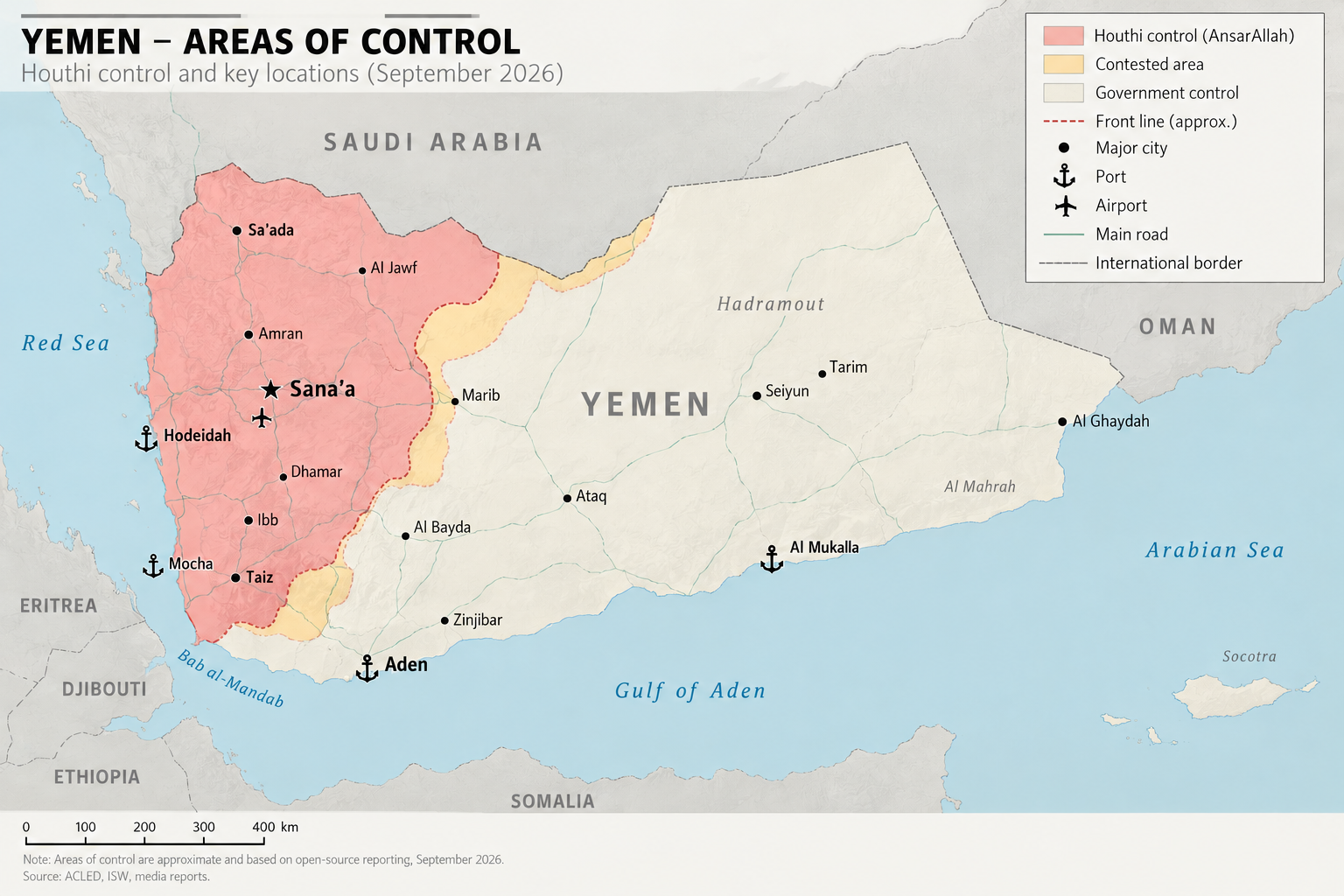
It is also moving its operations into Saudi Arabia. Last weekend it attacked the main Saudi military base bordering Yemen, writes The Guardian. This attack against the Sharurah base targeted “weapons depots and command and control centres that are managing the aggression against our nation and people”, the AnsarAllah military spokesperson Yahya Saree wrote on X. Since then, AnsarAllah moved further north, this weekend attacking the Yanbu port as well as the King Khalid international airport in Iran, writes Deutsche Welle. AnsarAllah military spokesperson Yahya Saree said they had “carried out two successful military operations using a large number of ballistic and cruise missiles and drones. The first targeted sensitive sites in the Saudi capital, Riyadh, and the second targeted Aramco facilities in Yanbu.”
This leaves Saudi Arabia in very, very dangerous situation, notes 3W.
From a financial perspective, Bloomberg writes that national oil company Saudi Aramco has told its customers in Europe that they should not expect any Saudi crude oil in September of October. 3W notes that this effectively means no income for the Saudi government for at least 2 months.
Saudi Aramco has told its customers in Europe that they should not expect any Saudi crude oil in September of October
From a military perspective, it appears AnsarAllah is utilizing the strategy deployed by Iran against the US. AnsarAllah appears to be systematically destroying the ability of Saudi Arabia to pose a threat against Yemen, attacking key nodes in Saudi Arabia’s military and energy infrastructure, gradually moving outward.
The inability of Saudi Arabia to effectively counter this can be learned from Riyadh’s diplomatic response.
Last week already 3W noted that crown prince Mohammed Bin Salman had asked US president Trump to intervene – twice in a single day. Responsible Statecraft writes that when reporters asked Trump about the calls, he said, “The Houthis called us, and they let us know they don’t want to fight with us”. Thus, 3W notes, really indicates the US is not interested in supporting Saudi Arabia.
Turkey and Pakistan, the signatories to the Mecca Accord, have, so far, also refused to come to the aid of Riyadh. Turkey’s foreign minister Hakan Fidan said on Saturday that Saudi Arabia may have military needs and that Turkey was ready to help, writes Reuters. But at 3W we note Fidan chose his words exceptionally carefully: “They may have some military needs, especially on some technical issues. We would have no issues in meeting these” This, in our view, means that Turkey is willing to sell Saudi Arabia weapons. But deploying the Turkish military in defense of Riyadh is clearly not in the cards at the moment.
A senior Turkish official told the Middle East Eye that the treaty’s defence commitments were not yet legally operative, as it still needs to pass through the signatories’ domestic approval processes, while the institutions and military arrangements needed to implement them would take time to develop. Getting all this done “could take a few years”, the official said. 3W notes that of there was a real willingness in Ankara and Islamabad to support Riyadh, they would not have spoken about “procedures” but instead just have gotten things done. In other words, no support is coming from Turkey.
The Saudi crown prince Mohammed Bin Salman also travelled to Egypt for emergency meetings last week, but that too has not led to deployment of Egyptian forces, writes Al Jazeera.
ZeroHedge writes about the rumours that Saudi Arabia then approached Syria to ask it to deploy fighters to aid the campaign against AnsarAllah. Apparently, Damascus too refused, leaving as the only option left for Saudi Arabia the recruitment of mercenaries on an individual basis. 3W notes that this cannot possible change the “battlefield dynamic”, since the main weakness of the Saudi’s is “command and control”. For decades Riyadh has been one of the biggest spenders on military hardware, but it completely lacks the ability to effectively manage this hardware. Throwing mercenaries into this mix will therefore not fundamentally change the equation.
All this means Riyadh does not have much time to find a solution. With every day that passes, Saudi Arabia is likely to weaken both militarily and economically. And, 3W notes, this opens the doors to a “palace coup” in Riyadh, since the Saudi political elite is not as united as its counterpart in for example Iran. Remember that Mohammed Bin Salman had to fight over power with Mohammed bin Nayef, and then consolidated his power through the infamous Riyadh Ritz Carlton affair.
this opens the doors to a “palace coup” in Riyadh, since the Saudi political elite is not as united as its counterpart in for example Iran
This possibility takes us at 3W back to our original speculation when we looked at this particular conflict, which was that the US – Israel Alliance could be allowing this all to happen in order to punish Saudi Arabia for not supporting the War on Iran enough. A palace coup could be what the US and Israel are pushing for in this case, by “riding the wave” of Iran’s strategic counter to the Alliance attempts to strangle it. To establish a new Saudi ruling elite that will loyally and faithfully submit to the US – Israel Alliance, unconditionally.
In this regard it is noteworthy that the US is actively talking to AnsarAllah at the US embassy in Muscat, Oman. Reuters writes that AnsarAllah is trying to keep the US out of the conflict by telling the US that it remains committed to the ceasefire agreement that the two parties reached after Trump’s 30 day war against Yemen in March 2025.
As to where Saudi Arabia should go next, Trita Parsi writes on his Substack that Saudi Arabia should understand it will not be aided by the US, that the American security order in the Middle East is effectively dead, and as long as Saudi Arabia pretends otherwise, things will just get worse for it. US bases in GCC countries have proved to be sources of insecurity rather than security, Parsi notes. They were supposed to prevent Iran from starting a war against the GCC. Instead, it was the US itself that started the war – against the objections of several GCC states – and within that war, the bases didn’t deter Iran from attacking. Rather, the bases served as magnets for Iranian attacks. The US could not protect the bases from Iranian attacks, and consequently, it cannot protect the GCC states. The collapse of the old security order in the Gulf offers a chance to forge a new order in the region. One that is centred on inclusive and collective security, rejects bloc formations, and rests on the shoulders of regional powers themselves, rather than being underwritten by external powers, writes Parsi. That means moving away from a system in which the US seeks to organise half of the region against the other half, and towards one in which regional states develop institutions to manage their rivalries. Under this vision, 3W notes, the solution for Saudi Arabia would be in opening up to, and sitting down with, Iran and AnsarAllah. Rather than begging the wider Middle East, include Israel, to come and fight again