

|
Getting your Trinity Audio player ready...
|
Welcome to The Geopolity’s What We’re Watching (3W), our daily look at the interconnected worlds of Geopolitics, Economics and Energy. Curated from the world’s leading sources of information, our analysis and commentary is designed to help you make sense of the events driving the major developments in the world.
Before returning to what has been the focus of 3W over recent months, the US – Israel Alliance War on Iran, today we first review the latest developments in the Ukraine War.
This week, namely, US president Trump’s favorite diplomatic envoys, Steve Witkoff and Jared Kushner, travelled to Moscow and Kiev. They first met with Russian president Vladimir Putin on Saturday to discuss US ideas for ending the war in Ukraine, writes Axios. On the side of the meeting, Gene Lange, the acting head of sanctions at the US Treasury Department, met with Putin envoy Kirill Dmitriev, while Treasury Secretary Scott Bessent met his Russian counterpart on the sidelines of the G20 Finance Ministers meeting in Asheville, North Carolina last week. To facilitate the talks, upon the request of the US the Russian agreed to halt attacks on Ukrainian cities, Axios notes.
The diplomatic move comes as Ukraine is losing the war, writes The Spectator. Western sanctions on Russia have basically failed, it says. In addition, Kyiv is running out of money, and men to defend itself, just as surely as it has already run out of Patriot interceptors to defend its skies against the Kremlin’s barrages, it writes.
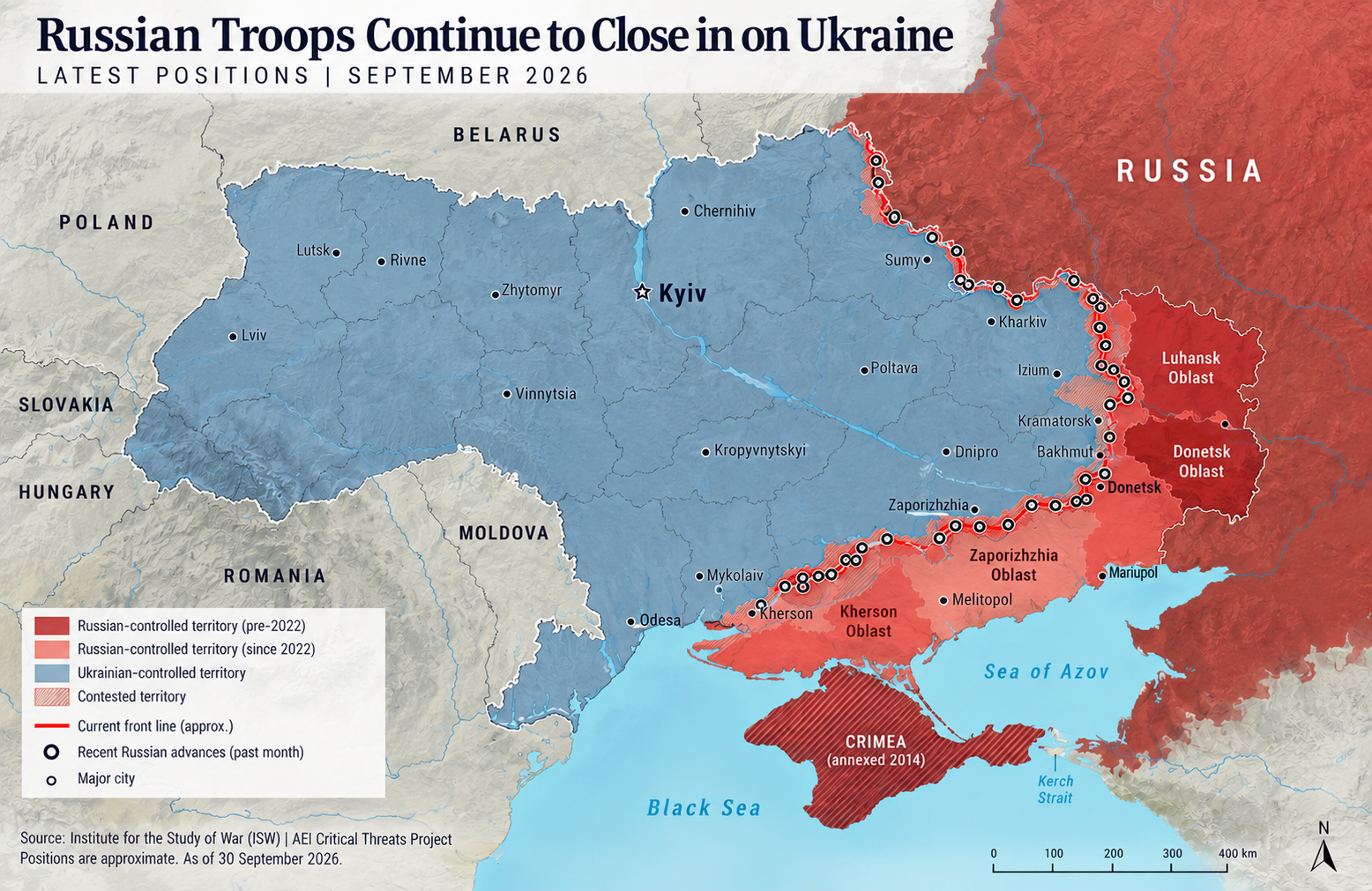
Meanwhile, or consequently, Russia’s army is gradually inching towards the so-called “fortress belt” cities of Sloviansk and Kramatorsk, the capture of which would bring Russia closer to its goal of seizing the entire industrialised Donetsk region, writes Reuters. Russian forces are less than 15 km (9 miles) from Sloviansk and Kramatorsks. Both are under worsening strikes by killer drones and guided bombs.
On Sunday, Witkoff and Kushner then held several hours of talks with Ukrainian president Volodymyr Zelenskyy in Kyiv, writes The Financial Times. People familiar with the talks told the FT that the Americans brought few new ideas and were instead seeking to revive earlier proposals for a ceasefire between Kyiv and Moscow. This leaves the prospects of a broader ceasefire increasingly remote, FT notes, as both sides have escalated their long-range strikes over recent months, targeting ships in the Black Sea as well as military and energy infrastructure.
The New York Times writes that because the US has no real new ideas to bring about a negotiated settlement of the Ukraine War, the focus of its diplomatic endeavor was really about getting Russia and Ukraine to talk again.\
the US has no real new ideas to bring about a negotiated settlement of the Ukraine War, the focus of its diplomatic endeavor was really about getting Russia and Ukraine to talk again
However, immediately after the visit by Witkoff and Kushner, Russia struck Ukraine exceptionally hard, writes CNN. Russia launched “a massive strike using ground and air-based precision-guided weapons and attack drones,” the Russian Defense Ministry said in a statement on Tuesday. Forces hit “facilities belonging to Ukraine’s military-industrial complex, logistics and warehousing centres,” the statement added. Five people were killed and nearly 30 others were wounded in the attack, which involved ballistic and cruise missiles, as well as drones, according to the Ukrainian Interior Ministry.
Nevertheless, on Tuesday US president Trump called Russian president Putin to tell him he wants to see a quick end to the War in Ukraine and a full restoration of US – Russia ties thereafter, writes Reuters. Putin, in turn, told Trump that Russia had no hostile intentions when it came to Europe despite repeated claims to the contrary by various European politicians.
Some analysts see these developments as evidence that the US is on Russia’s side. We at 3W see it differently. Following CIA director Ratcliffe’s “secret visit” to Russia late August, we wrote that it would be unwise for Moscow to base its plans in the geopolitical realm, including Ukraine, on US offers or threats. Because the US, due to its imperial hegemonic mindset, will only make offers and threats to weaken those it sees as adversaries. Never to find a compromise solution. To us, therefore, the combination of talks with continued Russian attacks signal that Russia is indeed of this realization. Following the complete failure of the Alaska Summit between Trump and Putin in 2025, Russia will now meet US envoys, politely listen to them, and nod in agreement whenever their words align with Russia’s interests and plans – while fundamentally ignoring whatever it is they have to say. Following his conversations with Witkoff and Kushner Russian president Putin already said to his associates that he remains committed to continuing the war in Ukraine, that he is determined to seize control of all of Ukraine’s eastern Donetsk region, and that he believes Russia’s army can achieve this goal in the next six months, writes Bloomberg.
And this leaves the US stuck in another war it caused by pushing for NATO expansion into Ukraine and Ukraine’s political and economic integration into the western hemisphere. And as in the case of the War on Iran, while this “US war of choice” achieved some US geostrategic objectives (in particular a weakening of Europe and its firmer integration in the US Empire), it had unforeseen consequences which did significantly more damage to these same US interests (in particular the reinvigoration of Russian military and its military-industrial complex, and the enhanced strategic integration of Russia with China and Iran).
Speaking of the War on Iran, earlier this week we at 3W noted that despite the Bessent announcement that the US would henceforth focus on economic warfare against Iran, in reality the US is escalating militarily again. On Tuesday this continued, as the US military struck five Iranian vessels, writes The Associated Press. US Central Command said it struck the tankers after Iran’s Revolutionary Guards targeted a Navy warship with ballistic missiles twice over the past two days. “The US warship successfully evaded the attempted Iranian attacks and continued to patrol regional waters. No American personnel were harmed,” it said in a statement. It said the Iranian tankers destroyed were the Kivik, Charminar, Horizon 1 and the Riesco in the Gulf of Oman, as well as the Derya near Kharg Island in the Strait of Hormuz. Following the American strikes, Iran then launched missiles toward US targets in Jordan, Iranian state-run media said. Iran’s Revolutionary Guard Navy on Tuesday also warned crews of oil tankers near ports in Kuwait and Bahrain to immediately leave their vessels, saying the ships could be targeted in retaliation for US attacks on Iranian tankers.
The New York Times also notes that the Iran War is currently in an escalatory phase (again). Senior Iranian leaders have issued increasingly sharp warnings in response to US military operations against their country. Mohammed Bagher Ghalibaf, Iran’s lead negotiator and the speaker of Parliament, told lawmakers on Sunday that the era of “proportionate responses” to American attacks was over. “From now on, any aggression against Iran’s interests and security will be met with a response that is faster, heavier, and more painful,” he said. Soon after, Iran’s security chief, Mohsen Rezaei, announced plans to impose a “restricted zone” for shipping in the Persian Gulf that would go beyond the country’s efforts to control the Strait of Hormuz. And, Iran has acted upon these warnings, this week attacking American warships for the first time.
3W notes that the current tit-for-tat escalations create a very dangerous environment, at least for the global economy. Oil prices beat $100 per barrel on Tuesday, writes The Financial Times. While the US attacked Iranian oil tankers, Iran said it had attacked 8 oil tankers linked to US allies in response. This could damage oil exports from the Gulf in a more structural, longer-term manner, 3W notes.
To this latter point, also on Tuesday the Iranian-backed Houthis in Yemen launched strikes on several Saudi cities, writes Reuters, wounding 73 people and setting oil installations ablaze. The attacks targeted a Saudi airbase in the southern city of Khamis Mushait as well as Saudi state oil company assets in the cities of Abha, Najran and Jazan.
After the attack, Saudi Arabia’s foreign minister prince Faisal bin Farhan warned that the kingdom would not hesitate to defend itself, writes Ther National, while Pakistan’s Defense Minister Khawaja Asif said that any attack on Saudi Arabia could activate the Mecca Defense Alliance, writes Bloomberg. “We’re bound by the terms and conditions of this pact and, God willing, we’ll honor this pact if there’s aggression. There should be no ambiguity about this,” Asif said in an interview with Geo News. The Houthis should recognize that their actions “could make this agreement operational,” he said. He urged the Houthis not to draw Saudi Arabia further into Yemen’s conflict, saying any attempt to do so could bring the pact into play. “We are hoping the situation will die down,” he said.
In other words, writes 3W, through ignoring its commitments under the MOU, and instead opting for an escalation in both the economic and military war on Iran, the US is risking all-out war across the region and gambling the energy infrastructure of “West Asia” again.