

The resignation of Prime Minister Keir Starmer means Britain is set to appoint its seventh prime minister in just ten years. Since David Cameron resigned following the Brexit referendum in 2016, Britain has cycled through Theresa May, Boris Johnson, Liz Truss, Rishi Sunak, Keir Starmer and now another incoming leader. No democracy has experienced such rapid leadership turnover without a constitutional crisis, military defeat or economic collapse.
While the British media continues to explain this phenomenon through individual mistakes or poor communication, focusing on personalities misses the bigger story. Britain’s problem is not simply its leaders. The country’s political class has consistently failed to address the growing list of structural and strategic challenges facing the nation. The result is a growing sense that elections change governments, but not outcomes or the lives of ordinary people.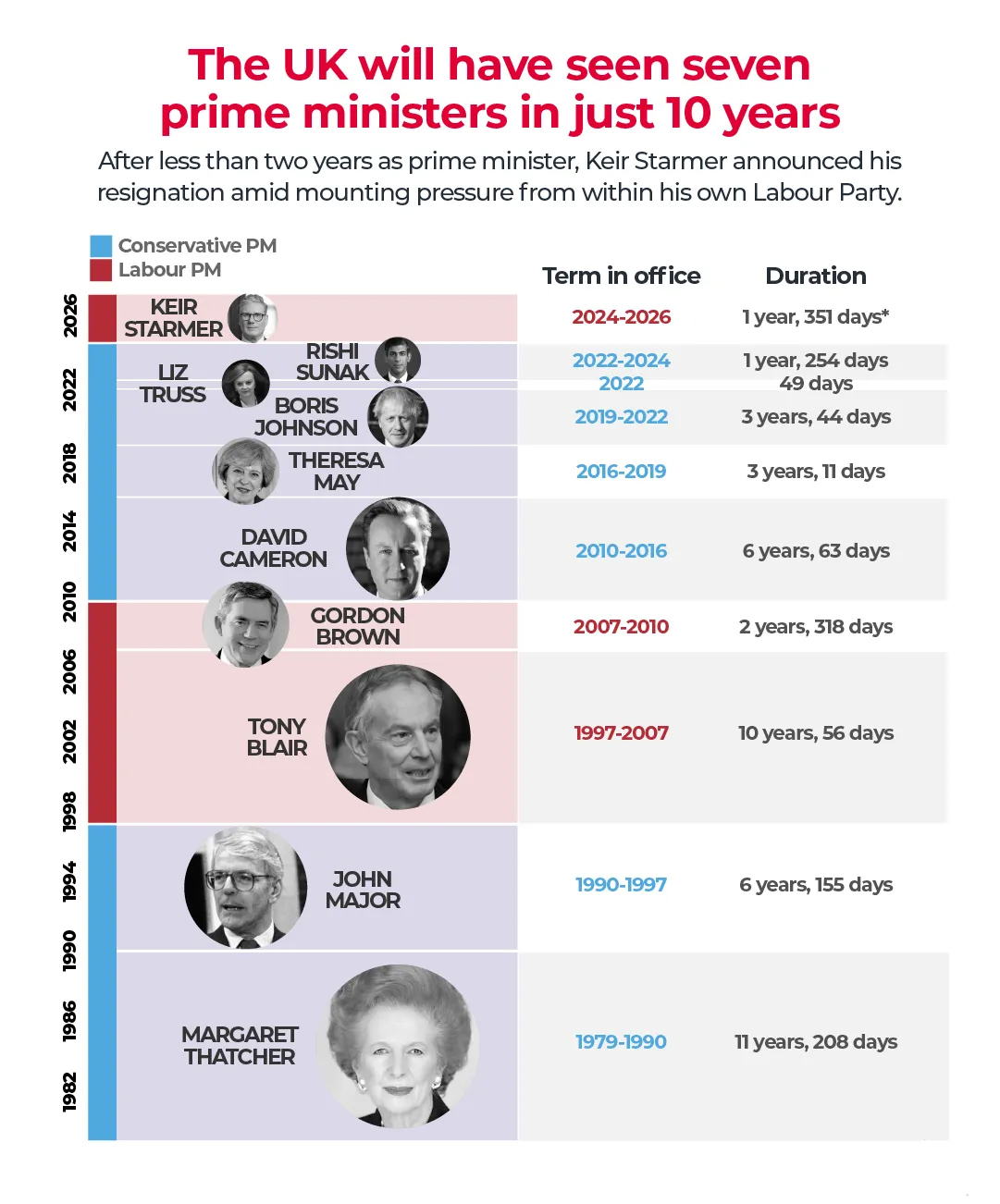
Post-war struggles
Britain may have won the Second World War, but it lost much of its economic strength. At its height, the British Empire provided access to cheap raw materials, guaranteed export markets and control over global trade routes. After 1945, however, decolonisation rapidly eroded these advantages. Countries that had once imported British goods increasingly built their own industries, while Britain lost the preferential trading arrangements that had supported its manufacturing base.
At the same time, the rise of Germany and Japan as industrial export powers steadily weakened Britain’s economic position. The country emerged from the war burdened by enormous debts—particularly to the United States—with ageing factories, outdated infrastructure and depleted gold and foreign currency reserves. Unlike America, Britain had financed much of the war through borrowing. While Britain struggled, the United States emerged richer and more industrially powerful than ever.
Britain’s response was nationalisation and state ownership. After 1945, successive governments brought large sections of the economy under public control, including coal, steel, railways, electricity, gas and telecommunications. The aim was to guarantee employment and modernise industry. While some sectors improved, many became increasingly inefficient, with persistent losses ultimately borne by taxpayers.
As trade union membership expanded, strikes became increasingly frequent and governments often struggled to implement reforms. Entire industries were paralysed. By the 1970s Britain had become synonymous with inflation, wage disputes and declining productivity. The crisis reached its peak during the Winter of Discontent, when widespread strikes disrupted public services and undermined confidence in the country’s economic model. When Britain was forced to seek assistance from the International Monetary Fund in 1976, many viewed it as a symbol that the nation had reached rock bottom.
Neoliberalism
When Margaret Thatcher came to power in 1979, she argued Britain suffered from excessive government intervention and powerful trade unions. Her ambition was nothing less than to remake Britain’s economic model.
State-owned industries were privatised on the belief that competition would improve efficiency. New laws restricted strikes and secondary picketing, while the defeat of the miners during the 1984-85 strike dramatically weakened the power of organised labour. Businesses gained far greater flexibility over hiring and fireing.
The government also deregulated large parts of the economy, reducing restrictions on business and allowing market forces to play a greater role. The most significant transformation came in the City of London. The 1986 Big Bang swept away many financial regulations, attracting foreign banks, expanding electronic trading and turning London into one of the world’s leading financial centres. Finance increasingly replaced manufacturing as the engine of the British economy.
Britain may have won the Second World War, but it lost much of its economic strength
Many of these reforms improved efficiency, but they also produced lasting consequences. Manufacturing employment collapsed, factories closed across large parts of the country, and many former industrial communities—particularly across northern England, South Wales and parts of Scotland—never fully recovered, losing not only jobs but also their economic identity.
While much of the North entered prolonged decline, London and the South East prospered as financial services expanded. Britain’s modern north-south divide widened dramatically, with productivity in London remaining significantly higher than in much of the rest of the country.
Britain also shifted away from producing goods towards providing services. Finance became a major source of tax revenue but also left the economy more exposed to financial shocks, as demonstrated during the 2008 global financial crisis.
The neoliberal transformation also contributed to rising wealth inequality. Property, investments and financial assets appreciated rapidly, while many workers in declining industrial sectors saw fewer opportunities. Asset ownership increasingly became the defining measure of wealth.
The neoliberal transformation also contributed to rising wealth inequality
New Labour abandons the Left
By the time New Labour came to power in 1997, the neoliberal political and economic landscape created by Margaret Thatcher had become Britain’s new consensus. Rather than dismantling Thatcher’s reforms, Tony Blair embraced many of them. His government retained privatised industries, accepted flexible labour markets, maintained restrictions on trade union power, upheld the independence of the Bank of England and continued to position the City of London as the engine of British economy.
Although New Labour invested heavily in public services, it did so without fundamentally challenging the market-based model established during the 1980s. This continuity led Margaret Thatcher to famously remark when asked about her greatest achievement: “Tony Blair and New Labour. We forced our opponents to change their minds.” The comment reflected a widely held view that Thatcher had shifted Britain’s political centre of gravity so decisively that even the Labour Party accepted many of the principles she had championed. As a result, the economic framework established during the Thatcher years survived successive governments, leaving many of the strengths—and weaknesses—of that era embedded in Britain today.
Red Team, Blue Team
The traditional rivalry between Labour and the Conservatives once reflected competing visions of society. The Conservatives represented business, private enterprise and limited government, while Labour emerged from the trade union movement advocating a larger role for the state in protecting workers and redistributing wealth.
Over time those differences narrowed. Following the reforms of the 1980s and the emergence of New Labour, both parties broadly accepted the same economic framework. While they disagreed over details, both embraced globalisation, financialisation, market-led growth and Britain’s post-industrial economy.
The result has been the emergence of a broad political centre that dominates both major parties. This consensus has provided stability for financial markets and business, but many voters increasingly believe it has failed to address concerns over housing, wages, public services and regional inequality.
As trust in the mainstream parties has declined, support for anti-establishment movements and protest parties has steadily grown.
Margaret Thatcher famously remarked when asked about her greatest achievement: “Tony Blair and New Labour. We forced our opponents to change their minds.”
The Real Economic Challenge
The UK may remain one of the world’s largest economies, but many of its underlying social indicators tell a different story. Britain now has more food banks then MacDonalds branches, nearly a quarter of the population lives in poverty and just 50 families own half the nations GDP!
Britain’s economy has become heavily dependent on services rather than production. Manufacturing now accounts for around 8-9% of GDP, while financial services contribute a similar share. When finance and related professional services are combined, they account for around 12% of economic output. Britain has evolved from a manufacturing-led economy into one driven by finance, business services and the City of London. While this has generated considerable wealth, it has also deepened regional inequality and increased the country’s exposure to financial shocks.
Successive governments have managed these problems rather than solved them. The consequence is a growing perception that Britain’s political system works effectively for corporations, financial interests and asset owners, but far less effectively for ordinary citizens.
The EU was never the real problem
Brexit was supposed to resolve Britain’s political crisis. Supporters believed it would allow the country to take back control, invest more in public services and unlock new economic opportunities. A decade later, many of those promises remain unfulfilled. Brexit fundamentally changed Britain’s relationship with Europe, but it did not solve the structural problems that drove dissatisfaction in the first place. Economic stagnation, regional inequality, pressure on public services and declining trust in political institutions all remain. Brexit ultimately became another chapter in Britain’s political crisis rather than its solution.
The UK may remain one of the world’s largest economies, but many of its underlying social indicators tell a different story. Britain now has more food banks then MacDonalds branches, nearly a quarter of the population lives in poverty and just 50 families own half the nations GDP!
Seven Leaders, One Problem
The average tenure of a British prime minister is now just 23 months. Appointing another leader is unlikely to change Britain’s trajectory because the leadership crisis is ultimately a symptom rather than the cause.
The rapid turnover of prime ministers reflects a political class struggling to reconcile the competing demands of financial markets, political elites and the wider public. Until those underlying structural problems are addressed, Britain is likely to continue replacing leaders without resolving the challenges facing the country. Seven prime ministers in ten years is not simply evidence that individual politicians keep failing—it is evidence that the political system itself is struggling to produce lasting solutions.
Note – for further reading Geopolity has published a series of booklets on the geopolitics of key nations, including the geopolitics of Britain