

Despite spending hundreds of billions of dollars on sophisticated military equipment, Saudi Arabia has failed to secure victory against the Houthis. The disparity between the two protagonists could hardly be greater: a technologically advanced, well-funded military confronting an indigenous fighting force rooted in tribal networks and guerrilla warfare.
The asymmetry is reminiscent of the United States and the Taliban in Afghanistan. Yet whereas the Americans occupied Afghanistan’s principal cities, Saudi Arabia has struggled to establish lasting control over territory contested by the Houthis. Despite sustained aerial bombardment and extensive use of proxy forces, Riyadh has been unable to translate its material superiority into a decisive military advantage.
The reasons for this failure lie in Yemen’s geography, Saudi Arabia’s political and military institutions, and the contrasting organisational structures of the two sides.
The Geography of Defeat
The geography of northern and central Yemen is fundamentally inhospitable to an invading army reliant on mechanised formations and technological superiority.
The Yemeni highlands, an extension of the Sarawat mountain system, contain steep escarpments, rocky valleys, deep ravines and extensive cave systems. Armoured vehicles lose much of their tactical advantage, whilst the movement of troops and supplies becomes difficult and vulnerable to ambush.
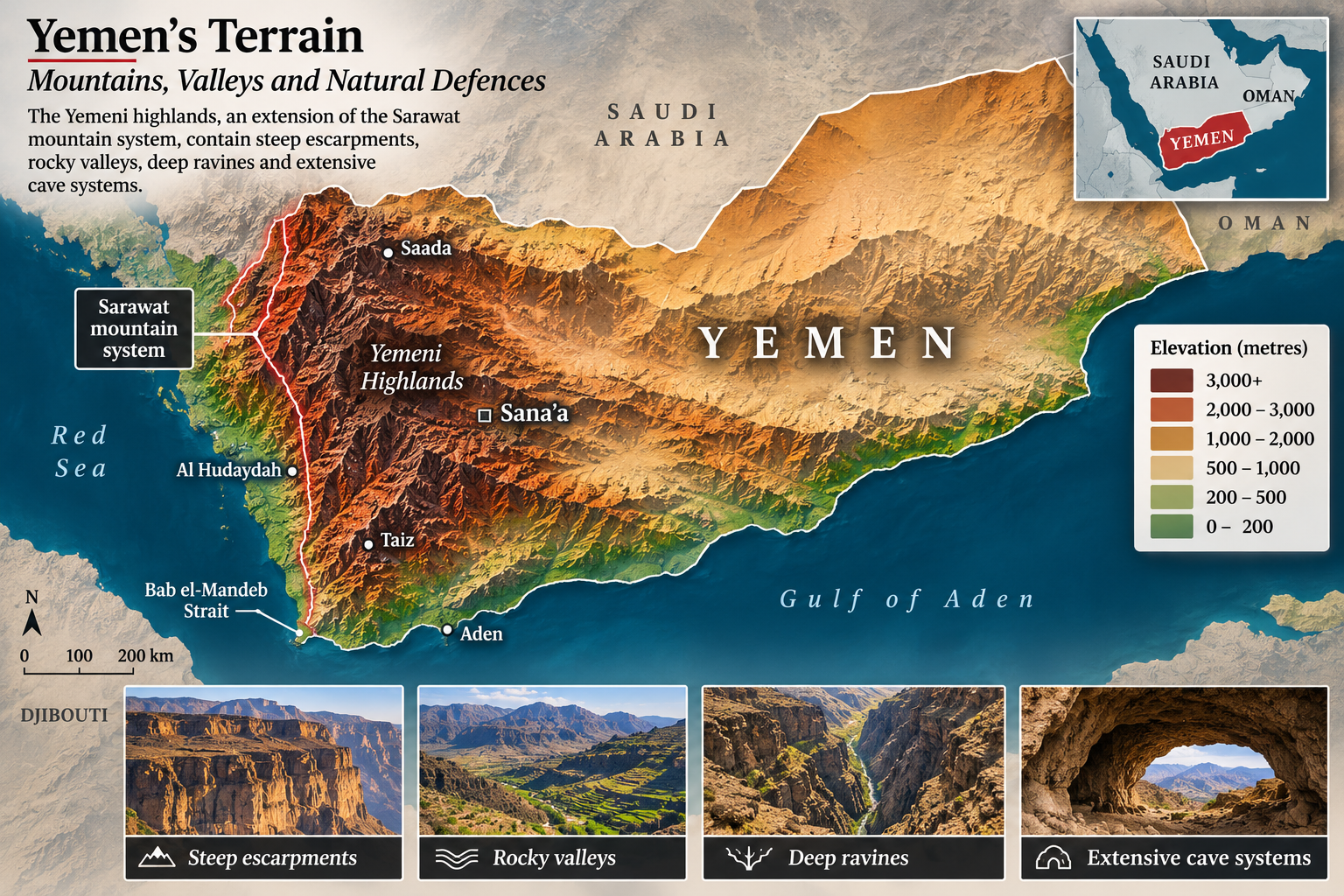
For the Houthis, this geography is an enormous strategic asset. Mountains provide natural defensive positions, whilst underground facilities protect personnel, weapons and command structures. Mobile missile and drone units can operate with considerable flexibility, complicating Saudi aerial surveillance and targeting.
Air power alone, therefore, cannot defeat the Houthis. Saudi Arabia would need to commit significant ground forces to clear, secure and hold extensive areas of Yemeni territory. It is precisely here that the fundamental weaknesses of the Saudi military become apparent.
An Army Designed to Protect the Monarchy
The Saudi armed forces have historically been structured around the overriding requirement of preserving the Al Saud monarchy. Their institutional development has been shaped as much by the threat of domestic instability and military coups as by the requirements of conventional warfare.
The American security umbrella has allowed the Saudi leadership to prioritise the security of the monarchy without developing an entirely self-sufficient expeditionary military capability.
The consequence is a military possessing impressive equipment but comparatively limited experience of sustained, independent operations.
Loyalty to the royal establishment has traditionally been an essential consideration in military appointments and promotions. Political reliability can take precedence over independent judgement, initiative and professional competence.
Royal patronage and wasta — influence exercised through personal, familial and tribal connections — remain important features of Saudi institutional life. The result is a military hierarchy in which professional advancement does not necessarily correspond to operational ability.
The Saudi armed forces have historically been structured around the overriding requirement of preserving the Al Saud monarchy. Their institutional development has been shaped as much by the threat of domestic instability and military coups as by the requirements of conventional warfare
The Paralysis of Centralised Command
These weaknesses are compounded by a centralised decision-making structure fundamentally at odds with modern warfare.
Contemporary battlefields require rapid decisions. Identifying a target is only part of the challenge; commanders must possess the authority to act before the opportunity disappears.
Effective militaries delegate considerable authority to junior officers and non-commissioned officers (NCOs). The Saudi military has historically struggled to develop this culture. Operational decisions remain concentrated among senior commanders, with junior officers often reluctant to act without explicit approval.
An equally significant weakness is the limited development of an empowered NCO corps. In professional armies, NCOs maintain discipline, supervise training and exercise immediate tactical authority.
Where authority is concentrated at the top, soldiers become executors of instructions rather than independent decision-makers, whilst junior officers become transmitters of orders rather than battlefield leaders.
Military effectiveness depends not simply on weapons but on an organisation’s ability to distribute authority, process information and act decisively.
The Culture of Accountability
Institutional weaknesses are reinforced by a political and administrative culture that places considerable importance on personal standing, hierarchy and the avoidance of embarrassment.
Where acknowledging mistakes carries professional consequences, protecting one’s reputation can become more important than establishing what went wrong. Military setbacks may be attributed to external factors or subordinates rather than failures of leadership and planning.
This creates a serious obstacle to institutional learning. Officers may recognise the deficiencies of a strategy but remain reluctant to challenge it, particularly when professional advancement depends on relationships with senior commanders.
Saudi Arabia’s extensive system of state patronage and government benefits can also weaken incentives for professional competition and individual initiative.
An old joke, contrasting supposed Japanese and Arab attitudes towards difficult tasks, captures the distinction rather neatly. The Japanese man is said to reason: if someone else can do it, so can I; if nobody can do it, then I must. The Arab response is supposedly: if someone else can do it, let him; and if nobody can, how can I?
Where appointments depend heavily on political connections, underperforming commanders may remain in place for reasons unrelated to military competence. Mistakes are consequently repeated because the institution struggles to confront them openly.
Saudi Arabia’s extensive system of state patronage and government benefits can also weaken incentives for professional competition and individual initiative.
The Monarchy’s Fear of Its Own Army
There is a more fundamental explanation for Saudi Arabia’s reluctance to commit to a major ground war: the monarchy’s concern about concentrating military power.
For the Al Saud dynasty, the armed forces represent both an instrument of national defence and a potential source of domestic political instability.
The regular armed forces, National Guard and internal security organisations have historically been maintained as distinct institutions, limiting the concentration of military power under a single commander.
Mobilisation for a major war, however, necessarily brings together personnel, weapons and commanders who would otherwise operate within separate institutional structures. This can create new centres of military influence and potentially alter the domestic balance of power.
For Mohammed bin Salman, the challenge is not simply how to defeat the Houthis. It is how to mobilise sufficient military power without creating an armed establishment that could eventually threaten his own authority.
The irony is that the very arrangements designed to protect the monarchy may have weakened its ability to wage an effective conventional war.
The irony is that the very arrangements designed to protect the monarchy may have weakened its ability to wage an effective conventional war.
The Houthi Advantage: Experience, Motivation and Organisation
The Houthis, formally known as Ansar Allah, represent a contrasting institutional model. Emerging from northern Yemen’s Zaydi revivalist movement, they fought six rounds of conflict against the Yemeni government between 2004 and 2010. These conflicts provided battlefield experience, hardened their leadership and established networks of tribal and local support.
The movement has since developed a sophisticated military organisation incorporating conventional units, missile forces, drones and intelligence capabilities. Its combination of ideological mobilisation, tribal relationships and decentralised operations has made it a resilient opponent.
The Saudi-led intervention in 2015 was intended to demonstrate overwhelming military superiority and bring the conflict to a rapid conclusion. Instead, it reinforced the Houthi narrative of resistance against foreign intervention and deepened their military experience.
Whilst Saudi Arabia has invested heavily in advanced military technology, the Houthis have developed relatively inexpensive capabilities that impose disproportionate costs on their wealthier adversary.
The Saudi-Emirati Rivalry
Riyadh’s position is further complicated by competition with the United Arab Emirates over Yemen’s political future.
Saudi Arabia has supported Yemen’s internationally recognised government, represented by the Presidential Leadership Council (PLC), seeking to preserve a unified Yemeni state and maintain a security buffer along its southern border.
The UAE has cultivated its own political and military relationships, particularly through the Southern Transitional Council (STC), which seeks the restoration of an independent South Yemen.
Saudi Arabia views Yemen primarily through the prism of border security. The UAE places greater emphasis on maritime trade routes, commercial networks and strategically important ports and islands.
Despite being partners in the original intervention, the two Gulf monarchies have supported competing political and military actors. This fragmentation has undermined the coherence of the anti-Houthi campaign.
For Riyadh, an eventual accommodation with the Houthis may be conceivable. Managing an increasingly ambitious Abu Dhabi, whose regional objectives conflict with Saudi interests, presents a different strategic challenge.
A Strategic Failure With No Easy Resolution
Saudi Arabia’s predicament is worsening. Its much-publicised offensive to retake Bab el-Mandeb and surrounding areas has collapsed to the point that the Houthis now threaten Aden itself.
Geography favours the defender, whilst the Houthis possess extensive experience of irregular warfare and effective local mobilisation. Saudi Arabia remains constrained by centralised command, political patronage and limited operational initiative. Divisions within the anti-Houthi coalition further undermine its military strategy.
The fundamental lesson is that military expenditure and military effectiveness are not interchangeable. Advanced aircraft, precision-guided weapons and surveillance systems cannot substitute for competent leadership, motivated soldiers, decentralised decision-making and a coherent political strategy.
The Houthis do not need to defeat Saudi Arabia in a conventional confrontation. They need only survive, impose continuing costs and prevent Riyadh from achieving its political objectives.
The consequences extend beyond Yemen. Bab el-Mandeb is one of the world’s most strategically important maritime chokepoints, with implications for international shipping, energy markets and the regional balance of power.
Saudi Arabia’s failure exposes the limitations of a regional power whose economic resources and technological acquisitions have outpaced the development of its military institutions.
The central paradox is that the Saudi monarchy has built a military establishment designed to protect its political survival, but in doing so may have compromised the military effectiveness required to defend its strategic interests abroad.
Its greatest obstacle in Yemen may not be the Houthis themselves, but the institutional architecture of the Saudi state.