

On Thursday 19 November, the political leaders of the US, China and Russia will be meeting on the sidelines of the Asia-Pacific Economic Cooperation (APEC) Summit in Shenzhen, China.
The trilateral meeting was a suggestion by the US, writes The South China Morning Post. US president Trump was scheduled to travel to APEC and meet Chinese president Xi there. During October, Trump began raising the idea of making the bilateral meeting trilateral, as Russian president Putin was also scheduled to attend APEC. US Secretary of State Marco Rubio then pushed the idea of a trilateral summit during a phone call with Chinese Foreign Minister Wang Yi last Wednesday.
The Wall Street Journal writes that Russian president Putin supported the idea, as the trilateral meeting at APEC would coincide with negotiations Russia is having with the US on ending the war in Ukraine. Continuing these talks together with China could give the Russian more leverage over the US, Putin is said to have reasoned.
As to what is likely to be discussed, the trilateral meeting is an outcome of the bilateral negotiations between the US and China that were triggered by US president Trump’s “Trade War,” which 3W said back in 2025 is an American attempt to maintain its global hegemony by keeping China down economically. China has responded to America’s “weaponization of trade” by positioning itself as a protector of the international order originally built by the US. For example, Chinese president Xi’s speeches at the World Economic Forum in Davos have been calling for a defense of economic globalization, arguing that it has caused tremendous social, scientific and technological progress, writes E-International Relations.
Over recent months, the US has been pushing to broaden the scope of the US – China bilateral dialogue from pure trade matters, to include Artificial Intelligence. This, China only reluctantly agreed to when Trump and Xi met in the US last September, but without a willingness to commit to anything, writes the BBC.
It will not be, as some fear, a ‘New Yalta’, under which the US and China agree on a fundamental reordering of the ‘geopolitical chessboard.
In the run up to the scheduled bilateral meeting between Xi and Trump in China this week, US treasury secretary Scott Bessent and trade representative Jamieson Greer held a video call with Chinese vice-premier He Lifeng. The South China Morning Post writes that the Chinese side tried to keep the agenda limited to trade, covering Chinese and American purchases of each other’s goods as well as tariffs. The US side, however, pushed for the inclusion on the agenda of AI. The US justifies its focus on AI by stressing the “dangers” of the technology. In the run up to the previous meeting between Trump and Xi, in the US during September of 2026, the American AI industry organized a public relations campaign to highlight the dangers in “uncontrolled AI development”, writes Emerald Book. In response, the US proposed to China a “management regime’ similar to the Non-Proliferation Treaty for nuclear weapons, under which an “international inspection regime” is established to monitor frontier AI labs, The South China Morning Post writes separately. In the 3W view, just like the NPT, this part pf the US agenda is designed to keep the US competitive. The NPT is designed to limit the number of nuclear powers, such that the US maintains an edge over most others. The role of a NPT-like system for AI would be to prevent China moving ahead of the US in the technology.
Following China’s acceptance of talks on AI, the US has been pushing the inclusion of nuclear arms on the agenda. The working-level teams have discussed “AI in critical weapons systems”, writes The south China Morning Post. From there, the US has increased focus on the nuclear part of “AI in critical weapons systems”, writes The Guardian. Trump told reporters the trilateral meeting would be about denuclearisation, the war in Iran, economics, trade and “my favourite subject, Ukraine”. 3W notes the order in which Trump mentioned the subjects to be discussed – nuclear first. Earlier this week, after a call with China’s top diplomat Wang Yi, US secretary of state Marco Rubio said both sides had “agreed on the importance of meaningful leader-level conversations to advance goals such as peace and denuclearisation”.
The role of a NPT-like system for AI would be to prevent China moving ahead of the US in the technology.
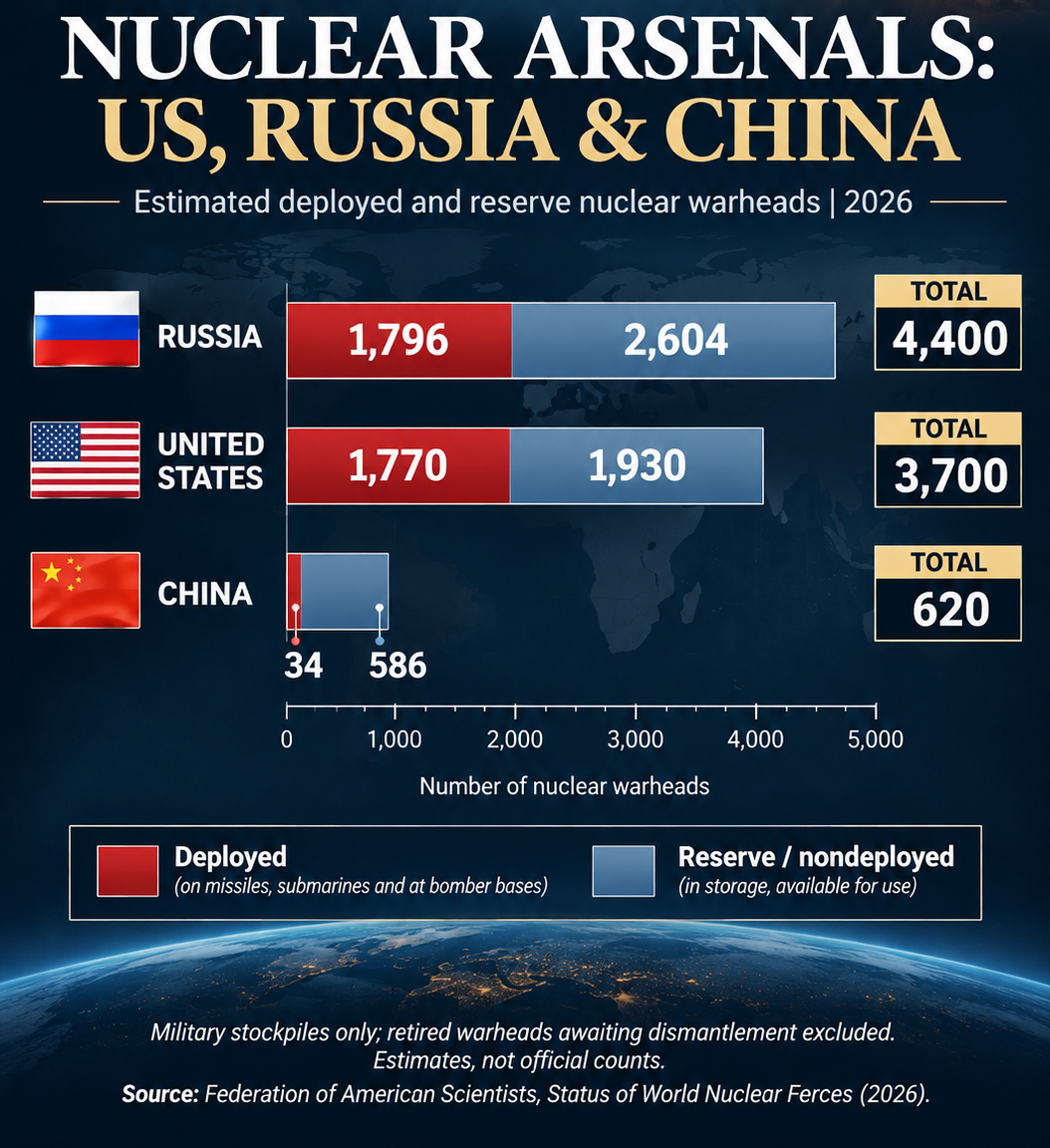
China has long rejected talks on nuclear arms, writes The South China Morning Post. It is significantly behind Russia and the US in nuclear weapons, but is trying to catch up. In China’s view, the US attempt to talk nuclear arms control is designed to prevent China from catching up. For this reason, China has been pushing back against US efforts to get it to join nuclear arms control conversations, writes Deutsche Welle. China also prefers that any talks on Ukraine be held directly between the United States and Russia, and discussions about the Korean peninsula to be between the US and North Korea, as China does not want to become dragged into these conflicts since they were created by the US to serve US geostrategic interests. But, since China’s main ambition is to stabilise the overall relationship with the US, in order to preserve the current global order as long as possible, it agreed to discuss AI with the US, as well as “AI in critical weapons systems”.
The US has also been using its leverage in semiconductors in order to motivate China to go along with the idea of a trilateral meeting. The Trump administration on Monday announced it was tightening a loophole that has allowed Chinese tech firms to bypass US restrictions on accessing the most advanced AI chips through third countries, writes Time Magazine. The new rule released by the Commerce Department will require that buyers of advanced semiconductors from certain countries will need to secure a license to sell or transfer those chips. The administration said the rule would specifically impact buyers from Indonesia, Malaysia, Singapore, Thailand, and Brazil, describing those countries as having a “higher than normal” risk of evading current sanctions. The new rule will also give US commerce secretary Howard Lutnick wide discretion as to which chips may require more safeguards. According to the rules, the secretary may inform a company selling AI chips “orally” about stricter export rules on certain items if the department believes there is “an unacceptable risk.” The measures are set to go into effect in 90 days, which in the 3W view indicates it is designed to pressure China – “you can either do as we say, or we will hurt you”.
To maintain control while talking about subjects it does not want to talk about, China has demanded a highly scripted proceeding for the trilateral meeting. Chinese officials told The Wall Street Journal that Beijing demands that the groundwork be done in advance of the actual meeting, to ensure an agreed-upon agenda and predetermined outcomes. Xi is said to like the optics of a historic trilateral meeting hosted by China —the photos, the statements and the propaganda value—without the risk of an unpredictable conversation.
Based on all the above, on Monday China announced the trilateral meeting will cover topics of “groundbreaking significance” including “safeguarding world peace”, according to The Guardian. “[The leaders] will exchange views in-depth on safeguarding world peace and promoting strategic stability in major-power relations, which is of groundbreaking significance,” said the Chinese foreign ministry spokesperson, Mao Ning. “Stronger communication among China, Russia and the United States, along with managing differences and stabilizing relations, serves the interests of all three countries.” 3W notes that this is highly generic, far removed from the specifics of the AI and nuclear arms treaties or the Iran and Ukraine peace treaties that the US has been pushing for.
This is the background to the Trilateral Meeting in Shenzhen. At 3W we note this makes clear that the meeting is unlikely to deliver any breakthroughs on any subject, be it AI, nuclear weapons, the Ukraine War or the War on Iran. The different parties are very far apart on all these subjects, and there are no signs anyone is willing to make the substantial compromises needed to get to something of an agreement.
In other words, Shenzhen is not the final outcome of a diplomatic process that is connected to the geopolitical conflict that is currently taking place, driving by a US desire to maintain its status of global hegemon, in the face of China’s rise. It will not be, as some fear according to Bloomberg, a “New Yalta”, under which the US and China agree on a fundamental reordering of the “geopolitical chessboard”, one that places the world on a certain trajectory for decades to come, as the original Yalta meeting did in 1945. Rather, the Shenzhen Trilateral Meeting is part of the geopolitical conflict, a “move and countermove” in the diplomatic arena, connected to similar moves and countermoves in the economic and military arenas.