


On paper alone the defence pact between Saudi Arabia, Turkiye and Pakistan creates a formidable alliance, the synergies between each nation are obvious and are complementary as the strengths of each nation cancel the weaknesses of its partners.
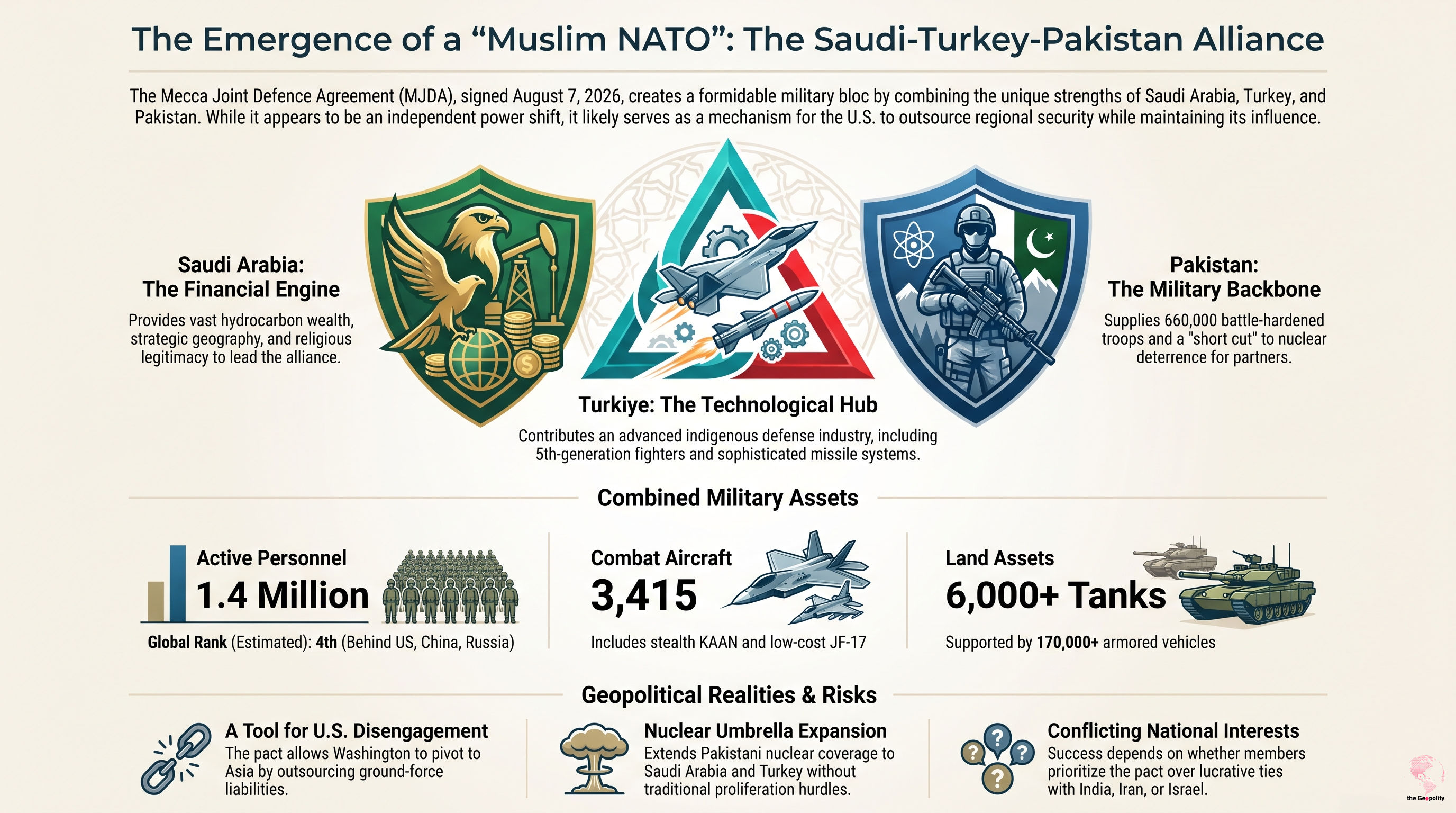
Whilst Pakistan lags, Turkiye has become a technologically advanced defence supplier, with a sophisticated indigenous defence industry producing products ranging from small arms to sophisticated radar and surface to Air missile systems. Saudi Arabia although lacking in both technology and population brings vast hydrocarbon deposits the associated finance a strategic geographical position and cultural and religious legitimacy to lead the islamic world, whilst Pakistan brings nuclear weapons and unlimited human resources to the table, an issue which Turkiye with its declining fertility and Saudi Arabia both lack.
With Turkish technical prowess, Saudi finance and Pakistani Human resources it is possible to envisage a power rivaling the world’s greatest powers both in terms of military might and manufacturing capability.
For turkey and Saudi their is an added benefit, it is both technically and politically difficult to develop Nuclear weapons, Extending coverage from an already nuclear armed state is a simply a matter of agreement and is politically acceptable on the world stage as paradoxically this is not considered proliferation, hence in an increasing unstable and transactional world for both Turkey and Saudi this pact constitutes a short cut to nuclear deterrence.
Again on paper the agreement transcends a simple defence pact it enhances and deepens trilateral cooperation in a number of key sectors.
The agreement establishes:-
High-Level Coordination: where permanent political and military bodies will be established to group Defence Ministers, Foreign Ministers, and Chiefs of General Staff into committees that co-ordinate defence and joint ventures.
Joint Military Drills: it establishes a mechanism for regular joint exercises which will span land, naval, air forces, air defence, and unmanned systems.
Industrial & Tech Integration: A particular focus is directed toward the joint development and production of military equipment, technology transfers, and sustainable maintenance logistics. Although it is yet to be announced whether Saudi Arabia will join Turkeys KAAN 5th generation fighter program,
Maritime Defense: Both Pakistan and Türkiye confirmed participation in the Saudi-led coalition to protect Red Sea shipping lane.
Combined, the three countries have defence capabilities exceeded only by the US, China and Russia. The combined forces include about 1.4 million active personnel, backed by large paramilitary reserve forces that dwarf active personnel. Pakistan provides the largest pool of active personnel at 660,000, followed by Turkiye at 481,000 and Saudi Arabia at 247,000, but more importantly Pakistan brings a battle hardened and professional force with Saudi financing that provides virtually unlimited capabilities to recruit and train additional personnel from Pakistan’s demographically young population. The Ukraine war has shown that in stark contrast to US experience in its Middle East campaigns and akin to the second world war, deep reserves of manpower are essential to fight wars when peer or near peer adversaries fight, Pakistan provides exactly these reserves.
Combined, the three countries have defence capabilities exceeded only by the US, China and Russia
In terms of air power the future looks significantly better than the present. Combined the three states possess 3415 aircraft but more importantly possess complementary development programs, Pakistan’s JF-17 program provides a low cost work horse whilst Turkey’s Kaan program provides the high end stealth capability that modern air wars demand. Although Saudi Arabia provides only 917 of the total airframes they are nevertheless more advanced than those of Pakistan and Turkey.
Combined land forces are also considerable, together the three nations field over six thousand tanks among over 170,000 other armoured vehicles. With significant tactical rocket forces and the capability to jointly produce the majority of the systems in use again there are considerable synergies between these nations.
The alliance also constitutes a significant naval power, combined the navies possess 344 naval assets and have the ability to indigenously produce warships from submarines to aircraft carriers
But agreements as can be seen by those signed by the US can be worth less than the paper that they are written on. The Budapest memorandum where the US and the UK gave security assurances to Ukraine and Hungary were not honoured similarly when Russia downed a Turkish F4 over Syria the response from NATO was at best lacklustre.
The three countries jointly signed the Mecca Joint Defence Agreement (MJDA) on August 7th 2026, similar to NATO’s article 5 where an attack on one is considered an attack on all eliciting a collective response this agreement also stipulates a collective response from all three but unlike NATO where in essence it was a defence agreement against one enemy i.e. the USSR. With the MJDA its adversaries are numerous and diverse.
But agreements as can be seen by those signed by the US can be worth less than the paper that they are written on
Pakistan has historical grievances with India exacerbated by India’s increasing control over Pakistan’s rivers, making war with India a significant possibility. Will Saudi Arabia jeopardise its over $100 billion of investment in India and support Pakistan in a war. With the political temperature in the gulf at boiling point will Pakistan, in the face of extreme public and military disapproval intervene against Iran when in the coming hostilities, Iran targets Saudi assets and most importantly of all, with Israel threatening strikes against Turkey among their increasing geopolitical struggle over Syria. Will the alliance defend Turkey against Israel, the principle ally of the US in the region?
The details of the agreement remain vague and vacuous, especially the thorny issue of foreign bases located on Saudi soil. Does an attack on a US facility constitute an attack on Saudi Arabia and precipitate a collective response?
The timing of the pact is interesting; it comes at a time when the US is embroiled in an intractable conflict in the middle east, where a face saving exit strategy seems to elude its grasp. Not only is the US militarily engaged with Iran but it seems to have lost control of its principal asset in the region Israel. The US and isreal do not seem to be on the same page when it comes to the future of the middle east, the US would like to see stable autocracies allowing it to shift focus towards the Asia pacific whilst the israelis seek managed chaos prevailing in the middle east which prevents a regional challenger from emerging and preserves Israel superiority in the region. For Israel, a declining US means its needs to become the new hegemonic power in the Middle East.
Trump has been gushing in his praise of it, further more it is hard to envisage an independent political manoeuvre from Saudi, pakistan or in fact turkey when their subordinate position to the US is considered. The politics of each nation, both internal and external are heavily influenced by the US and their policies are almost dictated by the US. Three years of carnage in Gaza and eleven years of bloodshed in Syria did not compel any collective action or agreement hence one can conclude this agreement is not the result of a moral or ethical concern and that the US is as much responsible for the agreement as the signatories.
The timing of the pact is interesting; it comes at a time when the US is embroiled in an intractable conflict in the middle east, where a face saving exit strategy seems to elude its grasp
If one were to examine the agreement in its geopolitical context, then it is easy to conclude that the agreement is in essence an agreement to protect Saudi Arabia exclusively. All states involved have regional focus rather than global, with the exclusion of Israel, Turkey does not have a peer competitor in the region and its armed forces are more than capable of dealing with its other regional adversaries. Pakistan’s regional adversary India, will only engage in a limited strike on Pakistan as deploying its forces into Pakistan in a sustained campaign to gain and hold territory will be ruinously expensive both in terms of man and machine. Hence any conflict would be extremely short, sharp and punitive in nature and will not require the participation of others. Saudi on the other hand both internally and externally requires assistance, its armed forces although well equipped lack a marshal spirit, young men raised in the lap of luxury, nurtured in the malls of Jeddah and Riyadh as its experience in Yemen against a insignificantly equipped enemy show do not constitute an effective fighting force. Hence we may conclude it is Saudi Arabia that is in need of protection rather than Pakistan or Turkey.
Although many have touted the agreement as a move away from US security arrangements for the Middle East, reality dictates that this complements rather than replaces US hegemony, in effect it absolves the US of its most difficult commitment, i.e. deployment of ground forces to aid secure Saudi Arabia and its monarchical regime. As the US has found from the ongoing conflict in Iran the prosecution of sustained conflict will eventually require the deployment of ground forces, a fact which due to demographic and political considerations it finds difficult to achieve. This agreement shifts that responsibility primarily to Pakistan whose ability to absorb losses is politically and demographically superior to the US.
Furthermore for the US whose ability to influence Israel has significantly waned, the security arrangement establishes a counter weight and helps contain the unilateral tendencies of the Israelis, when its actions threaten the interests of the US by destabilising its subordinate regimes, the example of Syria where a direct intervention of the US was required to prevent the Israelis toppling the Ahmad al-sharaa’s administration.
The most pressing issue is however the continuing war between the US and Iran, if and when hostilities resume the agreement however ambiguous provides a mechanism for Pakistan and Turkey to intervene on the side of the US under the pretext of protecting of their fellow signatory Saudi Arabia hence when all is taken into consideration it is not surprising that Trump’s lauding of the agreement has been profuse and bellicose.
The priority for the US over the last decade has been a controlled and gradual disengagement from the middle east to shift its focus to the Asia pacific theatre. This agreement may alleviate the vacuum left by such a pivot, by out sourcing its liabilities to its subordinate nations Pakistan and Turkey whilst continuing to reap the strategic, economic and political profits the Middle East offers.
Time will tell whether this agreement will be the basis of further integration of Muslim nations into a mutual defence arrangement or whether it remains an agreement on paper only. Saudi Arabia, Pakistan and to a large extent Turkey are not nations whose leaders prioritise their religious, ideological or even national interests. Rather, as can be seen by Erdogan’s inaction and compliance with US policies during the Syrian civil war, Pakistans inaction when india annexed Kashmir or Saudi suppression of opposition to the Gaza genocide. For the leadership of all three the continued survival of the regimes by conforming to US policy dictates supersedes any other consideration, hence it is expected that the agreement may serve the immediate interests of the US and amount to little more than a psychological manifestation of US policy.