


On March 18th 2026, when presenting the 2026 Annual Threat Assessment before the Senate Intelligence Committee, Director of National Intelligence Tulsi Gabbard said that five countries were researching and developing an array of novel, advanced or traditional missile delivery systems with nuclear and conventional payloads, that put the US homeland within range. On Pakistan, Gabbard told lawmakers that “Pakistan’s long-range ballistic missile development potentially could include ICBMs with the range capable of striking the homeland.” Pakistan’s military doctrine has for long been India-centric but with the changing global situation Pakistan may be entering a phase in which regional deterrence may gradually give way to wider strategic ambition.
Unlike its more expansive and often belligerent neighbour, India, Pakistan has pursued a notably more pragmatic path in the development of its missile arsenal. Where New Delhi has sought to cultivate a broad indigenous ecosystem for both core and ancillary missile technologies, Islamabad has adopted a narrower, more economical approach: relying heavily on its strategic partnership with China to supply critical technologies it does not yet possess itself or have the means to develop.
That choice has enabled Pakistan, despite its comparatively shallow industrial base and limited technological infrastructure, to field a missile force of considerable sophistication, sufficient to preserve strategic parity with a neighbour that is larger, wealthier and vastly more industrially advanced. While India invested heavily in the domestic manufacture of subcomponents across the supply chain, Pakistan concentrated instead on airframes, propulsion and systems integration, importing guidance and electronic subsystems from China and elsewhere. In retrospect, that decision appears shrewd. Many of the once highly specialised electronic components that required costly bespoke defence-industrial facilities are now commercially available on global markets, rendering some earlier investments in indigenous production increasingly redundant.
Pakistan’s missile ambitions have, however, been shaped as much by constraint as by design. Limited finances and a narrowly India-centric strategic doctrine have confined its programme largely to short and intermediate-range systems. Unlike the broader deterrent postures adopted by major powers. Pakistan has not pursued intercontinental ballistic missiles, having little strategic rationale beyond the subcontinent.
Rudimentary Origins
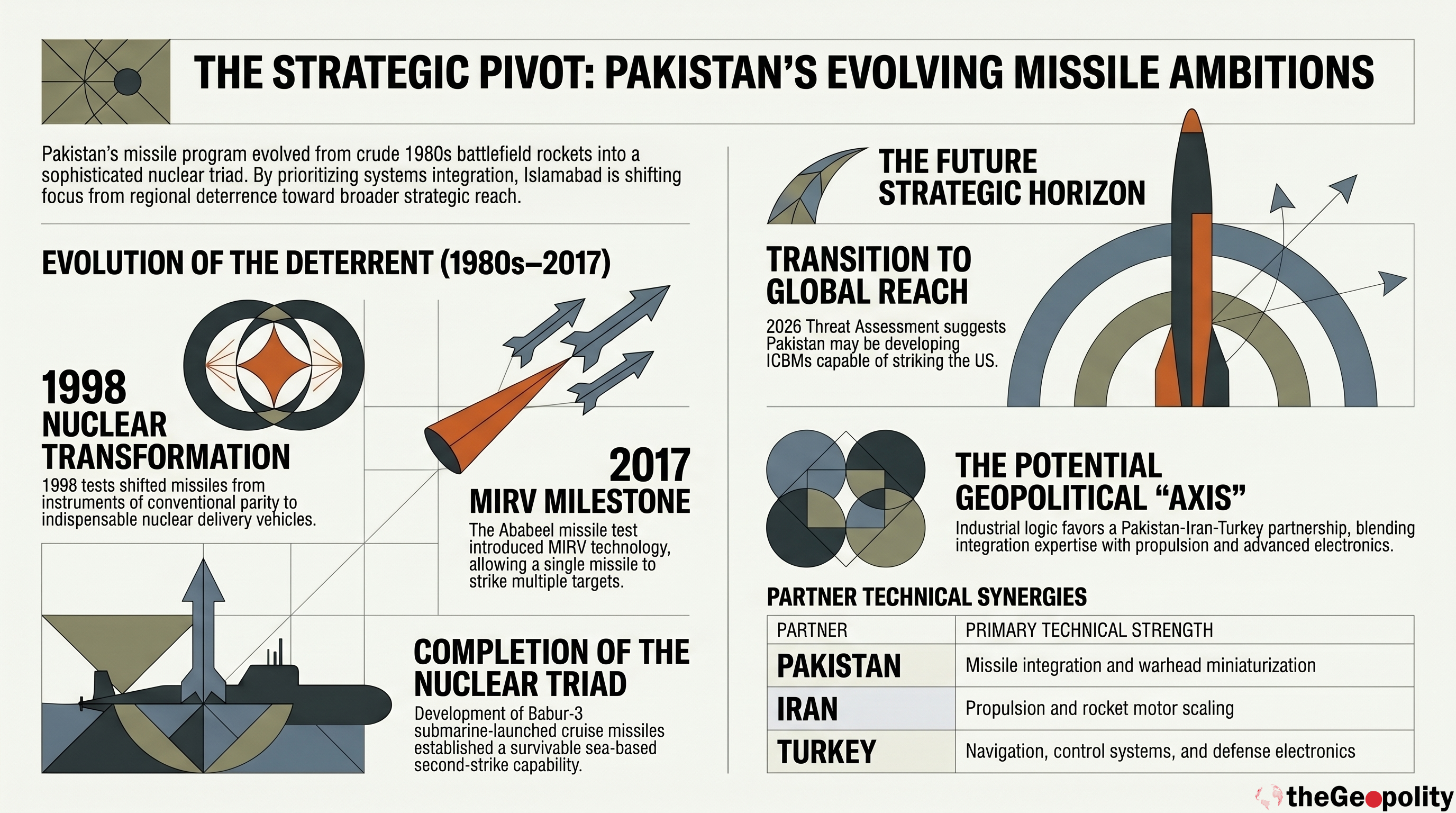
The origins of Pakistan’s missile programme lie in the 1980s, when Pakistan responded to India’s Integrated Guided Missile Development Programme, which produced the Prithvi short-range and Agni intermediate-range systems. Pakistan’s earliest indigenous efforts, Hatf-I and Hatf-II, first tested in 1987, were rudimentary unguided battlefield rockets of modest range and poor accuracy. Yet with the infusion of Chinese and North Korean technology, progress accelerated markedly.
The nuclear tests of 1998 transformed the programme’s urgency. Until then, Pakistan’s missiles had served chiefly as instruments of conventional parity; after the nuclear test, they became indispensable vehicles for nuclear delivery.
Between 1998 and 2010 Pakistan pursued a dual-track development strategy. One strand centred on the liquid-fuelled Ghauri programme, overseen by A.Q. Khan and Khan Research Laboratories, the other focused on the solid-fuelled Shaheen family under the National Development Complex. Although the Ghauri line offered potential as the basis for a future space launch vehicle, it was ultimately abandoned in favour of the more practical, quicker-launching and militarily flexible Shaheen series.
Pakistan concentrated instead on airframes, propulsion and systems integration, importing guidance and electronic subsystems from China and elsewhere
Alongside its ballistic missile work, Pakistan has steadily advanced its cruise missile capabilities. In 2005 it surprised outside observers by unveiling the Babur (Hatf-VII), a ground-launched cruise missile capable of terrain-hugging flight and low-observable penetration. Two years later came the Ra’ad (Hatf-VIII), an air-launched counterpart. These were later joined by the Babur-3 submarine-launched variant, giving Pakistan the sea-based leg of what is now effectively a nuclear triad.
A further milestone came in 2017, when Pakistan tested the Ababeel missile, equipped with MIRV (multiple independently targetable re-entry vehicle) technology. Designed to evade missile defence systems and strike several targets with separate warheads from a single missile, Ababeel marked Pakistan’s entry into a more advanced strategic tier and raised concern in both Washington and New Delhi. The subsequent commissioning of larger rocket motor test facilities has prompted speculation that Islamabad may eventually seek larger-diameter boosters capable, in time, of supporting intercontinental-range systems exceeding 5,500km.
Today Pakistan’s missile inventory reflects the steady maturation of that strategy.
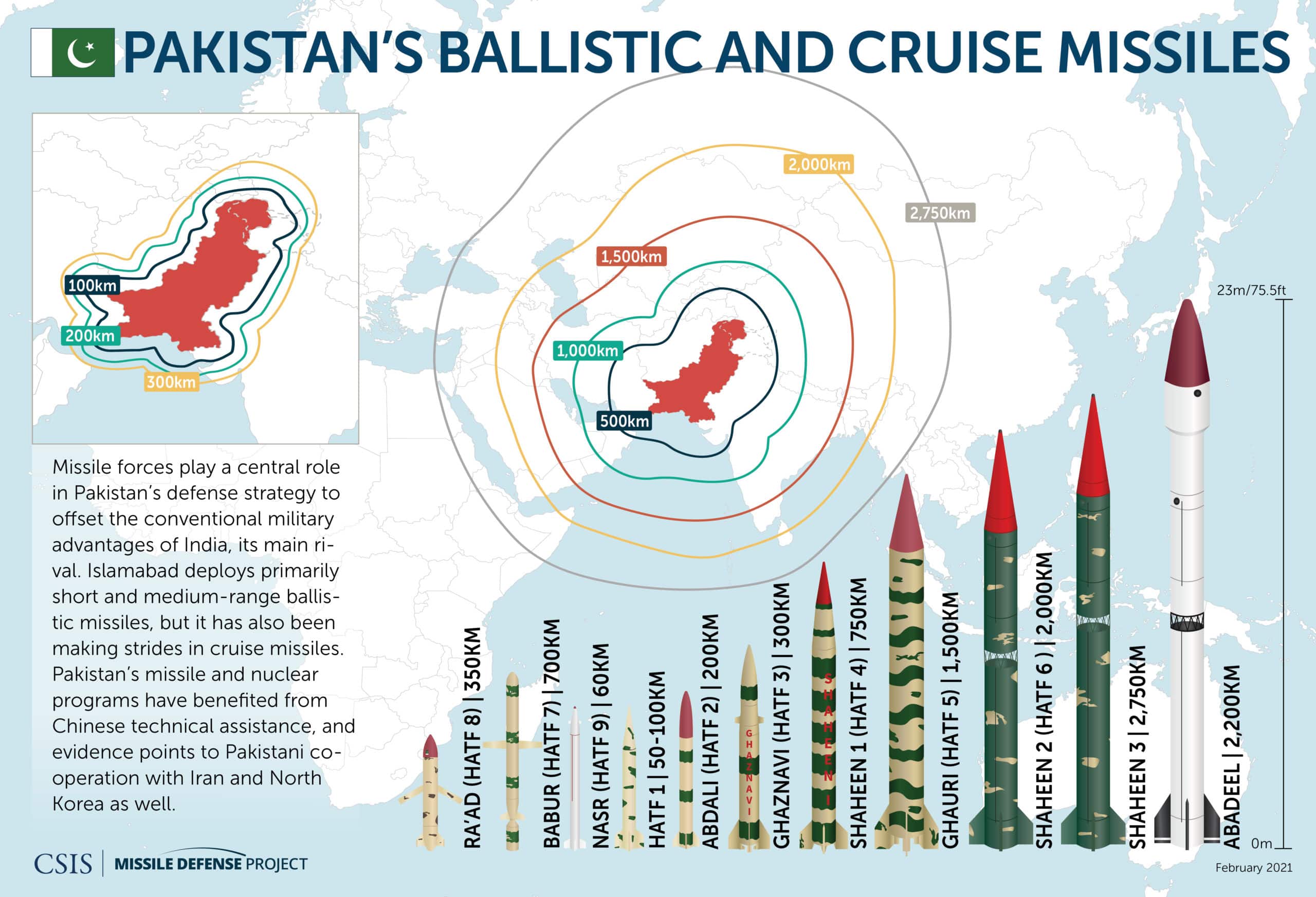
Pakistan’s missile programme has evolved from crude battlefield rockets into a multifaceted strategic force encompassing tactical nuclear weapons, medium-range ballistic deterrents and increasingly survivable second-strike cruise systems. Its next phase is likely to be defined by wider MIRV deployment, more credible sea-based nuclear deterrence and steadily improving precision-guided strike capabilities.
Strategic Shift
Yet the strategic context in which that evolution takes place is itself shifting. For much of its history, Pakistan’s missile doctrine has been framed almost exclusively by India; every major system in its inventory has been calibrated with the subcontinent in mind. That assumption may no longer hold indefinitely. As American influence in parts of Asia and the Middle East wanes, Islamabad’s planners may begin to contemplate a broader strategic horizon, one in which Pakistan is no longer concerned solely with deterring India, but with preserving autonomy in a more fluid and contested geopolitical order.
Such a transition would bring both new dangers and new opportunities. A weakening American capacity, or willingness, to police regional defence relationships could open space for deeper technological collaboration among states that have until now faced diplomatic or sanctions-related constraints. In that context, a notional axis linking Pakistan, Iran and Turkey presents intriguing possibilities.
Each brings complementary strengths. Pakistan has accumulated extensive experience in ballistic missile integration and warhead miniaturisation. Iran has demonstrated notable advances in propulsion, rocket motor scaling and long-range missile endurance. Turkey, by contrast, has built a sophisticated indigenous electronics and defence manufacturing sector, particularly in guidance, navigation and control systems, precisely the area in which both Pakistan and Iran remain comparatively dependent on foreign suppliers.
Were such cooperation ever to deepen beyond the political symbolism that currently defines much of it, the industrial logic would be difficult to ignore. Combined expertise in propulsion, airframes, guidance and payload engineering could, in theory, provide the foundation for far more ambitious strategic systems, including longer-range missiles approaching intercontinental capability.
That prospect remains speculative, and formidable obstacles endure; divergent national interests, sanctions regimes, export controls and the political sensitivity surrounding missile proliferation all militate against rapid progress. Nor is there yet clear evidence that Pakistan has abandoned its historically India-centric deterrence posture in favour of a genuinely global strategic outlook.
What is clear, however, is that Pakistan’s missile programme is no longer static. It is entering a phase in which regional deterrence may gradually give way to wider strategic ambition. If the last four decades were shaped by parity with India, the next may be shaped by Pakistan’s attempt to position itself within a changing Eurasian balance of power, where missiles are not merely weapons of deterrence, but instruments of geopolitical reach.