

|
Getting your Trinity Audio player ready...
|
Last Sunday 3W analyzed the US – Iran ceasefire negotiations in Islamabad, Pakistan, as well as US president Trump’s announcement following the failed meeting that the US would next implement a blockade of Iran – a tactic Trump has previously deployed against Venezuela and Cuba.
We said in our analysis that there are basically three pathways forward from here. One is hat Trump declares victory and walks away. The second is that negotiations continue behind the scenes, and eventually lead to an agreement that is acceptable to all parties. The third s a return to war, where 3W explained why we believe that is the most likely scenario at this stage.
Below we look at what has happened since:
According to Axios, differences over Iran’s nuclear program — with the US demanding Tehran does not enrich uranium and give up its existing stockpile — were the main sticking point that prevented a deal. The US demanded a 20 years moratorium on nuclear activity in the Iran, and the removal of Iran’s stockpile from the country. Iran said it would agree to a “monitored process of down-blending” the stockpile, and a 5 year moratorium on enrichment, writes The New York Times. Iran and foreign observers at the meeting were surprised by the US withdrawal from the talks, which they saw as sudden and unexpected, and giving the impression the US was not in Islamabad to actually negotiate. Vance came to deliver the US maximalist demands, and after Iran’s initial refusal, left without really negotiating. Vance himself confirmed this during his press conference where he blamed the failure of the talks on Iran not accepting US demands. Axios adds that during the meeting, Vance not only spoke on the phone with US president Trump, but also Israeli prime minister Netanyahu. According to Netanyahu, Vance assured him the US objective was ensuring no Iranian enrichment “in the coming years, and that could be in decades.”
3W notes that this information confirms two of 3W’s earlier assessment regarding the talks. First, the US did not go there to negotiate, but to buy time. This supports the thesis that the US is in fact preparing for another round of military attacks on Iran. Second, the US negotiating position is based on Israel’s wish list. This too supports the thesis that the US is preparing for another round of military attacks on Iran, because that is the Israeli objective. War is increasingly Israel’s go-to response to geopolitical challenges — not just the strategy but the norm, writes The New York Times. For Israel’s maximalist leaders, cease-fires are too often seen as getting in the way of efforts to finish the job. And even when Israel enters cease-fires, it continues to fire unilaterally — as with Gaza and Lebanon.
the US demanding Tehran does not enrich uranium and give up its existing stockpile — were the main sticking point that prevented a deal
In order to increase pressure on Iran, US president Trump on the weekend ordered a naval blockade of Iran – following a script he previous deployed regarding Venezuela and Cuba. US Central Command, which oversees military operations in the Middle East, on Monday said it would prevent merchant ships from traveling to or from Iranian ports, writes The New York Times. Central Command said the blockade would be “enforced impartially against vessels of all nations”. As to how the US navy would practically do this, NYT says the US will be monitoring traffic at Iranian ports. It could then dispatch destroyers to intercept vessels leaving the Strait, or send helicopters with soldiers to board the vessel. The Wall Street Journal adds that the US has 15 ships available for the operation. But, they are kept far away from the Iranian coastline due to fear of being targeted by Iranian missiles or drones. This makes the operation difficult to execute.
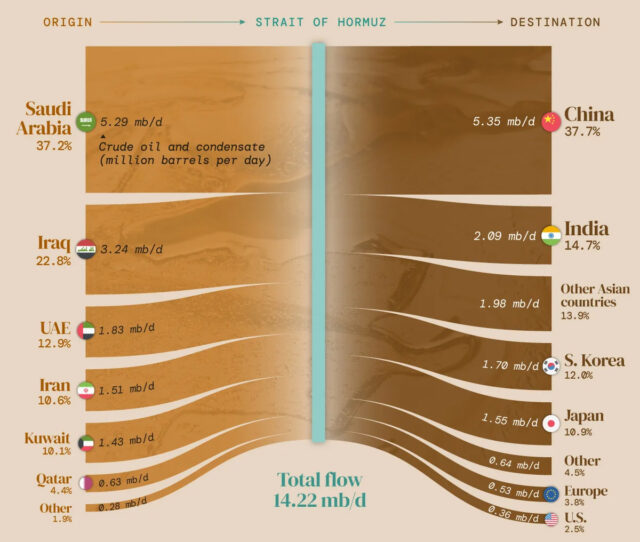
3W has serious doubts regarding this new US plan. Beyond the question of whether the US navy has the practical ability to deliver upon its task, considering the fact that Iran’s advanced missile technology that forces the American ships to stay well clear from the Iranian coast, in our view there are also second order implications that need to be taken into consideration.
Firstly, Iran should be expected to respond to the US blockade with a complete blockade of the Strait of Hormuz. This significantly worsens the negative implications of the US – Israel War on Iran for the global economy – the supply of critical inputs for the global economy will go down further, prices will go up more. So in its attempt to hurt Iran by damaging the Iranian economy through blocking its ability to export, the US – Israel Alliance is hurting the global economy more. This, it should be expected, will lead to pressure on the US to end their (stupid) idea as soon as possible. This is also the view of Gideon Rahman of the Financial Times, who writes that time is on Iran’s side.
Already, the UK and France have said they do not want to be part of it, calling instead for de-escalation to enable traffic through the Strait again, writes The National. The US’s NATO allies also said they would not get involved in the blockade, writes Reuters.
From the moment it started this war, US plans have failed, while the Iranian responses have been highly effective, leaving the US on the backfoot
Secondly, Saudi Arabia has been an even more outspoken opponent of the US naval blockade, pressing the US to drop its blockade and return to the negotiating table as soon as possible, writes The Wall Street Journal. Saudi fears Iran might retaliate by also closing the Bab al Mandeb. Saudi Arabia has been able to get its oil exports back up to their prewar level of around seven million barrels a day despite the blockage in the strategic strait by piping its crude across the desert to the Red Sea, WSJ writes. Those supplies would be at risk if the Red Sea’s exit route were closed as well.
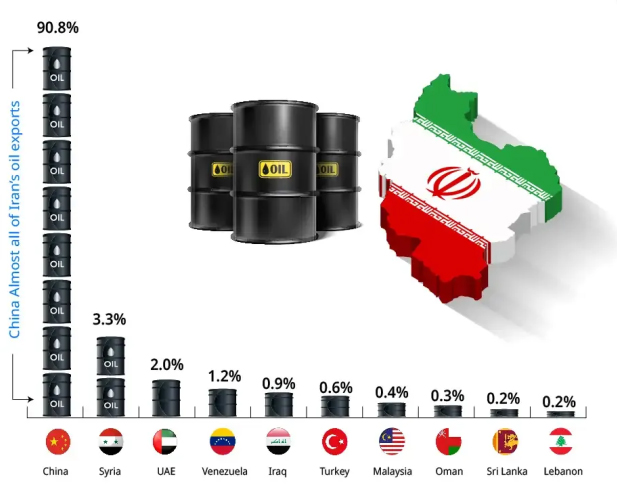
Thirdly, there is also the “customer perspective”. Most of Iran’s oil exports have been going to China on board Chinese vessels. Is the US really going to board and hijack Chinese vessels? Does the US really believe China would sit back and allow that to happen? Does China not have significant leverage over the US at present through its control over the rare earth minerals supply chain? In this regard it is interesting to note that on Tuesday, 3 Chinese owned ships moved through the US blockade into the Strait of Hormuz, writes Reuters. Officially to collect product from the UAE and Iraq, but all the vessels concerned have a long history of moving Iranian products around and are for that reason on a sanctions list of the US. In the 3W view, this is likely to be a Chinese move to call the US’s bluff…
For these reasons, the US naval blockade we at 3W expect will have the same level of success as the earlier elements of the plan. It will not lead to an Iranian surrender just as the “decapitation strikes” failed to; or the attacks on Iran’s military infrastructure; or the arming of the Kurds; or the destruction of Iran’s industrial base; or the “boots on the ground” to capture Iran enriched uranium; or the threats to “annihilate Iranian civilization” and returning the country of “savages” to the “stone ages”. From the moment it started this war, US plans have failed, while the Iranian responses have been highly effective, leaving the US on the backfoot with Iran having escalation dominance. The US naval blockade will just confirm this strategic assessment, we expect.
Based on this assessment, what next?
Back to our original scenarios, can Trump just walk away by declaring victory? As we explained above, every move he makes just makes the hole he finds himself in deeper. His ability to declare victory declines with every passing moment.
Can the US and Iran return to the negotiating table? Axios writes that Pakistani, Egyptian and Turkish mediators are trying to keep negotiations going. Trump wants to prevent Iran from using the Strait of Hormuz as leverage in the talks, it says. Pakistan was still passing messages between Tehran and Washington, writes Reuters. The problem 3W sees is that successfully negotiations require two sides willing to compromise. The US, on the instigation of Israel, has in Islamabad proven to be unwilling to compromise on anything. Axios adds that even today, according to US officials a deal can only be reached if Iran shows more flexibility and recognizes that the Islamabad proposal is the best it will get. Reuters writes that the US continues to demand Iran end all uranium enrichment, dismantle all major nuclear enrichment facilities, turn over its highly enriched uranium, accept a broader peace, agree a security framework that includes regional allies, end funding for regional proxies, and fully open Hormuz charging no tolls – that, 3W notes, are essentially the “Iranian surrender demands” that Netanyahu convinced Trump to adopt during December 2025, as we noted last Sunday.
That leaves military escalation as the still the most likely pathway forward. It is certainly what Israel will continue to push for, as 3W explained last Sunday. When we first discussed the Israeli stance on the ceasefire, at 3W we noted that Israel’s political elite was completely against it, with even the so-called “liberals” pushing Netanyahu to continue fighting. Today, we add that the Israeli public also wants continued war against Iran, writes Ynet. Nearly two-thirds of Israelis oppose the ceasefire with Iran, it says. 3W notes this means there are no constraints on Netanyahu. Therefore, as long as he dominates US policy making, the war will continue.
What this would achieve is likely to be only destruction. When Trump hinted that next he could bomb Iranian port facilities, Iran issued threats of its own, writes The Associated Press. “Security in the Persian Gulf and the Sea of Oman is either for everyone or for NO ONE”, it said in a statement. An Iranian military statement said: “NO PORT in the region will be safe.” In other word, 3W notes, the current trajectory serves only the interest of parties that would welcome destruction of both sides of the Persian-Arabian Gulf…
One comment
Abbas Mughal
14th April 2026 at 3:15 pm
it was really a good insight and i it seems like one of the most likely scenarios. but why are you overlooking the threat posed by regional countries, especially Pakistan, as there are reports that it has foot on ground in KSA. and any attack there (even if it is false flag attack) can trigger a new scenario. where the threat for Iran is on its long border not from the sea. in my view that’s the only scenario which can bring Iran back on table and accept humiliating terms of negotiation. i know it seems difficult and it will create big problems for Pakistan as well. but want to have your take on it.