

Iran has spent decades building a formidable missile arsenal. Ballistic and cruise systems form the backbone of its deterrent, providing Tehran with the ability to strike targets across the Middle East. Yet this strength sits alongside a striking weakness: years of sanctions and isolation have left the country without a modern, integrated air-defence network and with an air force that lags far behind its regional and international adversaries.
Recent operations by the United States and Israel have illustrated this imbalance with uncomfortable clarity for Tehran. The relative ease with which Western and Israeli aircraft were able to suppress Iranian air defences — particularly around the capital, Tehran — highlighted the limitations of the country’s defensive architecture.
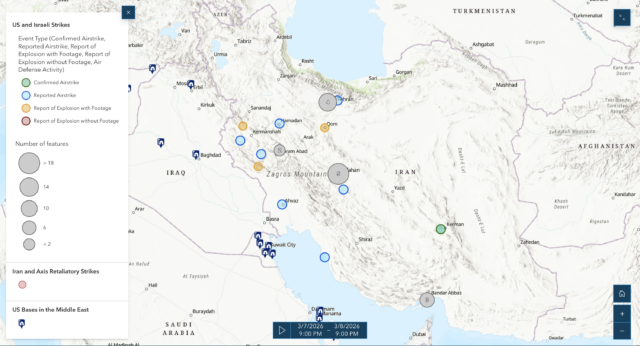
Much of Iran’s air-defence network relies on systems that are either outdated or domestically adapted from older designs. The most numerous is the Mersad, a medium-range system derived from the American MIM-23 Hawk first fielded in the 1970s. While modified and locally produced, it remains fundamentally rooted in Cold War technology.
Alongside the Mersad, Iran has deployed several indigenous systems, including the Ra’ad family, the 3rd Khordad and the Tabas. For longer-range interception the country has developed the Bavar-373, which Iranian officials claim approaches the capabilities of the Russian S-300. Short-range protection is provided by systems such as the Ya Zahr, a reverse-engineered version of the Chinese HQ-7, and the more recently unveiled Zoubin. Despite the proliferation of names and platforms, the overall network lacks the integration and sophistication seen in modern air-defence systems. Without a credible and technologically competitive air force capable of contesting the skies, these ground-based defences are vulnerable. Aircraft operating from outside Iranian airspace, including over Syria and Iraq, could launch stand-off munitions capable of degrading or neutralising such systems before they posed a serious threat.
Despite the proliferation of names and platforms, the overall network lacks the integration and sophistication seen in modern air-defence systems
If Iran’s air defences reveal weakness, its missile forces represent the opposite. Tehran possesses one of the largest and most diverse missile arsenals in the region. According to the Center for Strategic and International Studies, several systems in service have the range to reach Israel. These include the Sejjil and Ghadr, each capable of reaching around 2,000 kilometres; the Emad with a range of roughly 1,700 kilometres; the Shahab-3 at 1,300 kilometres; the Khorramshahr with a similar 2,000-kilometre reach; and the Hoveyzeh cruise missile with a range of around 1,350 kilometres.
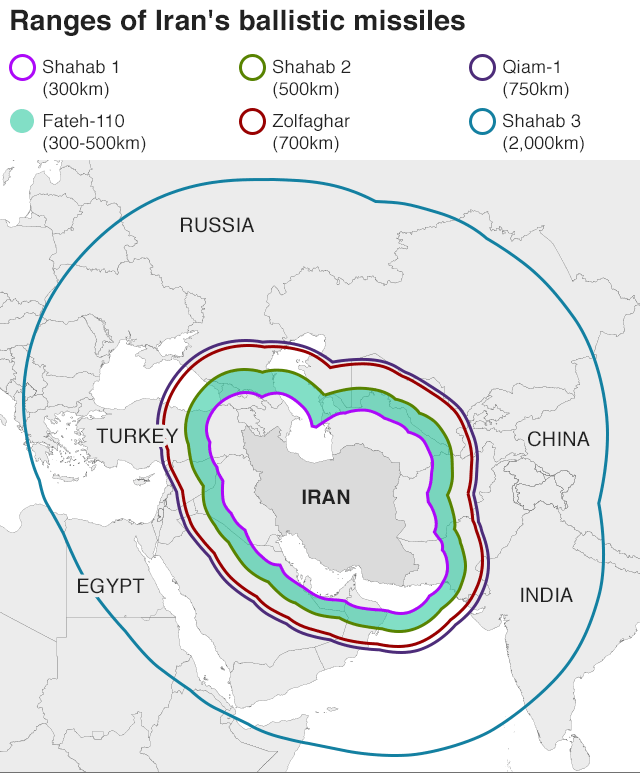
Much of this arsenal is stored in hardened underground facilities, the so-called “missile cities” that Iranian media frequently showcase. These installations offer protection from conventional attack but also create identifiable focal points for enemy targeting. Should air superiority be established by the United States or Israel, repeated strikes on launch infrastructure and tunnel complexes could gradually erode Iran’s ability to bring missiles to the surface and fire them. In such a scenario, the destruction of launchers or the collapse of tunnels could literally entomb weapons underground, steadily reducing Tehran’s offensive capacity.
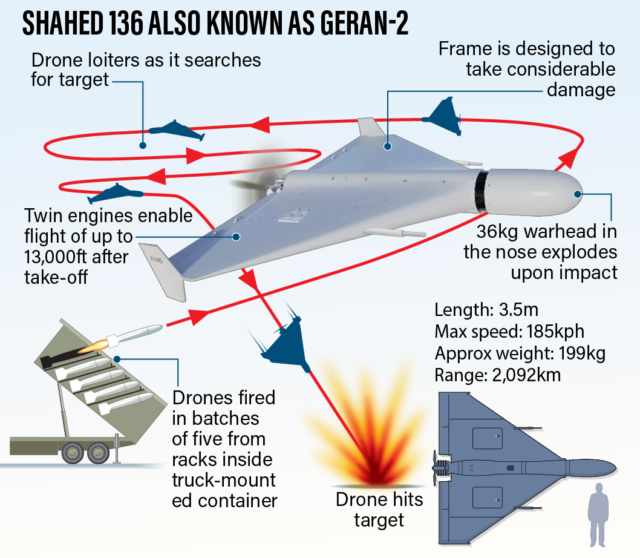 Iran’s unmanned aerial vehicles form another significant element of its arsenal. The country fields a wide variety of drones, ranging from reconnaissance platforms to loitering munitions such as the now infamous Shahed series. Individually these drones are relatively cheap and expendable, but their value lies in numbers. Swarms of low-cost drones can overwhelm sophisticated air-defence systems, forcing defenders to expend interceptors that may cost millions of dollars against targets worth only a fraction of that sum.
While air and missile power dominate discussions of modern warfare, the prospect of ground conflict remains central to winning wars. Washington’s reluctance to deploy large numbers of troops to Iran is not without merit. The country fields the largest armed forces in the Middle East, with more than one million active and reserve personnel. Only Turkey and Egypt maintain forces of comparable scale.
The Islamic Revolutionary Guard Corps in particular represents a capable and ideologically motivated component of Iran’s military. Any invasion would likely encounter fierce resistance and incur substantial casualties. Admittedly, much of Iran’s manpower is unevenly equipped and trained, and its effectiveness against technologically advanced forces would fall short of the headline numbers. Yet sheer size still matters. In the defence of national territory, numbers alone can impose severe costs on an attacker.
Iran’s strategic thinking reflects this reality. Recognising its disadvantage in high-end air power and integrated air defence, Tehran has embraced what it terms a doctrine of “passive defence”. This approach emphasises camouflage, concealment, dispersion of forces and extensive use of underground facilities. Large concentrations of troops or equipment are avoided wherever possible in order to reduce vulnerability to air strikes.
The broader picture that emerges is one of asymmetry. Iran has invested heavily in capabilities that can survive and retaliate, missiles, drones, dispersed forces and hardened infrastructure, while accepting weaknesses in areas such as modern air power and integrated air defence
Geography also works in Iran’s favour. The country’s mountainous terrain and vast strategic depth complicate any invading force’s logistics and manoeuvre. These factors increase the survivability of Iranian forces, allowing them to absorb initial blows while imposing attritional costs on an opponent.
For this reason, some policymakers in Washington and Jerusalem have floated the idea of relying on proxy ground forces — particularly Kurdish militias — to provide the “boots on the ground” that American or Israeli forces are reluctant to commit. Yet even among supporters of a more confrontational policy toward Tehran, the feasibility of such a strategy remains highly disputed.
Iran’s armed forces are in many ways designed specifically to counter this type of hybrid intervention. Unlike Saddam Hussein’s army in 2003 or the Taliban’s forces in the early stages of the Afghan war, Iranian units possess substantial quantities of modern ground-launched precision weapons. Anti-tank guided missiles, shoulder-launched surface-to-air missiles and other ground launched stand-off systems are widely distributed. If Iraq’s insurgency after the fall of Saddam possessed significant numbers of ATGM’s then a US occupation would have been costly to the point of impossible. Such weapons would make close air support more dangerous and complicate any attempt by lightly equipped proxy forces to advance under Western air cover.
The broader picture that emerges is one of asymmetry. Iran has invested heavily in capabilities that can survive and retaliate, missiles, drones, dispersed forces and hardened infrastructure, while accepting weaknesses in areas such as modern air power and integrated air defence.
In strategic terms, this leaves Tehran with limited options for sustained offensive operations against technologically superior adversaries. Its ability to strike back remains real, but diminishing. Missiles and drones are still a real threat to the US and Israelis, but a prolonged campaign would quickly expose structural weaknesses. Consequently, Iran’s military posture increasingly reflects a defensive logic: one designed less to win a conventional war outright than to endure, absorb punishment and impose economic, political and military costs till the US and its regional allies lose the appetite for escalation.
In Iran’s estimation it did not need to invest in an airforce or air defence as deterrence was provided by the presence of its proxies in close proximity to Israel. However, in its folly it forgot to consider that its presence in Syria and Lebanon were reversible and depended by enlargement on the strategic posture of the US.