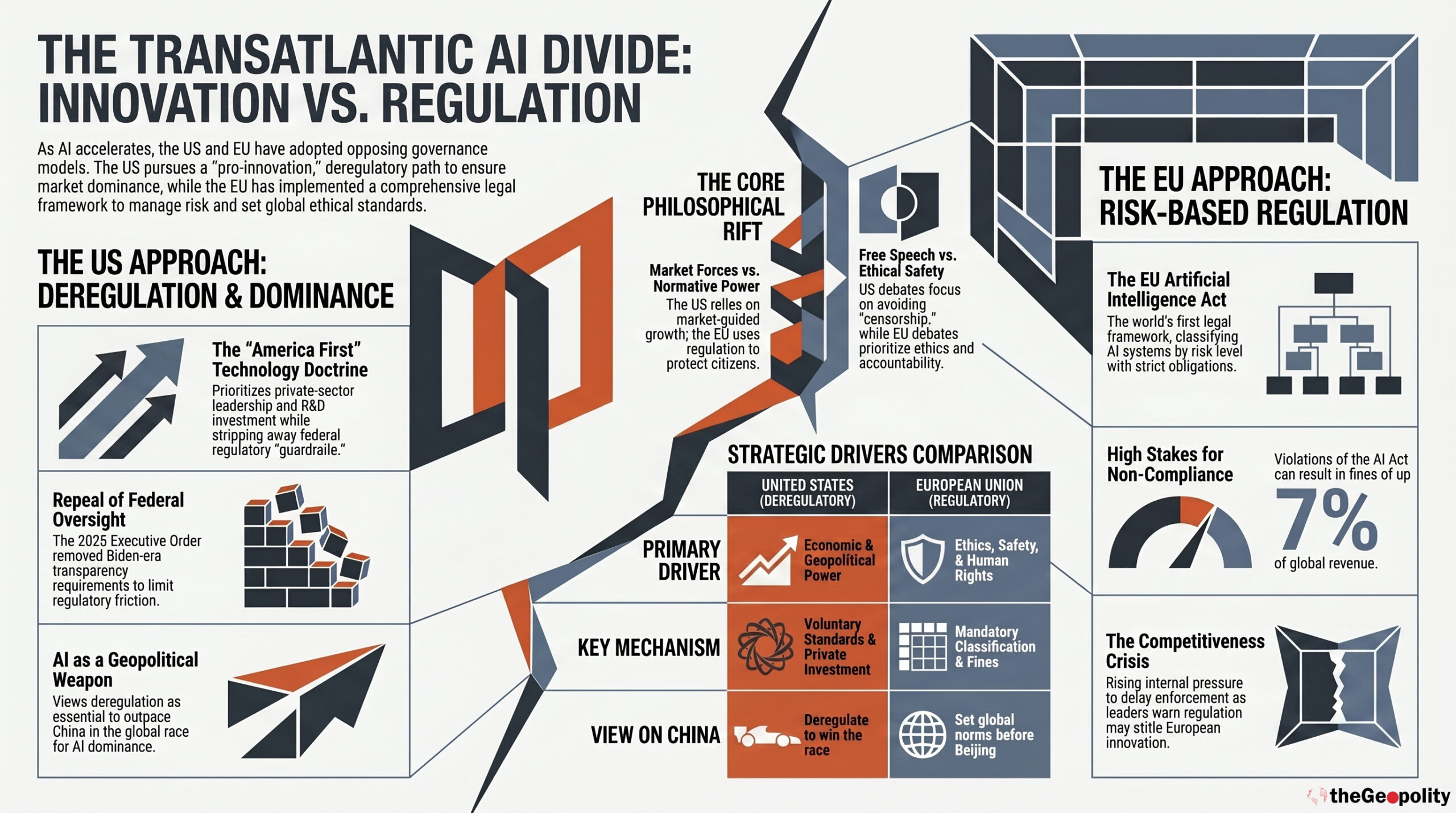


As artificial intelligence (AI) accelerates into every sector of the economy, the US and Europe are moving in starkly different directions on how to govern it. While Washington under the Trump administration is tearing down what few rules existed in favour of an aggressively pro-innovation agenda, Brussels continues to press ahead with a far-reaching regulatory framework aimed at managing risk and ensuring safety. The transatlantic divide over AI governance has become one of the defining policy cleavages of the West’s new leadership era, reflecting deeper philosophical and political differences about how power, innovation and responsibility should be distributed in the digital age.
America’s Deregulatory Turn
In January 2025, President Donald Trump signed his first major technology directive, the Executive Order on Removing Barriers to American Leadership in Artificial Intelligence. The document framed AI leadership as essential to human flourishing, economic competitiveness, and national security, while promising to strip away ideological bias and social agendas in AI systems — a clear reference to Republican complaints about content moderation and liberal guardrails embedded in chatbots and online platforms.
The order repealed former President Biden’s 2023 AI executive order, which had largely relied on voluntary commitments for transparency and testing rather than hard rules. While Biden’s framework had already been light-touch, Trump cast it as an overreach, accusing it of stifling innovation and censoring conservative voices. His new order signalled an even looser approach: minimal federal intervention, heavy emphasis on private-sector leadership, and a commitment to double down on R&D investment to ensure US dominance in AI.
At the February 2025 AI Action Summit in Paris, Vice President J.D. Vance made the administration’s stance explicit, urging allies to prioritize innovation over regulation. Tech executives echoed the sentiment: Google CEO Sundar Pichai warned that the biggest risk could be missing out. Within weeks, several companies updated internal guidelines to align with the administration’s position — most notably OpenAI, which revised its Model Spec to embrace intellectual freedom in outputs, a move widely interpreted as easing content restrictions.
Trump’s approach is consistent with the broader America First technology doctrine: promote domestic AI champions, limit regulatory friction, and treat safety frameworks as optional. While few new rules are being proposed, the administration is considering enforcement action through agencies like the Federal Trade Commission to challenge what it sees as politically motivated content moderation. State-level activity continues, with California and Colorado introducing limited AI bills, but the federal government has made clear it will not impose new mandates on developers. Instead, future policy will focus on large-scale AI infrastructure, export controls on China, and incentives for private investment rather than public safety standards.
Trump’s approach is consistent with the broader America First technology doctrine
Europe’s Regulatory Experiment
Across the Atlantic, the European Union is attempting something very different. The EU’s Artificial Intelligence Act, which entered into force in 2024, represents the world’s first comprehensive legal framework for AI. Building on the Digital Services Act and General Data Protection Regulation (GDPR), it seeks to classify AI systems by risk, from unacceptable (such as social scoring or mass surveillance) to minimal, and impose obligations accordingly. Developers of high-risk or systemic models face extensive documentation, testing, and cybersecurity requirements, with fines of up to 7% of global revenue for violations.
The AI Act’s ambition is clear: to set the global standard for trustworthy AI. But it comes at a time when Europe’s industrial competitiveness is under growing strain. Former European Central Bank President Mario Draghi’s 2024 Report on the Future of European Competitiveness warned that excessive regulation could cripple innovation. His findings, echoed by leaders in France, Germany, and Italy, have sparked calls to streamline or delay aspects of the AI Act to prevent Europe from falling further behind the United States and China.
Even European Commission President Ursula von der Leyen’s centre-right European People’s Party has begun to question Brussels’ regulatory zeal. In January 2025, it called for pauses on several major frameworks, arguing they were excessive and burdensome for small and medium-sized enterprises. France’s Emmanuel Macron has been particularly vocal, pushing for exemptions for foundation models like those developed by French startup Mistral AI and urging a more flexible, innovation-friendly environment.
Despite internal dissent, the European Commission is moving forward with implementation. The first bans — covering unacceptable risk AI — took effect in early 2025, with requirements for high-risk systems due in 2026 and full compliance by 2027. The Commission’s AI Code of Practice, released in mid-2025, offers voluntary guidance ahead of enforcement. Yet critics argue it merely adds confusion: the Computer and Communications Industry Association, representing firms like Amazon and Meta, claims it imposes disproportionate burdens and may undermine competitiveness.
Adding to the pressure, more than 45 major European corporations, including Airbus, ASML and Mistral, have jointly called for a two-year moratorium on enforcement. They warn that compliance costs and uncertainty could drive AI companies to treat Europe as a secondary market — a place to test regulations, not innovation. The US government has also intervened, urging Brussels to delay implementation and arguing that the Code of Practice discriminates against American firms. So far, the European Commission has refused to yield, but the confrontation highlights a widening rift in transatlantic digital governance.
Diverging Philosophies, Converging Challenges
At the heart of this divergence are two competing visions of technological modernity. The US views AI as a frontier of economic and geopolitical power — something to be unleashed, guided by market forces, and lightly coordinated through voluntary standards. The European Union, shaped by its experience regulating data privacy, seeks to tame the technology through oversight and classification before its risks spiral out of control.
These differing instincts are rooted in deeper structural and political realities.
- Economic structure: The US benefits from a concentrated ecosystem of powerful AI firms — OpenAI, Anthropic, Google, Meta — with vast capital and data resources. Regulation is seen as a potential brake on national advantage. The EU, lacking similar tech giants, leans on regulation to exert normative power and protect citizens.
- Political culture: US debates frame AI around free speech, censorship, and innovation; European debates focus on ethics, safety, and accountability.
- Strategic competition: Both sides cite China as the ultimate benchmark. For Washington, deregulation is a weapon in the race for dominance; for Brussels, rules are a way to set global norms before Beijing does.
Ironically, despite their rhetorical contrast, both jurisdictions are now adjusting. The US is quietly retaining several Biden-era initiatives, such as federal AI research funding and infrastructure acceleration. The EU, under mounting internal and external pressure, is exploring ways to simplify compliance and delay key provisions of the AI Act. In both cases, pragmatism is overtaking ideology.
At the heart of this divergence are two competing visions of technological modernity. The US views AI as a frontier of economic and geopolitical power… The European Union, shaped by its experience regulating data privacy, seeks to tame the technology through oversight and classification before its risks spiral out of control
The Road Ahead: Fragmentation or Convergence?
The next few years will determine whether transatlantic AI regulation converges around shared standards or diverges into rival regimes. Several forces will shape the outcome.
First, business pressure is mounting on both sides. In the US, even pro-Trump executives recognise the need for some guardrails to manage liability and public trust. In Europe, corporate lobbying for regulatory relief is intensifying, with major firms warning they may relocate development to the US or UK if compliance costs remain excessive.
Second, global competition will keep both sides cautious. The rapid advance of Chinese AI firms, particularly in applied sectors like robotics, surveillance, and chip design, has injected urgency into Western strategies. Washington’s AI action plan, expected later in 2025, is likely to focus less on regulation and more on export controls, semiconductor dominance, and supply-chain resilience. Brussels, meanwhile, has announced a €20 billion investment in AI data centres to boost its industrial base.
Third, political transitions within Europe may soften the bloc’s regulatory stance. As the European Parliament and Commission recalibrate their economic agenda for the late 2020s, Draghi’s competitiveness report will continue to frame the debate. A more flexible, tiered approach, retaining core safety rules while relaxing burdens for startups, is already under discussion.
Yet uncertainty will persist. Companies operating in Europe face overlapping obligations under the AI Act, GDPR, and national laws, while U.S. firms risk political scrutiny at home over AI bias and misinformation. The risk is a patchwork of incompatible standards, where developers must tailor systems to each jurisdiction — fragmenting the Western AI ecosystem just as China pushes for unified leadership in its own market.
Toward a Transatlantic Compromise?
Despite tensions, a middle path is possible. Both sides share interests in preventing catastrophic misuse, maintaining data security, and ensuring their AI industries outpace authoritarian competitors. Coordination mechanisms, such as joint research initiatives, reciprocal safety standards, and trusted data flows, could bridge the gap. The 2025 EU-U.S. digital trade framework, though still vague, provides an early platform for such dialogue.
Ultimately, the fate of Western AI governance may hinge on trust — between governments and industry, and across the Atlantic itself. If the US continues to deregulate while Europe enforces without flexibility, fragmentation will deepen, giving China and other powers space to set their own norms. If, however, Washington and Brussels can align innovation incentives with minimal but credible oversight, they could together define the global standard for responsible AI.
Conclusion: Regulation in an Age of Acceleration
AI’s trajectory is moving faster than any previous technological revolution, and both sides of the Atlantic are struggling to keep pace. The US is betting that freedom to innovate will secure leadership; the EU is betting that legitimacy and safety will secure longevity. Neither approach alone will suffice. As AI evolves from experimental tools to critical infrastructure, regulation, or the lack of it, will shape not just markets but the geopolitical balance of power. The West’s challenge is to prove that openness and oversight can coexist — before others decide the rules.