

When Russian forces crossed into Ukraine on the 24th February 2022, many expected a short war. Some predicted Kyiv would fall in days. Others believed Russia’s economy would collapse within months. Four years later, neither forecast has materialised. Instead, Europe is witnessing the return of industrial war — trench lines, artillery duels, drone swarms, mobilisation drives, and great-power negotiations over territory. The Russia–Ukraine war has not merely reshaped Eastern Europe. It has shattered assumptions about modern warfare, Western power, sanctions, deterrence, and alliance politics.
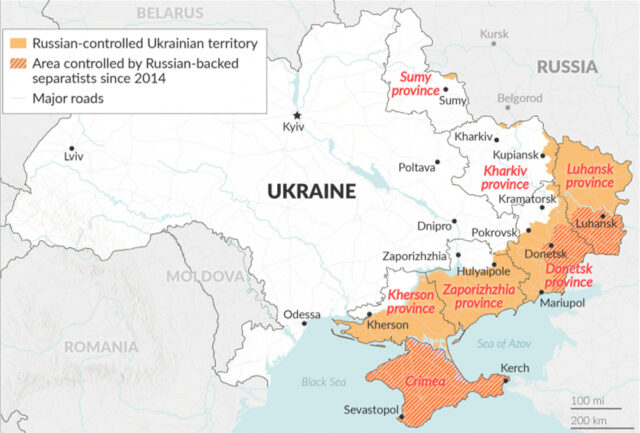
War of Attrition – The Ukraine war has turned like most wars into one of attrition. Both sides have now settled into positions where they are trying to exhaust the other as rapid manoeuvre and dramatic breakthroughs have failed. This is why for the last three years the front line which stretches 800 miles from the North-East of Ukraine to Crimea in the south has moved only incrementally. Gains are now measured in villages. Each kilometre costs enormous manpower and equipment.
The war is now about industrial depth, mobilisation of soldiers and logistics and the ability to resource this. Russia has a large population, large industry and larger economy that can go on for years exhausting the Ukrainians. Ukraine has a population 4 times smaller than Russia and an economy 12 times smaller than Russia. Ukraine’s strategy now is to survive and remain resilient and for this it is completely dependent upon western arms, money and loans. Ukraine now relies entirely on western sentiment, support and public opinion.
Industrial Capacity Win Wars – The war in Ukraine has demolished the illusion that precision weapons alone determine outcomes. For long the US has promoted the idea that fancy, advanced military platforms can cripple large armies. But over the last 4 years, despite Russia’s dash to Kyiv, its boring things like artillery, armored vehicles and manoeuvre warfare which have proven decisive. In Ukraine, artillery shells, refurbished armour, logistics chains and steady production have proven decisive.
Despite proclamations of decisive battles and decisive weapons systems in a prolonged conflict, industrial capacity, logistics and mobilisation are the key factors. Production and refurbishment of weapons have proven decisive in this war. Europe has now discovered that post–Cold War cuts and dwindling stockpiles was a mistake and Russia has proven that mass production still matters.
Stalin was right when he said: “quantity has quality all on its own” and “wars are not won on the battlefield but in the factories.”
Despite proclamations of decisive battles and decisive weapons systems in a prolonged conflict, industrial capacity, logistics and mobilisation are the key factors
Manpower and Demographics Matter More Than Ever – Western warfare has for long promoted decisive battles with cutting edge technologies and modern platforms. Wars have for long been reduced to a single battle or weapon system that would prove to be decisive. But the Afghan and Iraq wars and now the Ukraine war has proven again that it’s the more mundane things like manpower and mobilisation that matter.
The Ukraine war is a territorial war. Russia is attempting to create a buffer region with its invasion and maintaining an occupation. Ukraine on the other hand is trying to win back its territory and defeat the Russians. In such a war, which is most wars, being able to resource this, mobilise troops, rotate them and deploy them will be the deciding factor.
As Ukraine has a smaller population and as the war continues, this will strain its ability to mobilise, whilst Russia has a large population and so has a lower tolerance for troop losses. This means it can stay in the war longer.
This war is about casualty replacement, rotation cycles and officer regeneration. Ukraine is having to reduce the age of conscription as it struggles to replace its soldiers and Russia for the moment has not carried out a full scale mobilisation. This is another area where Russia has the advantage over Ukraine.
Drones Have Come of Age – The war in Ukraine has become the first large-scale conflict in which drones are not supporting systems — but central actors. What began in 2022 as reconnaissance augmentation has evolved into a drone-dominated battlefield ecosystem. Today, from tactical trenches to deep strategic strikes, unmanned systems shape tempo, lethality, and operational design. Cheap commercial drones, modified with explosives, now destroy tanks worth millions with loitering munitions blurring the line between drone and missile.
Cheap commercial drones, modified with explosives, now destroy tanks worth millions with loitering munitions blurring the line between drone and missile
Ukraine adopted a decentralised, innovation-driven model as it is facing an enemy with more resources and larger forces. Ukraine has been making heavy use of FPV drones to attrit infantry and armor; it has integrated drones with artillery for rapid kill chains. Ukraine has also conducted missions deep into Russia targeting oil refineries, depots, and airfields. Ukraine has been most successful with its maritime drones that degraded Russia’s Black Sea Fleet.
Under Volodymyr Zelenskyy, Kyiv has emphasized domestic drone production to reduce dependency on Western munitions. The aim being to offset Russia’s artillery and manpower advantage through asymmetric precision and depth strikes.
Drones have stabilised defensive lines, raised the cost of maneuver, its increased daily attritional losses and reduced survivability of heavy platforms. But they have not delivered decisive breakthroughs. Drones are not winning the war on their own but they are shaping how the war is fought.
Russia Should Have Lost – But Adapted – When Russia launched its invasion of Ukraine back in 2022, it believed it had overwhelming power to conquer Ukraine and believed the Ukrainians wouldn’t put up much resistance and Kyiv would fall within a week. So confident were the Russians, soldiers who entered Ukraine from Belarus to conquer the capital Kyiv, they took their parade uniforms with them. As a result, Putin didn’t call for a full mobilisation and believed a force of 100,000+ troops would be sufficient to pacify the country.
But the subsequent dash to Kyiv fell apart, and it became clear to the Kremlin that the forces it had deployed could not accomplish the objectives set for them. The blitzkrieg tactics that were meant to give Russia a rapid victory with the capitulation of Ukraine was a failure of epic proportions. Russia should have lost the war, but Russia’s leaders adapted. They ordered the withdrawal of over 40,000 Russian troops, and did not continue with the pointless and failed front and effectively abandoned the whole front.
Russia adapted and moved the troops to buttress other fronts, rather than continue fighting. This adaptation is what has now put Russia on top in the war. The glaring error committed by Russia’s leaders was because they prosecuted the war on many assumptions. All armies will have assumptions about their enemy when they go to war. Russia did not expect to fight a high-intensity battle in Ukraine and bet on a quick collapse of the Ukrainian state and military. Russian assumptions went further and included Kiev falling in a matter of days. All of these assumptions led Russia to be overconfident and deploy forces based on the best-case scenario rather than the worst case scenario. This proved to be fatal. Today, Ukraine nor the West have not been able to capitalise on this.
Empty Western Promises – When Russia invaded Ukraine back in 2022 western leaders fell over themselves promising they would back Ukraine “however long it takes” and “whatever it takes.” Western governments ran campaigns to get their public on side and Ukrainian flags were hoisted on public buildings. But as the war turned into one of attrition and not the quick, swift victory the west were advocating, their promises began to wane.
When Ukraine needed long range missiles, fighter jets, tanks and other weapons systems, on each occasion debate would ensue that would delay delivery. Eventually whatever was provided was never in sufficient quantities to make a difference on the battlefield.
What should now be clear to everyone is European and American interests are not the same as Ukrainian interests. Whilst Ukraine is in a battle for its survival, the US and Europe are pursuing different strategic goals, which has made Ukraine the battleground between them and Russia.
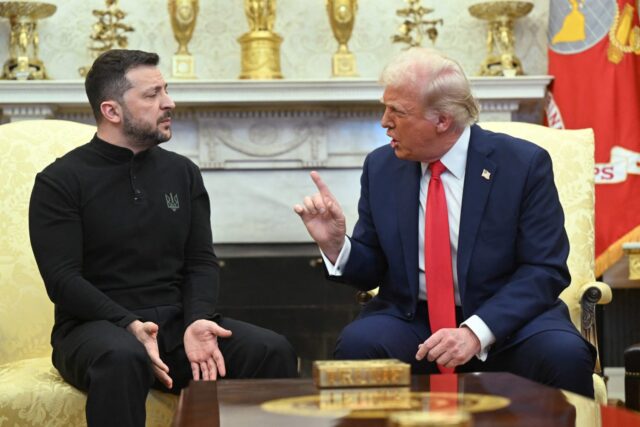
The US has been playing Russian roulette with Ukraine. The US has now done a complete u-turn on Ukraine, blaming the country for starting the war. President Trump is now forcing Ukraine to agree to a deal that includes giving up territory. Ukraine is now joining a growing list of nations that believed in US security guarantees only to be dumped when the US pursued other goals. The Kurds in Syria have learnt this the hard way and Qatar also learnt this the hard way when Israel attacked it in September 2025, despite US security guarantees.
Sanctions Hurt, But Don’t Break Great Powers – When Russia invaded Ukraine back in 2022 the west moved to sanction Russia that saw her expelled from global institutions, her membership of global competitions cancelled, all making Russia, officially the most sanctioned nation in history.
What needs to be kept in mind is whilst the West drastically increased sanctions on Russia, these were not the first sanctions against her. Sanctions against Russia began after its initial annexation of Crimea back in 2014. Ever since then Putin has been building up Russia’s economic defences so that it would be able to resist whatever measures the West imposed – dubbed the Fortress Russia Strategy. Since 2014, Putin has aspired for Russian economic self-sufficiency and has attempted to ensure that the West can never exert economic control over his country. The Fortress Russia Strategy necessitated that Russia diversify its economy away from oil and gas and lessen dependence on Western technology and trade.
This is why Russia was able to absorb the unprecedented sanctions and that’s why its economy did not collapse. Instead Russia rerouted trade to Asia, energy flows adapted and China came to replace Europe and its financial system localised. The fact that China, India and Turkey did not join the western sanctions regime along with the global south the sanctions imposed friction and long-term structural costs — but they did not produce political implosion.
What Russia has shown is sanctions are attritional tools, not regime-change instruments.
Nuclear Weapons Matter – Ukraine has learnt the hard way what denuclearisation means. Ukraine in early 1992 was the third biggest nuclear power as it possessed a third of the Soviet Union’s nuclear arsenal. Ukraine agreed to give up its nuclear arsenal and from 1996 and 2001 it either destroyed its arsenal or transferred nuclear material to Russia. Ukraine’s decision to give up nuclear weapons was after extensive deliberations with the US and Russia, and hefty security assurances by the three original Non-proliferation Treaty (NPT) powers — the US, Russia, and UK — and by France and China, as well. Now, with 20% of Ukraine occupied by Russia, Ukrainians have now realised this was a big mistake.
Moammar Gaddafi of Libya and Bashar al-Assad of Syria have learnt the hard way what can happen if you give up your WMD programmes and Ukraine has joined this list of nations that gave up their WMD programmes only to be invaded. In a strange twist of fate, the reason NATO refused to implement no fly zones or physically intervene is the fact that Russia possesses nuclear weapons, proving in the end that possessing nuclear weapons does matter.
In a strange twist of fate, the reason NATO refused to implement no fly zones or physically intervene is the fact that Russia possesses nuclear weapons, proving in the end that possessing nuclear weapons does matter
The West Is Not Monolithic – The show of unity by the West when Russia invaded Ukraine is now a distant memory. The US said it would support Ukraine for as long as it takes and Europe promised the world even though it knew it likely would be unable to deliver.
Now the US is saying they are out, Europe is being accused of not delivering and becoming a drain on US resources. The US is now telling Ukraine if they want to remain in the war they would need to sek out European support as the US was now calling it a day.
All the talk of the western bloc defending western civilization and Russian expansion, was just that, talk. The US continues to accuse Europe of being freeloaders who expect the US to fund their defence industries and armies, whilst they continue to shrink their militaries.
The west is now a divided front with the US now advocating Russia’s arguments on the war and its propaganda. It’s Ukraine’s fault for causing the war and Europe’s fault for trading in energy with Russia. The US in the same war has held diametrically opposed positions.
Wars End at the Table — But Not on Equal Terms – All wars either end with talks and talks are usually organised to reach such a position. There are 3 separate tracks of talks taking place with the Ukrainian demands playing little part.
When Trump took office in 2025 he began direct talks with Russia with his key advisors meeting their opposites from Russia and then with Trump meeting Putin in Alaska. What has come out of these meetings is the US has accepted Russian demands and began talking about other global strategic issues from the Arctic, Siberian energy and technology.
The talks between the US and Ukraine usually involved Ukraine demanding weapons and money, but they have now turned into Ukraine being told to end the war by accepting Russia’s position and giving up territory. The war is now being blamed on Ukraine and the end of the war is in the hands of Ukraine by giving up 20% of its country to Russia.
The third set of talks are the trilateral talks between Russia and Ukraine overseen by the US. These talks have been over tactical issues from prisoner exchanges, wheat corridors and ceasefires. They have not included strategic issues.
Ukraine’s position remains that it wants security guarantees from the west, which include some form of NATO and EU membership. Ukraine would prefer a western military presence and nuclear weapons placed in the country. The Russian position remains that there should be no western military presence in Ukraine and no NATO and EU membership. The Russian position also includes Ukraine giving up the Donbas and southern Ukraine oblasts, which Russia believes it has now annexed.
None of the talks prioritise the Ukrainian position.