

The decision by the Organization of the Petroleum Exporting Countries to hold together the global oil market has long rested on a simple premise: that its core members, particularly Saudi Arabia and United Arab Emirates, shared broadly aligned geopolitical and economic objectives. That assumption no longer holds. The UAE’s move to distance itself from OPEC constraints is not simply an energy story—it is a geopolitical signal that the Gulf’s internal balance of power is shifting, and with it, the foundations of global energy coordination.
At its core, the UAE’s decision reflects a growing divergence from Saudi Arabia. For decades, OPEC functioned as a mechanism that effectively tied Abu Dhabi’s oil policy to Riyadh’s strategic priorities. Saudi Arabia, as the cartel’s dominant player, has traditionally set the pace—restricting supply to maintain prices and leveraging oil as a geopolitical tool. The UAE, despite its own significant reserves and capacity, largely followed suit. But today, the two states are no longer aligned in either their outlook or their economic ambitions.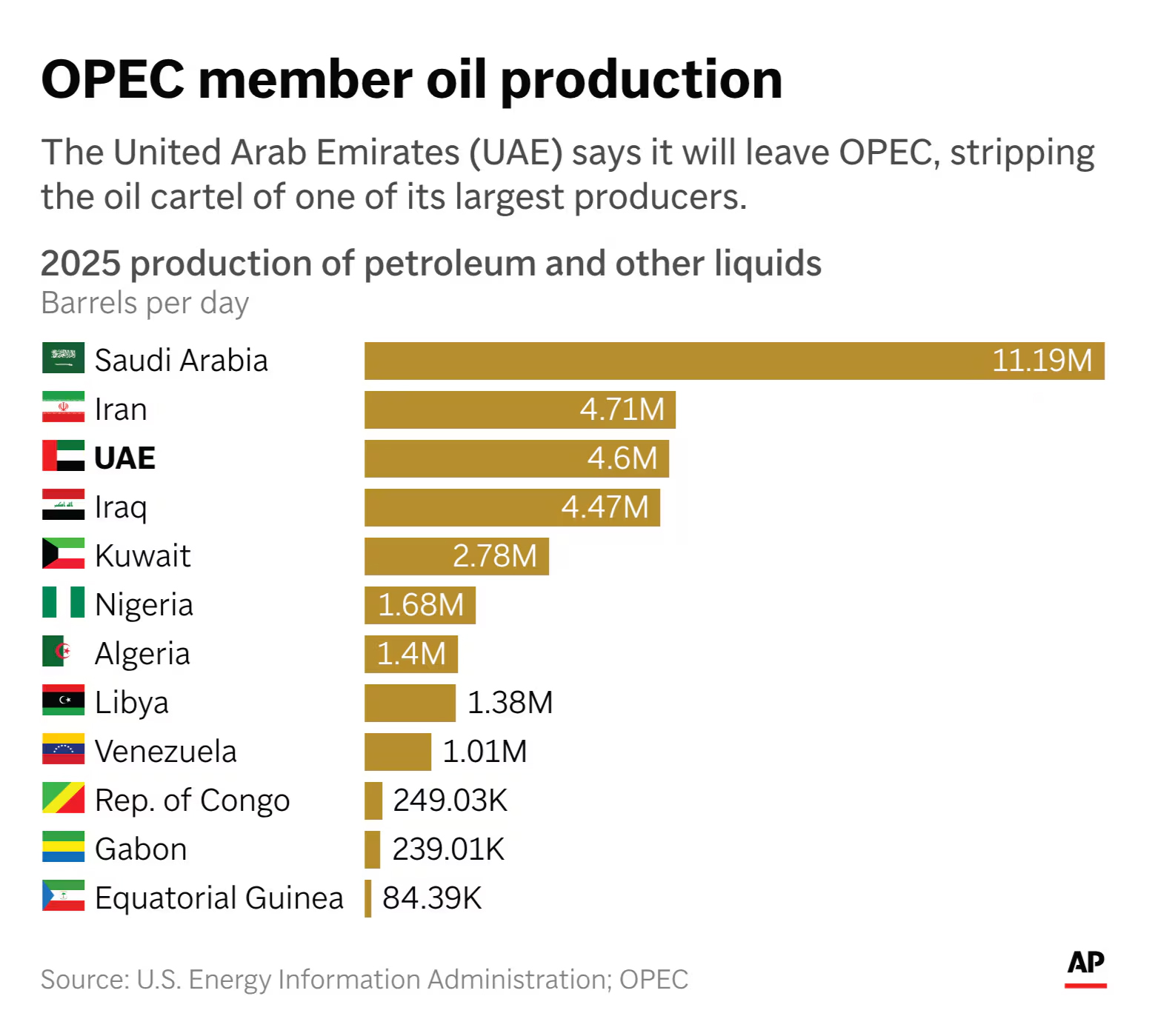
Saudi Arabia continues to view oil as a long-term pillar of global demand and geopolitical influence. Its strategy is built around maintaining price stability and extending the relevance of hydrocarbons well into the future. The UAE, by contrast, appears to be operating on a different timeline. It is increasingly concerned about the long-term trajectory of oil demand in a world of energy transition, technological disruption, and shifting consumption patterns. For Abu Dhabi, the priority is not simply preserving prices—it is monetising reserves while demand still exists, even if that means breaking from coordinated production limits.
At its core, the UAE’s decision reflects a growing divergence from Saudi Arabia
This divergence is compounded by broader geopolitical differences. In recent years, the UAE has pursued been at odds with Riyadh on a range of political issues. It has moved quickly to normalise relations with Israel through the Abraham Accords, positioned itself as a regional hub for technology, finance, and security cooperation. Saudi Arabia has ended up on the opposite on a number of political issues to the UAE.
In Yemen, the UAE intervened and focused on strategic ports and influence networks, while Saudi Arabia remains deeply entangled in the conflict’s security and political dimensions. In Sudan, the two have backed different actors, reflecting different priorities. Even on Iran, their approaches diverge. Saudi Arabia has leaned toward working behind the scenes, whilst publicly calling for de-escalation. While the UAE has been firmly on the side of Israel and the US.
These differences are not merely diplomatic—they are structural. The UAE is positioning itself as a global economic hub, competing directly with Saudi Arabia’s ambitions to transform Riyadh into the region’s primary business and financial centre. Dubai’s long-standing role as a commercial gateway is now being challenged by Saudi efforts to attract multinational headquarters and investment. At the same time, both states are investing heavily in emerging sectors such as artificial intelligence, logistics, and advanced manufacturing. What was once a complementary relationship is becoming increasingly competitive.
Energy policy sits at the centre of this rivalry. For Saudi Arabia, controlling supply through OPEC remains a key instrument of both economic management and geopolitical influence. For the UAE, those same constraints are beginning to look like a limitation. By stepping away, Abu Dhabi is signalling that it no longer sees its interests as fully aligned with the cartel’s collective outlook.
What we are witnessing is the gradual unravelling of a system that has defined global energy politics for decades
External dynamics are accelerating this shift. The UAE’s closer alignment with the United States is particularly significant. Washington has taken exception on occasions with OPEC, seeing coordinated production cuts as a distortion of global markets and a challenge to American energy interests. The rise of US shale production has already weakened OPEC’s dominance, and the UAE’s move further fragments the group’s cohesion. From an American perspective, this represents a strategic opportunity: a less coordinated oil market benefits US producers and reduces the geopolitical leverage of any single bloc.
There are also clear signs of deepening security ties between the UAE and the United States, as well as Israel. The deployment of advanced defence systems, including Israeli missile defence capabilities, underscores a growing alignment that extends beyond economics into security. In this context, the UAE’s energy policy shift brings it more in line with the US.
The timing of the move is also telling. It comes as the UAE has sought closer financial integration with the United States, including discussions around mechanisms such as dollar liquidity support. While not explicitly linked, the convergence of these developments suggests a degree of coordination. The UAE is not simply acting unilaterally—it is repositioning itself within a changing global order.
For OPEC, the implications are profound. The cartel has already been under strain from internal disagreements and external competition. The departure—or even partial disengagement—of a key member like the UAE weakens its ability to manage supply effectively. While there are indications that core members, including cooperation with Russia through the OPEC+ framework, will attempt to maintain unity, the underlying pressures are intensifying. The more individual states pursue independent strategies, the harder it becomes to sustain coordinated action.
This fragmentation has direct consequences for the oil market. Without tight coordination, production decisions become more competitive and less predictable. The likely result is increased volatility and, potentially, downward pressure on prices as producers prioritise market share over collective discipline. For countries like Russia, which rely heavily on stable energy revenues, this introduces a new layer of uncertainty.
Yet the broader significance extends beyond oil. What we are witnessing is the gradual unravelling of a system that has defined global energy politics for decades. OPEC was never just an economic organisation—it was a geopolitical instrument that allowed a group of states to exert collective influence over one of the world’s most critical resources. Its weakening signals a shift toward a more fragmented, competitive, and multipolar energy landscape.
The UAE’s break from OPEC is not an isolated event—it is an opening signal. It marks the beginning of a new phase in Middle Eastern geopolitics, one defined less by unity and more by competition, less by coordination and more by strategic divergence. The oil market may be the immediate arena, but the implications will be felt far beyond it.
The question now is not whether OPEC can survive in its current form, but whether the era of coordinated energy power is coming to an end.