

People are essential for a society to exist and whilst societies in different forms have always existed the nation state, today’s most dominant model of organising society has only been around for a fraction of the time humans have existed. But today there are a number of nations whose population decline has reached the point that there are question marks if the nations will continue to exist.
The causes, factors and similarities are surprising. Of the 10 nations likely to disappear all of them are the world’s largest economies, they have all industrialised and urbanised and one would think having developed they would not have such social issues.
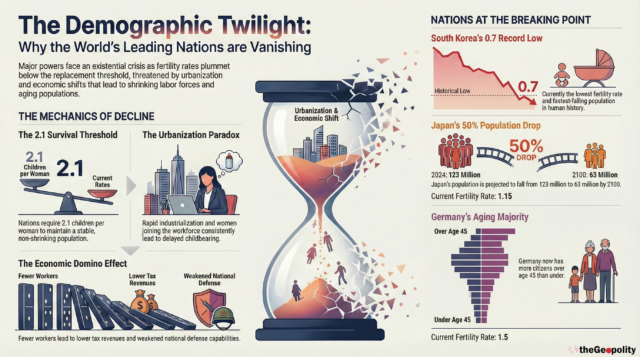
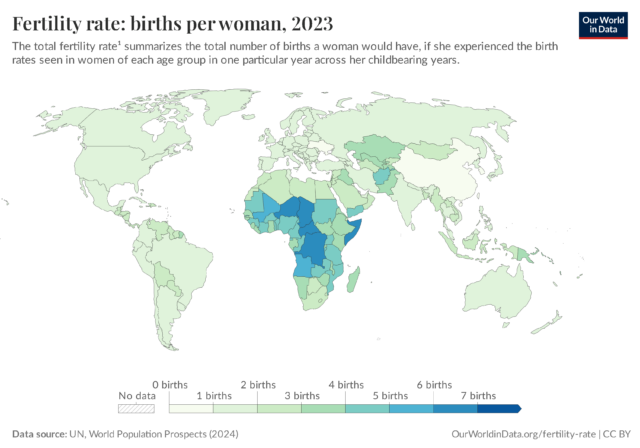
A nation needs on average, a fertility rate of 2.1 children per woman to maintain a stable population, any higher the national population grows, any lower than the nation’s population begins to shrink. A shrinking population has so many adverse effects. A shrinking population means a shrinking labour force, which means a fall in taxes for the national government, it also means less people in the army to defend the nation. A shrinking population means a lack of replacement for those who pass away, which affects the national economy. There is no technological solution to declining demographics currently and that’s why if you’re running out of people, you will likely cease to exist in the long run.
Germany – Germany has the worst demographics in the world. It’s already in demographic decline and has been so for decades. So, everything we are used to about the Germans, from industry, quality and exports are all under threat in the long run. It all started out good for the Germans, they came into existence as a nation in 1871, rapidly industrialised and despite the defeats in WW1 and WW2 they became a global innovator, with global brands dominating the world. But it’s all gone horribly wrong.
As Germany rose from the ashes of WW2, economic modernisation led to urbanisation and to more and more women joining the work force and delaying childbearing. After reunification these factors got even worse and today Germany has more people over 45, then under. The German fertility rate has dropped from its peak in 1965 and fell below the replacement rate in 1970. Today the German fertility rate of 1.5 children per woman is well below the replacement rate. Germany has for decades relied upon immigration as its labour force has been shrinking. The future of Germany looks extremely bleak.
Japan – If Germany didn’t exist, Japan would have the worst demographics. Japan urbanised around the same time as Germany and achieved this much faster than them. After WW2 Japan became the manufacturing hub of the world and many considered it would be Japan that would knock the US off from being the world’s largest economy. But then it went horribly wrong.
Japan’s fertility rate has been dropping since 1970 as many took part in Japan’s economic miracle with a hardcore work culture that prioritised work over everything else. This led to delays in having children. The economic crash from 1990 led to high costs of living and high housing costs which led to the Japanese reaching retirement without having many children.
Today, Japan’s fertility rate has fallen to 1.15. This has resulted in 30% of Japan’s population being over 65, there are more people over the age of 50 in Japan than under. Japan has a population today of 123 million, this is expected to fall to half – 63 million by the end of the century. The future of Japan is as bleak as Germany’s.
Italy – Italy became a nation in 1861 when dozens of independent kingdoms, duchies, and city-states on the Italian peninsula were consolidated into a single state. Each region of the Italian peninsula had different economies, regional development and resources and this led to major challenges in developing the country. Southern Italy has struggled economically compared to the north of Italy and this remains a major problem even today.
Italy’s fertility rate has been falling since 1975, its youth unemployment has always remained high and that’s why Italy has struggled to fund 25% of its population that’s over the retirement age. Italy’s retired population outnumbered children (those under 14) back in 2005. Italy today has more people over 47 than under, and this will rise to 52 by 2050. It remains to be seen if Italy will still exist in 2100
Russia – Russia has been through so many upheavals in its modern history and this has led to major problems with its population growth and structure. Of the 60 million deaths in WW2, Russian deaths were half of these. It took the Soviet Union until the 1970s to reach the replacement rate, but this took significant Soviet social programs. But the decline of the USSR in the 1980s and then collapse in 1991 led to the 1990s becoming the lost decade. Poverty went from 2 million to 60 million, a 3000% increase. UNICEF noted that this resulted in 500,000 ‘extra’ deaths per year.
Russia has had a fertility rate below 2.1 since the late 1980’s, today Russia has more people aged over 41 then under. Russia is losing nearly 400,000 workers every year and its current population of 144 million will fall to below 130 million by 2046 if current trends continue.
China – China for long was the world’s largest populated nation, but the communist era was a disaster in the country, which was only reversed after the open and reform era in 1979. Due to China’s population being out of control, China instituted a one-child policy to bring its population growth under control. Whilst China’s population growth did indeed fall, nevertheless China’s population continued to increase, just at a much slower rate.
But for the last 3 years China’s population has been declining. China’s one child policy reduced the fertility from ~6.0 in the 1960s to below 1.6 today. Rapid industrialisation led to rural workers moving to cities who delayed marriage and childbirth. This has now caused a major headache for China. The one-child policy has created a major population imbalance, 1 in 3 Chinese in the next few years will be over 65. This means China’s labour force is already shrinking and less and less people will have to support a growing retired population. This all comes at the worst possible time for China who wants to make domestic consumption its economic model and move away from an export driven economy. As its labour force is shrinking, and its overall population is shrinking China’s economic rise may very well be premature
South Korea – South officially has one of the lowest fertility rates in the world at 0.7 children per woman. It’s also officially the fastest-falling fertility nation in history. South Korea earned the title economic tiger during the 1970’s with its rapid economic development and export driven economy. But it’s the way this was achieved that has now come to haunt the economic tiger.
South Korea Industrialised and urbanised so quickly that in just two generations large-family traditions were dismantled. Women joined the workforce, and the culture of delaying children and marriage made the country’s demographics even worse. South Korea has more people over 45, then under. At the current rate South Korea’s population will drop from 51 million today to below 30 million by 2100.
US – The US will be celebrating its 250th anniversary in 2026. Whilst the US founding fathers needed to grow the nascent nation’s population and expand back in 1776, they will probably be turning in their graves with the divisions the US currently faces and its demographic prospects. Unlike the nations already outlined, the US doesn’t face an acute demographic problem, but it nevertheless faces some challenges with regards to its population that is already causing fractures. The US fertility rate peaked at 3.77 in 1957 and dropped below the replacement rate in 1973, the same year Roe v. Wade legalised abortion as a right. Through immigration the US was able to increase its fertility rate from the 1980s-2000, only for it to fall below the replacement rate in the early 2000s.
The average age at first birth in the US is now 30 and singlehood has resulted in falling marriage rates. The US population is getting old, but it will not reach the problems other nations are facing anytime soon. What the US is facing is another problem. By 2050 the Caucasian population in the US will be a minority, outnumbered by Latinos, blacks and immigrants. This is already causing problems in the US and is something that led to the rise of Donald Trump. The US now depends on immigration for its workforce and to replace its elderly.
By 2050 the Caucasian population in the US will be a minority, outnumbered by Latinos, blacks and immigrants.
Greece – Like much of Europe Greece urbanised and this led to the decline of the traditional family. Greece’s fertility rate fell below the replacement rate in the 1980s and the economic crisis and austerity in the 2010s caused youth emigration that compounded matters.
Greece today has the highest average age at birth in Europe of 31. As a result, there are more Greeks over 46 than under. Without immigration or sustained pro-family reform, Greece’s population is expected to fall below 8 million by 2100.
Portugal – Despite the perception of sun and sea, Portugal like the other developed nations has seen its demographics change as it urbanised and many delayed having children. Portugal’s fertility rate dropped below the replacement rate in the 1980s, with an average age at first birth of 31.
Joining the EU has resulted in emigration out of the country. The UN projects Portugal’s population to fall to 8.1 million by 2100. By mid-century, one in three citizens will be over 65.
Spain – Spain’s fertility rate dropped below the replacement rate in 1980. After four decades of low fertility Spain has come to depend on immigration to maintain its workforce. The 2008 financial crisis and its long aftermath devastated youth employment—unemployment exceeded 40% among the young—delaying marriage and childbearing for a generation. Spain currently has more people over 45, than under. 20% of Spaniards are over 65, and that share is rising steadily. As one of Europe’s greying south economies, Spain’s ageing will feed into EU-wide debates over fiscal transfers, debt rules and economic reform.