

|
Getting your Trinity Audio player ready...
|
Welcome to The Geopolity’s What We’re Watching (3W), our daily look at the interconnected worlds of Geopolitics, Economics and Energy. Curated from the world’s leading sources of information, our analysis and commentary is designed to help you make sense of the events driving the major developments in the world.
Late last week, the US turned to its favorite news outlet to continue this effort. in a phone interview on Thursday, US president Trump told Axios the Strait of Hormuz is totally open again, under full US control. “That sucker is open. The Iranian response is very mild. They don’t want us to go back at them. That’s the whole ball game. The rest doesn’t matter,” Trump said. Iran is still firing at ships, but its ability to target them accurately is limited due to the successful US military campaign over recent weeks. Iranian mines have also effectively been removed, leaving the Arabian Gulf states rushing to get their cargoes out under effective US navy escort. All this as per Axios.
One may choose to believe this story, but we at 3W do not. We note this story echoes the story that US secretary of state Rubio told his counterparts from around the world last week, that the US does not intend to restart military action against Iran because the US has already succeeded in reopening the Strait of Hormuz. Axios also ran that story, and we at 3W explained then why it doesn’t rhyme with the facts.
What is going on, in our view, is that the US tries to portray strength, to hide its weakness. We explained this in our review of the “Economic D-Day” that US treasury secretary announced, and also about the “secret” visit by CIA director Ratcliff to Russia.
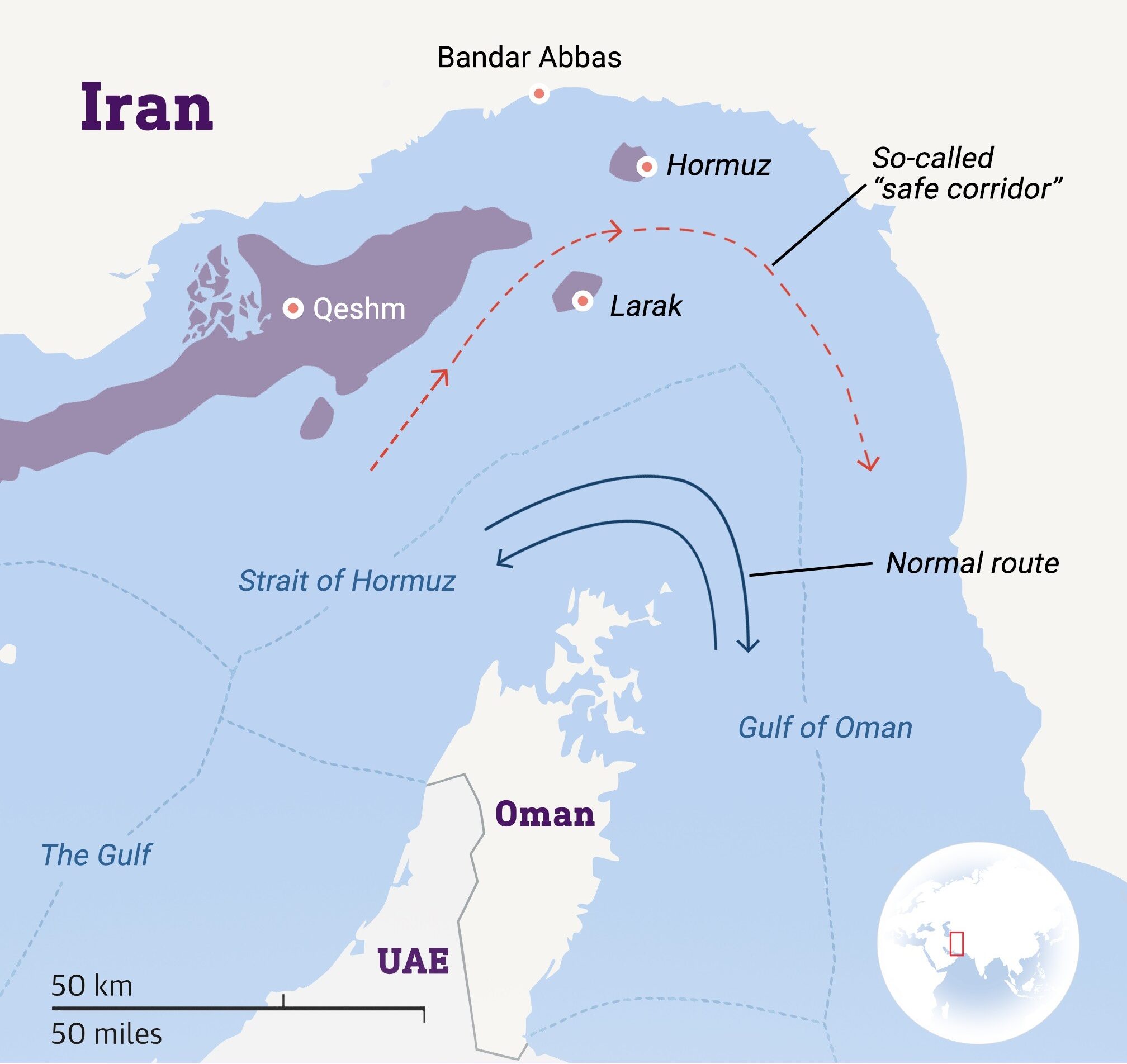 As if to prove that “not everything is well” around the Strait of Hormuz, on Sunday and Monday the US and Iran exchanged attacks again, for the first time in a month, writes The New York Times. The US military said on Sunday that its forces had bombarded Iranian troops on Larak Island that were preparing to launch rockets armed with mines into the Strait of Hormuz. Iran’s Islamic Revolutionary Guards Corps said it retaliated by firing at bases in Jordan and the United Arab Emirates that host US military personnel.
And to prove that the US is focused on crafting stories that make a terrible situation look less bad, after the US attack on Sunday US president Trump posted a video of what he claimed was a US attack on Iran’s Kharq Island. “Kharg Island being blown to smithereens!!! President DJT,” Trump wrote in an accompanying social media post. Reuters confirmed that the video clip was most likely “synthetically generated”, i.e. it was an AI fake.
Support for our 3W assessment also came from the UAE, whose government called for a “more realistic approach” to end the six-month Iran war on Monday, writes Bloomberg. “The state of neither war nor peace cannot be a sustainable solution, just as the policy of targeting the Arab Gulf states and Jordan has proven to be a failure,” Anwar Gargash, a senior diplomatic adviser to UAE President Sheikh Mohamed bin Zayed Al Nahyan, wrote on X. This leaves little doubt that contrary to US assertions, things are not “fine and dandy”. The Strait of Hormuz remains closed, under Iranian control.
In another, related topic, US president Donald Trump last Friday announced that his country would to take control of a fifth of Venezuela’s vast oil reserves. “At my direction, Secretary of State Marco Rubio, and Secretary of War Pete Hegseth, working closely with Highly Respected Interim President of Venezuela, Delcy Rodriguez, and, through a partnership with private business, have secured majority U.S. control of more than 65 BILLION BARRELS of proven Oil Reserves in Venezuela, at no cost to the American Taxpayer,” Trump wrote on social media, writes Reuters.
“THE BIGGEST OIL DEAL IN WORLD HISTORY”, Trump also posted, writes The Associated Press. AP further summarizes what is known about the deal in the following manner. The US government and an unnamed private operator in Venezuela formed a new company that was given the rights to untapped oil fields for 100 years. The deal involves the development of 17 fields with a proven potential of 65 billion barrels, and gives the US 55% effective output of the new private company, including an ownership stake and rights to buy oil at cost. American purchases of the oil will go toward the US strategic oil reserves and help meet the needs of the American military.
Venezuela’s acting president Delsey Rodríguez confirmed the agreement in a statement on Telegram, writes Bloomberg. She called the deal “historic,” while saying oil projects would generate $209 billion in taxes, based on a benchmark oil price of $65 per barrel. In a television appearance Rodriguez said the agreement is expected to grant the nation around $19 in profit per barrel of oil produced, Bloomberg writes separately. Rodriguez also said the agreement has a lifespan of 25 years, not 100, writes Bloomberg again separately. The 17 fields are expected to produce 1.5 million barrels per day.
Reuters adds the fields are most likely in the Orinoco Belt and Lake Maracaibo regions, the origin of Venezuela’s oil industry. Bloomberg further adds that the “unnamed private operator in Venezuela” is most likely Alejandro Betancourt, a deeply shady figure. In the past decade Betancourt has faced multiple criminal investigations in Switzerland, Spain and the US, into money laundering, including whether he had a role in a loan arrangement that US prosecutors say embezzled more than $1 billion from Venezuela’s state-owned oil company, writes The Washington Post. Betancourt, whose company is the second-largest private oil producer in Venezuela, has been the key intermediary between the US and Venezuela since the kidnapping by the US of Venezuela’s president Nicolas Maduro.
The 3W assessment of this announcement is as follows. We are reminded of the Red Line Agreement. After the collapse of the Ottoman Empire, the colonial empires of the day, the UK, France and the US, came together to agree a split of the oil wealth of the Middle East. They took a map of the region and drew red lines on it to demarcate who would “own” which oil territory. The US “deal” with Venezuela is essentially similar, as it simply hijacks the country’s oil wealth after kidnapping its president and threatening to kill the other politicians if they do not submit. The architect of the colonial Red Line agreement was Calouste Gulbenkian, who would become known as “mister five percent” because he arranged to personally receive 5% of the oil production (or equivalent profits). Alejandro Betancourt follows in Gulbenkian’s footsteps, as he is likely to make billions from the Venezuela arrangement.
If anything, this should further increase the resolve in Iran to resist the US – Israel Alliance. For while resisting the US is undoubtedly painful for a nation, clearly, submitting to the US will kill the nation.