


For decades, the US has enjoyed something no previous great power possessed on the same scale: the ability to borrow enormous sums in its own currency from investors across the world while simultaneously maintaining the most extensive military on the planet. That model is beginning to come under pressure.
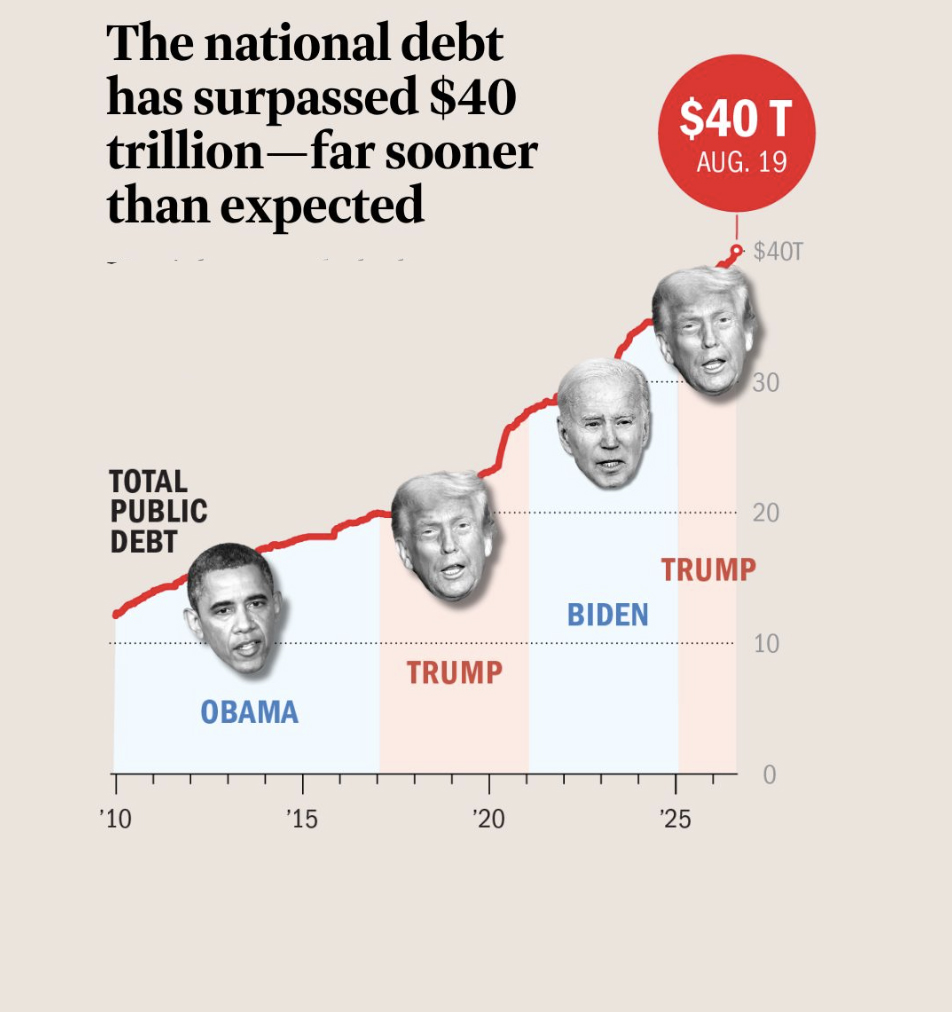
US gross national debt recently passed $40 trillion, more than double its level when Donald Trump first entered the White House in 2017. But the more consequential figure is what Washington must pay to service it. The Congressional Budget Office expects net federal interest costs to reach around $1 trillion in 2026, rising towards $2.1 trillion annually by 2036.
Washington therefore increasingly faces a problem familiar to great powers throughout history:
How do you maintain an empire abroad while financing the state at home?
The World’s Most Important Bond Market Is Under Pressure
US Treasury bonds occupy a unique position in the international financial system. Foreign governments, central banks, pension funds and investors have historically considered them exceptionally safe and liquid. This privilege allowed Washington to borrow on a scale that would create far greater problems for most countries. But investors increasingly want greater compensation for lending America money for decades. Long-term Treasury yields have risen, reflecting concerns over inflation, persistent deficits, enormous bond issuance and America’s overall debt trajectory.
This creates a potentially dangerous cycle: Higher debt requires greater borrowing. Greater borrowing increases Treasury supply. Investors demand higher yields to absorb it. Higher yields increase interest costs, requiring Washington to borrow still more. The Treasury has meanwhile expanded its programme of buying back older government bonds to improve market liquidity.
This does not mean investors have stopped trusting US debt. Buybacks are primarily a debt-management tool designed to improve trading conditions and manage cash. But the underlying problem remains. Washington needs investors to absorb extraordinary quantities of new debt while simultaneously wanting borrowing costs to remain low. Technical interventions can improve liquidity. They cannot eliminate $40 trillion of liabilities.
The Price of Empire
This is where America’s fiscal problem becomes geopolitical. The US does not operate like an ordinary nation-state. It maintains military forces across Europe, the Middle East and Asia alongside overseas bases, carrier groups, intelligence networks, nuclear forces and logistical systems capable of projecting power thousands of miles from North America.
Washington must simultaneously deter Russia, contain China, defend maritime routes, support allies and retain the capability to intervene in crises across multiple regions.
The fundamental problem is therefore not merely that America owes $40 trillion. It is that America’s geopolitical commitments were constructed when its fiscal position was considerably stronger. Washington is attempting to maintain a global system created during an era of overwhelming American economic dominance while simultaneously servicing an enormous accumulated debt.
Interest payments are particularly problematic because they create virtually no new capability. A trillion dollars servicing previously accumulated debt does not construct factories, improve infrastructure, provide healthcare, build aircraft carriers or develop new weapons
Guns, Butter — and Interest
America also has enormous domestic obligations. Social Security and Medicare must be financed. Infrastructure requires investment. An ageing population increases healthcare and pension costs. Industrial policy requires subsidies. The CBO expects federal spending of approximately $7.4 trillion in 2026, against revenues of around $5.6 trillion, producing a deficit approaching $1.9 trillion. America therefore faces three enormous claims upon its resources:
The domestic state. The national debt. The global empire.
Interest payments are particularly problematic because they create virtually no new capability. A trillion dollars servicing previously accumulated debt does not construct factories, improve infrastructure, provide healthcare, build aircraft carriers or develop new weapons. It pays for yesterday’s borrowing. The problem is therefore increasingly one of strategic opportunity cost. Every dollar consumed by servicing the debt cannot simultaneously renew America’s domestic economy or maintain its international position.
The Imperial Overstretch Problem
History contains numerous examples of powerful states discovering that military power ultimately rests upon economic foundations.
Spain repeatedly defaulted despite controlling a global empire. The Ottomans became increasingly dependent upon foreign creditors. Britain emerged victorious from two world wars but financially ruined. Eventually Britain found maintaining sterling’s global role, rebuilding its domestic economy and policing an enormous empire increasingly incompatible.
Modern America is not post-war Britain, Spain or the Ottoman’s. It retains unparalleled financial markets, technological and military capabilities and the world’s dominant reserve currency. But the underlying geopolitical principle remains: Power cannot indefinitely exceed the economic base supporting it. This is the essence of what historian Paul Kennedy described as imperial overstretch — when a great power’s strategic commitments increasingly exceed the resources available to sustain them. America is beginning to display elements of precisely this problem.
Power cannot indefinitely exceed the economic base supporting it
The Dollar Gives America Time
There is one enormous reason America’s situation differs from previous declining empires. The dollar remains the dominant international reserve currency and Treasury securities remain central to global finance. This gives Washington an extraordinary privilege: it can finance global power by issuing liabilities much of the world wants to own. Consequently, $40 trillion does not automatically mean America faces a debt crisis.
The greater danger is more gradual. Investors do not necessarily need to stop lending America money. They merely need to say: We will lend — but it will cost you more. Persistently higher borrowing costs would gradually reduce Washington’s freedom of manoeuvre.
America’s Strategic Choices Are Narrowing
For decades Washington could respond to almost every major problem in essentially the same way. War? Borrow. Financial crisis? Borrow. Pandemic? Borrow. Military build-up against China? Borrow. Domestic subsidies? Borrow.
That flexibility was itself an important component of American power. But accumulating debt means future presidents increasingly inherit constraints created by their predecessors. The CBO expects publicly held debt to reach 120% of GDP by 2036, while annual net interest expenditure approaches $2.1 trillion. Eventually Washington must choose between raising taxes, reducing domestic expenditure, reducing military commitments, accepting still larger deficits or generating sufficient economic growth to outrun the problem. Every option carries political and geopolitical consequences.
The $40 Trillion Warning
The United States is not bankrupt and the Treasury market has not ceased functioning. America retains enormous advantages: the dollar, deep capital markets, technological leadership, favourable geography, natural resources and the ability to borrow in its own currency. But $40 trillion is nevertheless a geopolitical warning.
America’s debt has more than doubled in less than a decade. Washington is running enormous deficits despite neither a depression nor a world war. Interest costs are over $1 trillion annually while America simultaneously attempts to maintain a military architecture spanning much of the planet. The critical question is therefore not whether America can continue financing its debt.
It probably can for some considerable time. The more important question is: What will financing that debt prevent America from doing?
Great powers rarely decline because they suddenly run out of money. Decline is usually slower. Accumulated commitments gradually reduce their freedom of manoeuvre until maintaining yesterday’s empire consumes resources needed to build tomorrow’s economy. That is the danger facing America.
America retains the commitments of a global empire while borrowing extraordinary sums to maintain the state supporting it. History shows that when a great power’s commitments begin exceeding the economic resources available to sustain them, something eventually has to give. The question is whether America restructures those commitments voluntarily — or whether financial reality eventually makes the decision for it.