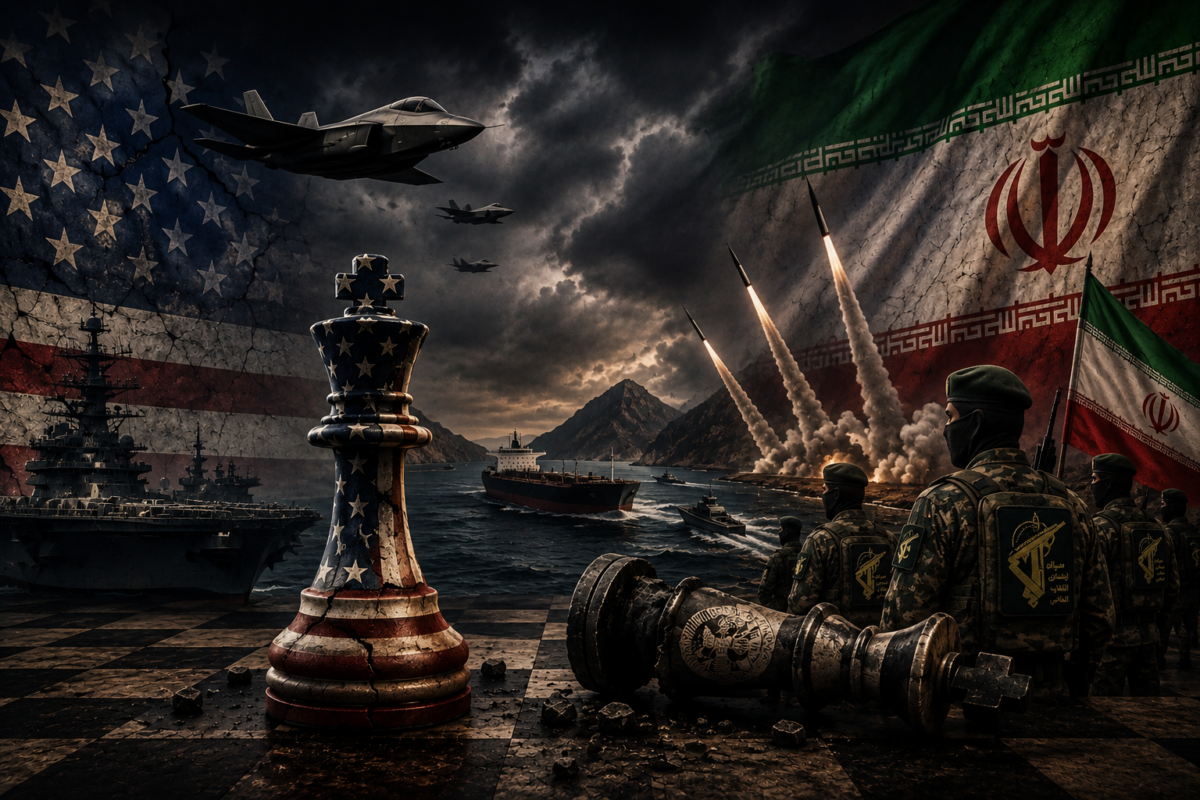


Iran may have done much wrong in its war with Israel and the US, from its senior leadership and much of its air defence network were wiped out within the opening days of the war. Nevertheless, Tehran also got several critical things right. What it got wrong stemmed largely from naivety and negligence; what it got right arose from geography, institutional resilience, and lessons drawn from the first iteration of this war.
The first thing Iran understood correctly was the nature, and the limits, of the American military posture in the region.
Washington reverted to its familiar doctrine: a short, sharp campaign of overwhelming force, euphemistically described as “shock and awe”, intended to disorientate and demoralise the regime after which internal fractures could be exploited to bend the Iranian regime to US will. Yet the campaign proved neither shocking nor awe-inspiring to the Iranians. It was anticipated, studied, and prepared for well in advance.
The experience of Afghanistan was particularly instructive. After two decades of war, the United States ultimately replaced the Taliban with the Taliban. American policymakers learned, often reluctantly, that secular opposition groups may speak the language of liberal governance but frequently lack legitimacy, cohesion, or administrative competence. Corruption, factionalism and elite looting rapidly hollow out such movements, creating failed states and political vacuums rather than stable pro-Western governments.
American policymakers learned, often reluctantly, that secular opposition groups may speak the language of liberal governance but frequently lack legitimacy, cohesion, or administrative competence
Hence, despite Israeli fantasies of Kurdish opposition forces marching triumphantly into Tehran, Iran correctly assessed that the United States had neither the appetite for another prolonged regional war nor the political capacity to launch and sustain a major ground invasion which would be required to replace the existing regime.
Nor did Washington possess a credible alternative political force capable of governing Iran after regime collapse. Although the Islamic Republic had clearly been penetrated by Israeli intelligence, the Iranian opposition remained fragmented, weak, and politically unviable.
Hence to completely replace the existing regime the US would have had to maintain a multi decade occupation of Iran like the debacle in Iraq and Afghanistan to build a new viable ruling structure to replace the current regime, a task it failed to do both in Afghanistan and Iraq.
For Tehran, therefore, this war was never fundamentally about annihilation. It was about coercion: compelling internal regime change and subjugation to American strategic demands. The Iranian leadership consequently adopted a doctrine not of victory, but of endurance. Unlike Saddam Hussein during the Gulf War, Iran calculated that it did not need to defeat the United States militarily. It merely needed to survive long enough for the economic and political costs of war to make a negotiated settlement, one preserving the regime’s independence, increasingly attractive to Washington and its allies.
Part of what where Iran succeeded lay in a threefold strategy: hardening the regime’s ability to wage war; imposing costs on American allies in the region; and internationalising the economic consequences of the conflict so that pressure for de-escalation extended well beyond the Middle East.
Like Switzerland, Iran has exploited its terrain to formidable effect. Much of the country is dominated by the Zagros mountain range, stretching across vast portions of the state. Over decades, Iran has tunnelled deep into these mountains to shield critical military infrastructure. Underground “missile cities” have been constructed where missiles can be manufactured, assembled, stored and deployed with significant protection from aerial attack. Elements of Iran’s air force and strategic assets were likewise relocated underground long before hostilities escalated.
Like Switzerland, Iran has exploited its terrain to formidable effect
In preparation for an inevitable confrontation with the United States and Israel, Tehran also amassed substantial stockpiles of ballistic missiles and Shahed drones, recognising that American and Israeli interceptor inventories are finite and extraordinarily expensive. The asymmetry is obvious: drones costing thousands of dollars can compel the expenditure of interceptors worth millions. Despite its relative economic weakness, Iran has therefore leveraged low-cost attritional warfare to strain sophisticated Western and Israeli defensive systems.
Iran also resisted the temptation to mass its forces, despite repeated Israeli and American attempts to provoke precisely such a move. Reports of imminent Kurdish offensives failed to persuade Tehran into concentrating troops in vulnerable areas where American and Israeli air superiority would almost certainly have inflicted catastrophic losses. By keeping forces dispersed and concealed, the regime preserved much of its ground capability and avoided the sort of decisive battlefield collapse that might have triggered internal disintegration.
Tehran also amassed substantial stockpiles of ballistic missiles and Shahed drones, recognising that American and Israeli interceptor inventories are finite and extraordinarily expensive
In preparation for an inevitable confrontation with the United States and Israel, Tehran also amassed substantial stockpiles of ballistic missiles and Shahed drones, recognising that American and Israeli interceptor inventories are finite and extraordinarily expensive.
The structure of the Iranian state itself also proved more resilient than many Western observers anticipated. In the West, the Iranian Republic is often portrayed as a purely personalist system centred entirely upon the Supreme Leader. In reality, the regime rests upon overlapping institutional networks. Bodies such as the Assembly of Experts and the Guardian Council share and duplicate aspects of authority, creating redundancies within the political system. Succession mechanisms are therefore designed to function rapidly in times of crisis.c
Meanwhile, the Islamic Revolutionary Guard Corps (IRGC) maintains an iron grip over internal security, while the decentralised nature of Iran’s conventional military and intelligence apparatus ensures continuity of operations even when senior leadership is eliminated. Mid-level commanders are expected to continue operating autonomously should command structures be severed.
By keeping forces dispersed and concealed, the regime preserved much of its ground capability and avoided the sort of decisive battlefield collapse that might have triggered internal disintegration
With pre-planned succession procedures already established, Tehran was able to restore much of its senior leadership more rapidly than many expected.
Another area Iran succeeded in was the targeting of American bases and regional allies.
Iran succeeded in rendering a number of American military installations and fixed assets inoperable, including early-warning radar facilities in Qatar and Jordan, while also damaging tankers and airborne surveillance assets in Saudi Arabia. Simultaneously, attacks upon petrochemical infrastructure across the Gulf altered the strategic calculations of Arab monarchies that had long considered themselves insulated by American military protection.
For decades, these states viewed the American presence as an absolute guarantee of security. The war demonstrated instead that such installations may function as liabilities as much as shields. Tehran effectively conveyed a simple message: if Iran descends into chaos, the Gulf monarchies will not remain untouched. That realisation significantly reduced regional enthusiasm for escalation.
The final and perhaps most consequential success of Iran was understanding the broader international mood.
After the economic dislocation caused first by Covid-19 and then by the war in Ukraine, neither the global economy nor America’s allies possessed much tolerance for another major geopolitical shock. By threatening and disrupting shipping through the Strait of Hormuz, Iran targeted not merely oil and gas flows but also fertilisers, chemical precursors and other strategic commodities essential to global supply chains. The resulting rise in prices imposed costs far beyond the battlefield itself.
Tehran’s calculation was straightforward: any economic pain inflicted upon Iran would not remain Iran’s burden alone. It would be shared by the wider world, thereby increasing international pressure for compromise and restraint.
Tehran’s calculation was straightforward: any economic pain inflicted upon Iran would not remain Iran’s burden alone. It would be shared by the wider world, thereby increasing international pressure for compromise and restraint
In the end, Iran’s performance in the conflict revealed both profound weaknesses and considerable strengths. Its intelligence failures were severe, its air defences penetrated with alarming ease, and much of its senior leadership was eliminated in the opening phase of the war. Yet the Islamic Republic also demonstrated strategic patience, institutional resilience and a clear understanding of the political limitations constraining its adversaries. Iran may not have won the war in any conventional sense, but it succeeded in avoiding the fate that befell Iraq or Libya: total state collapse. In modern conflict, survival itself can constitute a form of victory.