

|
Getting your Trinity Audio player ready...
|
Welcome to The Geopolity’s What We’re Watching (3W), our daily look at the interconnected worlds of Geopolitics, Economics and Energy. Curated from the world’s leading sources of information, our analysis and commentary is designed to help you make sense of the events driving the major developments in the world.
Last week, 3W reviewed the various ways the US – Israel Alliance War on Iran could develop. Escalation was one scenario, which assumed that the Alliance would not accept the current status quo, as it did not achieve any of its originally stated objectives of regime change and nuclear and ballistic missile program destruction, and in response would seek for ways to worsen the pain for Iran. 3W’s current assessment is that this is the path the war is currently on.
One reason we say this is the statements from the US leadership about the war over recent days. The New York Magazine writes that US president Trump said he felt “honored” to be killing the Iranian leadership, whom he referred to as “scumbags”. The US secretary of defense/war Pete Hegseth, meanwhile, compared Iran’s leadership to “rats” hiding underground, writes ABC News Australia.
This is quite clearly genocidal language, 3W notes. It dehumanizes the Iranian leadership, and dehumanization is a precursor to war crimes and crimes against humanity. The best example of this is the Nazi propaganda, which equated Jews with rats – see the film “The Eternal Jew”, for example.
These statements make clear the psychology of the US leadership. Narcissism (Trump), religious zealotry (Hegseth; or Peter Thiel, the financier of JD Vance, who is organizing a secret conference on the “Antichrist”, writes Reuters) and psychopathy (Trump and Hegseth) are the defining traits. And such people, when cornered by Iran’s highly successful strategy and associated tactics and operations (most recently evidenced by Iran’s successful downing of two US refueling planes over Iraq and its destruction of a further five on the tarmac of the Prince Sultan air base in Saudi Arabia, as per The Wall Street Journal), tend to lash out emotionally, escalating the killing and destruction, in an attempt to reestablish dominance. The German prime minister Merz also displayed this depraved psychology last week when he said that “responsibility for ending the war in Iran lies with the leadership in Iran”, according to Yahoo News. “The sooner the mullah regime stops, the sooner this war will end,” Merz said. Until that happens, Merz said he assumes that Israel and the US will continue “their defence” against Iran. 3W notes this makes clear that in Merz’s “lived reality”, it is only natural and normal that the brown-skinned people submit to the white-skinned overlords, and that the white-skinned people attack to destroy and kill the brown-skinned if they dare to resist. Merz clearly believes in the “ubermensch” like some of his infamous predecessors…
This mindset coupled with authority inevitably leads to crimes against humanity. Earlier Hegseth had announced that the US administration has suspended the “rules of engagement” that are designed to ensure the US military abides by International Laws of War. “Our warfighters have maximum authorities granted personally by the president and yours truly,” Hegseth said at a briefing four days after the war started, according to The New York Times. “Our rules of engagement are bold, precise and designed to unleash American power, not shackle it.” This new mode of operations is likely what caused the American attack on the Iranian girl’s school, which killed at least 175 civilians, NYT notes. Human Rights Watch has an overview of how the second Trump administration has systematically removed the “checks and balances” in the US military that were designed to prevent war crimes.
This mindset coupled with authority inevitably leads to crimes against humanity
3W adds that in Israel this mindset has now legalised the rape of Palestinians. Israel dropped charges against five Israeli soldiers accused of sexually abusing a Palestinian detainee at the Sde Teiman detention facility in 2024, writes AntiWar.com – even though this crime was caught on videotape.
All this means, in our 3W view, the US – Israel Alliance should be expected to become ever more aggressive and violent vis-à-vis Iran, as well as anyone whom the Alliance deems not supporting its War on Iran sufficiently. Effectively, the door to another genocidal military operation, akin to Gaza, has been opened.
The above described and explained dynamic is already underway. On Friday, the Alliance attacked Iran’s Kharq island, a critical node in its energy infrastructure, writes The Wall Street Journal. Iran had previously warned that any attack on its energy facilities would trigger retaliation against oil-and-gas infrastructure across the region linked to the US and its allies, WSJ notes. As such, this attack was clearly designed to escalate the conflict, 3W notes, hoping that Iran would hesitate to live up to its threat, whereby the Alliance would have re-established “escalation dominance”; or hoping that if Iran did live up to its threat, the Gulf countries would officially join the War on Iran on the side of the Alliance.
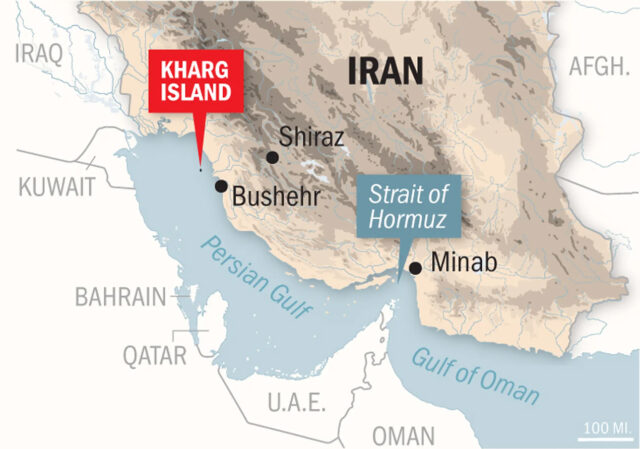
Iran responded as it said it would – recurring theme in this war, 3W notes. A day after the attack on Kharq it attacked the Fujairah bunkering hub and crude export terminal in the United Arab Emirates, writes Reuters.
Having failed to re-establish escalation dominance through Kharg the US – Israel Alliance then announced deployment of a military unit to seize it from the Iranians. An element of an amphibious-ready group and attached Marine expeditionary unit is heading to the region, writes The Wall Street Journal. Two ships from the Japan-based USS Tripoli Amphibious Ready Group and the 31st Marine Expeditionary Unit are now headed for the Middle East. An amphibious-ready group is a fast-response unit used to conduct sea-based amphibious assaults and special operations. The group’s embarked Marine expeditionary unit includes more than 2,000 Marines.
In parallel, the Alliance is trying to bring together an armada of naval vessels that can force a re-opening if the Strait of Hormuz. “The Countries of the World that receive Oil through the Hormuz Strait must take care of that passage, and we will help — A LOT!” Trump said in a social-media post, writes The Wall Street Journal. “This should have always been a team effort, and now it will be.” Trump also said in another social-media post that he hoped China, France, the United Kingdom, Japan and South Korea would be among those to send warships to the strait. The call got a muted response from the mentioned countries, writes The Guardian. The UK, Japan, China and South Korea have so far failed to commit. Germany also appeared sceptical. Its foreign minister Johann Wadephul said the scheme was “not effective”. In response, Trump escalated vis-à-vis the US allied countries, saying Nato faces a “very bad” future if they fail to assist in opening up the Strait of Hormuz, writes The Financial Times.
In parallel, the Alliance is trying to bring together an armada of naval vessels that can force a re-opening if the Strait of Hormuz
3W notes these Alliance actions are all totally predictable if one understands the psychology of the main actors. But, could the plan succeed? Experts doubt it, writes Barron’s. Iran’s weapons to keep the Strait of Hormuz closed weapons include mines, fast attack boats, missiles and drones. Layered on top of each other, they become exceptionally difficult to remove. In the best-case scenario, an “overwhelming military force” will need weeks to achieve it – while taking significant casualties. In all other scenarios, the operations develop as the British operation to take the Dardanelles Strait from the Ottoman Empire in 1915. That operation failed and led to the death of 250,000 allied soldiers. Reuters agrees that Iran holds all the cards when it comes to the Strait of Hormuz, not US president Trump. In addition, 3W adds, if indeed the US – Israel Alliance launches a military operation to force the Strait of Hormuz open, Iran has the option to ask the Houthi’s in Yemen to close the Bab al Mandab, which would close sea traffic through the Red Sea. And, in the unlikely scenario the operation succeeds and Iran loses control over the Strait of Hormuz, it could in response decide to target and destroy the oil and gas production facilities of the Gulf – such that there is nothing to be transported to the Strait anymore. In other words, if the Alliance escalates, Iran too can still escalate.
Despite these very, very high risks associated with the plan, Israel supporters such as the American congressman Lindsey Graham are calling upon Trump to just do it. Graham applauded Trump’s “decision to take the war to Kharg Island” and said Iran’s economy will be “annihilated” if it loses control of the oil hub, writes Axios. “Seldom in warfare does an enemy provide you a single target like Kharg Island that could dramatically alter the outcome of the conflict,” he wrote on X. “He who controls Kharg Island, controls the destiny of this war.” This is of course nonsense, notes 3W. But as we discussed last week, Israel would not mind a massive war that destroys the countries of the Arabian Gulf, and that is one should expect people like Graham to cheer on the madness.
the Alliance War on Iran is creating a massive economic problem around the world. And, this is going to get worse
For the moment, however, the Alliance War on Iran is creating a massive economic problem around the world. And, this is going to get worse, American oil executives told Trump officials over recent days, writes The Wall Street Journal. WSJ adds that the oil companies have since long considered a closing of the Strait of Hormuz as the biggest possible disruption to the global energy system. The resulting energy shock is set to deliver a punishing blow to economies around the world, in particular that of Europe, The Wall Street Journal writes separately. Rising energy costs threaten to accelerate deindustrialization as energy-intensive industries such as chemical makers close factories and shift production to China or the US. Rising energy costs will also raise prices. Many countries in Europe lack the ability to borrow more, after years of high spending following the 2008 financial crisis and the COVID pandemic. Asia, where billions of people are already dealing with gas outages, drawing up “crisis menus” and preparing for fuel rationing at the pump, will similarly be affected, writes Bloomberg.
The “rational” way forward, that is the way forward that serves the most interests of the most people, is for the US – Israel Alliance to make an agreement with Iran, 3W notes. Since the Alliance has not been able to bring Iran to its knees via sanctions and war, such an agreement requires acceptance of a number of Iran’s demands. As to what these demands are, “The end of the war depends on guaranteeing that it will not be repeated and on paying compensation,” Iran’s Foreign Minister Abbas Araghchi said on Sunday, according to The National. He also said Iran was in communication with various Gulf states on this. In addition, in an interview with Reuters Iran’s ambassador to Saudi Arabia Alireza Enayati said there should be a serious review of the security arrangement in the Middle East. “What the region has witnessed over the past five decades is the result of an exclusionary approach [within the region] and an excessive reliance on external powers,” he said in a written response to questions, calling for deeper ties between the Gulf Cooperation Council’s six members, along with Iraq and Iran. In other words, in addition to security guarantees and reparations, Iran also wants the US military out of the Gulf, Permanently. Both Araghchi and Enayati made clear how Iran will respond to further escalations by the Alliance. “If our energy facilities are targeted, we will also target American companies’ facilities in the region,” he said. The Iranian minister again denied that Tehran had already attacked the energy facilities of its neighbours. Iran has offered to form a committee with the Gulf countries to investigate the facilities that have been attacked. “Our attacks only target American bases and interests in the region,” Araghchi said.