
|
Getting your Trinity Audio player ready...
|
Welcome to The Geopolity’s What We’re Watching (3W), e our daily look at the interconnected worlds of Geopolitics, Economics and Energy. Curated from the world’s leading sources of information, our analysis and commentary is designed to help you make sense of the events driving the major developments in the world.
In this roundup, we take a closer look at the EU – India “Mother of all Trade Deals”.
It is a massive agreement between two economic blocs that together account for nearly 25% of global gross domestic product and a market of two billion people. 3W notes it is part of a real push by India to establish closer trade ties with countries around the world. And it provides both parties a real alternative to doing business with the US.
3W notes that diversifying away from the US is a natural strategic response in the current circumstances – if one thinks geo-strategically, with awareness and competency. That is interesting, because the US, through the Trump Tariff War, is actually trying to force countries to enter into closer trade relations with the US. Indeed, if other countries have an independent mindset and think strategically, the ultimate outcome is more likely to be the opposite.
Still, nothing is guaranteed. The EU – India agreement will need to go through the political process, and at 3W we note that the EU Parliament is trying to block the Mercosur agreement which the EU recently signed after more than 20 years of negotiation – a move that will delay its implementation by at least a year. The same could happen here, and the US’s close allies in the EU will certainly try that.
Nevertheless, assuming that the EU will eventually come to its sense, one should expect closer trade relations between the EU, India and China, which would significantly weaken the economic position of the US in the world. Which is why one should also expect the US to try and prevent this reordering of trade relations to take place.
Furthermore, we look at:
- The US – Isarael Alliance ambition when it comes to Iran, which is not just “regime change” but rather “nation destruction”
- The US position on security guarantees for Ukraine; where 3W notes that there in reality is no such thing as a “security guarantee”, and that the talks about it creates the environment that leads to war
- Nato’s preparations for war in the Arctic; which 3W notes is an offensive military operation that is likely to trigger a response from Russia and China, and thereby increase the likelihood of global war further
- India’s trade agreements with the EU, Canada and Mercosur; which in the 3W view highlight the major risk the US is taking on through its current “bullying approach” to geopolitics
Geopolitics
As to Iran, Iran expert Trita Parsi of The Quinsy Institute notes that just as the US – Israel Alliance amasses military hardware and troops in the Middle East, the US media starts talking of why making Iran a “failed state” would not be such a bad idea. For example, “Its borders are artificial, and a breakup would frustrate the interests of Russia, China and others”, writes The Wall Street Journal. 3W agrees with Parsi that the chosen narrative to justify the actions often indicates the ultimate objective behind the actions. In this case, it is destruction of the state of Iran, turning it into a failed state like Syria or Somalia, in order to further increase the power imbalance in the Middle East region between Israel and its neighbours. Two specific 3W thoughts in addition. Firstly, Iran MUST understand this war is a war of survival. The alliance will keep coming at it until it is destroyed. In this situation negotiations are pointless, only a diversion of attention while the Alliance regroups and rearms and prepares for another devastating blow. Iran needs to prepare a holistic national defense plan on the basis of this reality. As we said yesterday, it needs to enter BRICS, invite China and Russia to establish military basis in its country, and build nuclear weapons as soon as possible. Secondly, if any of the other countries in the region think that after Iraq, Lebanon, Gaza, Syria and Iran it will end, they are fools. The US – Israel Alliance plan is for Israel to dominate the Middle East, and this requires all the other states in the region to be failed states, as this is the only way a country of 6 million can dominate a region of tens of millions. Egypt, Saudi Arabia and Turkey: you have been warned!
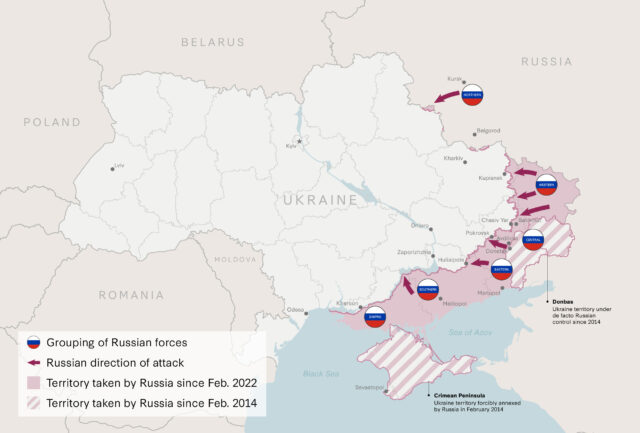
As to Ukraine, the Trump administration has indicated to Ukraine that US security guarantees are contingent on Kyiv first agreeing a peace deal that would likely involve ceding the Donbas region to Russia, writes The Financial Times. The White House also suggested that it would support Ukraine militarily only if it accepted a demilitarized zone on what would be the new east of the country. 3W notes that the whole subject of “security guarantees” is nonsense. Remember that Ukraine was already promised a security guarantee by the US back in 1994 when it was asked to give up its nuclear arms following the collapse of the Soviet Union. We further note that as long as Ukraine believes in “security guarantees” it will not acknowledge the fact that is exists on the border of a great power, just as Mexico and Canada. This is a fact that cannot be changed and it establishes limits on the country’s freedom to manoeuvre. Ukraine should recognize this fact, as do Mexico and Canada, as otherwise war will continue to be an inevitability.
Beyond the current geopolitical hotspots, The Financial Times writes about how NATO is preparing for war in the Arctic. According to Norway’s defence minister Tore Sandvik it is all defensive in nature. “This is homeland defence,” he said. “That’s why we’re putting this on the table for President Trump and when we meet allies. This is homeland defence [for the US], for London, for Paris, for Berlin, for all of the alliance.” FT further notes that Russia has numerous military bases bordering the Arctic area, and has been redeveloping its military stationed in these areas. 3W notes that Russia cannot be accused of displaying “imperial ambitions” regarding the Arctic. For example, it has not called upon Denmark to hand over Greenland. When in October 2025 the FT interviewed Nato’s most senior military officer, admiral Giuseppe Cavo Dragone, he said the Arctic was “of great interest” to the military alliance, and that the alliance was committed to keeping it open for “free navigation” and nascent business opportunities such as mining and oil and gas exploration. In other words, Nato is being used not for defense, but for geostrategic competition with Russia and China! 3W therefore notes that the reality is that the NATO operations in the Arctic are offensive rather than defensive. NATO is moving first, into the border areas of Russia. This will create a need for Russia and China to respond – which in western media will then be presented as an offensive act that NATO must respond to.
Macroeconomics
Europe and India have agreed a trade deal, with the objective of forging closer economic ties to hedge against US President Donald Trump’s tariffs, writes Bloomberg. The agreement would lower tariffs on most consumer and industrial goods traded between India and EU members, although it’s expected to exclude some agricultural products. The EU would also get enhanced market access for its car exports subject to a cap. India would get a new export market for the labour-intensive products it currently exports to the US. The pact is expected to be formally signed after legal vetting, which will likely take around six months. The European Parliament will also have to ratify it.
The BBC refers to the agreement as the “Mother of all Trade Deals”, as it will allow free trade of goods between the bloc of 27 European states and the world’s most populous country, which together make up nearly 25% of global gross domestic product and a market of two billion people. And it provides further details. The European Commission said would eliminate tariffs on most exports of chemicals, machinery and electrical equipment, as well as aircraft and spacecraft, following phased reductions. Significantly, duties on motor vehicles, currently as high as 110%, would be cut to 10% under a quota of 250,000 vehicles. That is six times larger than the 37,000-unit quota India granted to the UK in a deal signed last July. India will also cut tariffs on wine, beer and olive oil from the EU. India says almost all of its exports would get “preferential access” into the EU, with textiles, leather, marine products, handicrafts, gems and jewellery set to see a reduction or elimination of tariffs.
At around the same time, Canada and India pledged to expand trade in oil and gas, writes Bloomberg. Ottawa will commit to ship more crude oil, liquefied natural gas and liquefied petroleum gas to India, while New Delhi will send more refined petroleum products to Canada, following a meeting between Canadian Energy Minister Tim Hodgson and Indian Petroleum and Natural Gas Minister Hardeep Singh Puri. 3W notes that if the US does not successfully execute all its plans, and BRICS and the EU do what is wise, in a few years’ time the US will find itself isolated economically, i.e. in much worse shape than it is today.
The Institute for Strategic Studies notes that in 2025 New Delhi has concluded trade agreements with the EU, the United Kingdom, Oman and New Zealand, and is in negotiations to sign 12 other new agreements. In preceding years it has agreed free trade deals with the United Arab Emirates and Australia. In 2026, it hopes to add free tarde deals with Bahrain and Qatar, as well as Chile and Peru.
3W notes that diversifying away from the US is a natural strategic response in the current circumstances – if one thinks geo-strategically, with awareness and competency. That is interesting, because the US, through the Trump Tariff War, is actually trying to force countries to enter into closer trade relations with the US. Indeed, if other countries have an independent mindset and think strategically, the ultimate outcome is more likely to be the opposite.
That is not yet guaranteed. The EU – India agreement will need to go through the political process, and at 3W we note that the EU Parliament is trying to block the Mercosur agreement which the EU recently signed after more than 20 years of negotiation – a move that will delay its implementation by at least a year, writes Euronews. The same could happen here, and the US’s close allies in the EU will certainly try that. Nevertheless, assuming that the EU will eventually come to its sense, one should expect closer trade relations between the EU, India and China, which would significantly weaken the economic position of the US in the world. Which is why one should also expect the US to try and prevent this reordering of trade relations to take place.