

|
Getting your Trinity Audio player ready...
|
Welcome to The Geopolity’s What We’re Watching (3W), our daily look at the interconnected worlds of Geopolitics, Economics and Energy. Curated from the world’s leading sources of information, our analysis and commentary is designed to help you make sense of the events driving the major developments in the world.
3W ended last week with a review of the first three weeks of the US – Israel Alliance War on Iran. We noted that the Alliance’s original plans for the war had all failed, and that as a result the Alliance has been scrambling to make new plans in an attempt to bring the situation back under its control.
Some of these plans have already clearly failed. The idea to “decapitate” the Iranian regime, to enable a coup by Alliance aligned elements in Iranian society, is an example of this; as is the idea to use the Kurds to start a civil war in Iran; as is the idea to establish an “international armada” to force open the Strait of Hormuz.
The plans that are still being worked involving occupying Kharq island, in order to starve Iran of oil revenue; the idea to occupy Iran’s coast line, in order to end Iran’s control over the Strait of Hormuz; and the idea to capture, destroy or remove Iran’s stockpile of highly enriched uranium, to establish a face-saving excuse to end the war.
We also discussed last week the evidences that within the Alliance, Israel is in the driving seat, not the US. This, in fact, is one of the reasons why the Alliance’s plans are failing, because their success are commonly judged by a standard of success defined by US interests. The US interests based standard of success is a quick war, without many US casualties, that drives a change in Iranian policy that makes it more aligned with US interests. Primarily this is about ending Iran’s capabilities to act independently from the US, and that is why the US wants Iran to end its nuclear weapons program, its ballistic missile program, and its support for “non state actors” such as Hezbollah in Lebanon, the Houthi’s in Yemen, and the various Shi’ite groups in Iraq. However, at 3W we also noted last week that judged by the Israeli standard for success the War on Iran has been a tremendous success as it has caused chaos across the Gulf, significantly weakened Iran through destruction of its industrial base, and brought the Gulf states closer to the US – Israel Alliance. That is why, we said, Israel keeps pushing for escalatory plans that are more fantastical than realistic, because it wants to keep the war going for as long as possible.
And that is why we said the US is being humiliated, because it is simply being used for Israel’s interests, not its own.
In this roundup, we take a closer look at what has happened since we wrote all of the above.
First, we look at our thesis that Israel is in the driving seat. Oman’s foreign minister Badr Albusaidi last week wrote an opinion piece for The Economist, in which he argued that America made a grave error when it allowed Israel to drag it into this war. 3W notes that Albusaidi organized the talks between the US and Iran over the nuclear program, and as such is intimately familiar with “behind the scenes” proceedings. On the day before the current war he went public saying that Iran had shown willingness to make the compromises on its nuclear program needed to reach an agreement with the US. A comment which last week was confirmed by Britain’s national security adviser, Jonathan Powell, who attended the final talks between the US and Iran also said the offer made by Tehran on its nuclear programme was significant enough to prevent a war. Back to what Albusaidi wrote for The Economist, he says Israel’s leadership persuaded the US that Iran was so weakened by sanctions, internal divisions and the American-Israeli bombings of its nuclear sites last June, that an unconditional surrender would swiftly follow an initial assault and the assassination of the supreme leader the ayatollah. In reality, Israel knew this would not happen, 3W noted last week, but it just wanted to get the US into this war. And knowing the Trump (and Hegseth) psychology, Israel knew that once in, the US would follow suggestions to escalate. Therefore, Albusaidi says, “America’s friends have a responsibility to tell the truth. That begins with the fact that there are two parties to this war who have nothing to gain from it, and that the national interests of both Iran and America lie in the earliest possible end to hostilities.”
Israel’s leadership persuaded the US that Iran was so weakened by sanctions, internal divisions and the American-Israeli bombings of its nuclear sites last June, that an unconditional surrender would swiftly follow an initial assault and the assassination of the supreme leader the ayatollah
In addition, the US director of counterterrorism who resigned last week in protest over the War on Iran, Joe Kent, was immediately smeared by an editorial in The Wall Street Journal as an incompetent antisemite. The Associated Press and The New York Times were a bit more sophisticated, but both also tried to attach to Kent the stigmas of antisemitism and conspiracy theory. This attempt at character assassination means, in the 3W view, that attention should be paid to what Kent has to say. If he really was an incompetent antisemite, namely, there would be no need for an organized smear campaign. So what did Kent have to say? He did an extensive interview with Tucker Carlson in which, according to a summary by Mondo Weiss. Kent said that Israelis officials were able to push a war “agenda” on Trump by bypassing American intelligence with their own “narrative”. The Israelis argued that “enrichment is going to get them a bomb in a certain amount of time” and rightwing talking heads on TV then echoed the Israeli line. But in classified intelligence “we didn’t see anything of that,” Kent said. He found the process “infuriating.” The Israelis had a startling degree of access to the White House, Kent noted. “It did seem that Benjamin Netanyahu was…. in the White House quite a bit, and then his other officials as well, [Ron] Dermer, etc,” Kent said. “When you heard what they were saying, it didn’t reflect in [US] intelligence channels…. There was a clear gap between the intelligence and the information the president was given and the decision the president was making.” Kent said that the White House overrode the “caveat” that Israeli intelligence is provided “to influence us as well as to inform us.” Part of the problem, Kent noted, is that Americans “feel very comfortable with Israelis.” Many of the Israelis are “dual citizens, they sound like us, they don’t feel foreign.”
What these insiders make clear, in the 3W view, is that Israel has total control over US decision making when it comes to the Middle East. It is able to influence the top of the US pyramid by feeding the president the narratives and information he needs to make decisions that align with Israeli interests, while making him believe he is serving US interests. As part of this process, Israel ensures US institutions are kept out of the conversation, and that US media regurgitate the Israeli narratives not those coming from the US institutions. As further evidence of this dynamic being a reality, 3W notes that ahead of the July 2025 War on Iran Trump said regarding the testimony of his own director of national intelligence, Tulsi Gabbard, that Iran was not building a nuclear bomb, “I don’t care what she said”, wrote BBC.
Israel has total control over US decision making when it comes to the Middle East. It is able to influence the top of the US pyramid by feeding the president the narratives and information he needs to make decisions that align with Israeli interests, while making him believe he is serving US interests
Next, 3W looks at developments “on the ground” in the War on Iran.
In recent days, in preparation for an offensive to ”break open” the Strait of Hormuz and take Kharg island, American warplanes have ramped up strikes against missiles and their launchers along Iran’s southern flank, writes The New York Times. NYT is fair enough to note that even if successful, such military operations destroy only one of a variety of ways through which Iran controls the Strait. It doesn’t do anything about Iran ability to strike ships via high-speed motorboats, underwater drones, submarines and mines, or its ability to strike via rockets and drones launched from further inland.
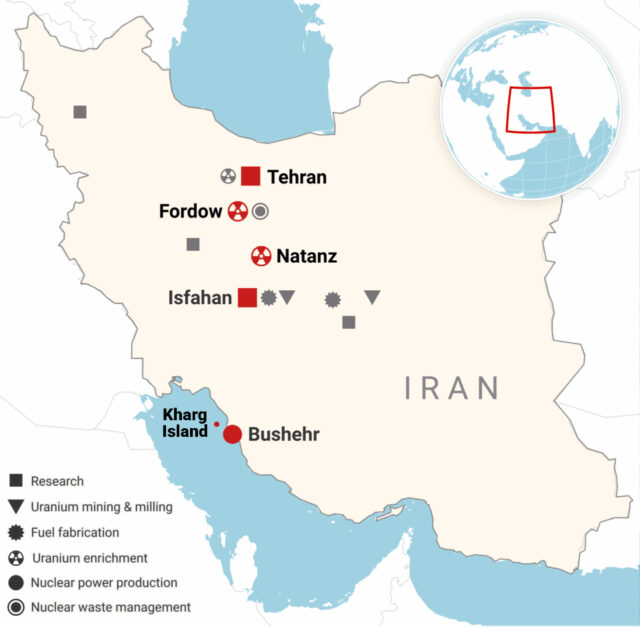
At the same time, in another escalation the US and Israel attacked the Shahid Ahmadi Roshan nuclear facility in Natanz in central Iran, one of the country’s most important uranium enrichment sites, about 220km (135 miles) southeast of Tehran, writes Al Jazeera. The Natanz nuclear facility was also targeted by Israel in the 12-day war between Iran and Israel in June 2025 – which, according to US president Trump then, left it completely destroyed, 3W notes. No leaks of radioactive material were reported or noted by international agency, which according to AJ is primarily due to the fact that Iran had expected the attack.
In response, Iran has attacked Israel’s nuclear facilities in the Negev desert, targeting the cities of Dimona and Arad, writes The Associated Press. Dimona is about 20 kilometers (12 miles) west of the nuclear research center and Arad around 35 kilometers (22 miles) north. AP notes the Israeli censor admitted the damage was extensive, with at least 10 apartment buildings struck, three of them now being in danger of collapsing. 3W notes that the Israeli censor severely underplays the actual facts on the ground. Israel’s military admitted it had not been able to intercept the missiles, AP notes – despite these being conventional rather than hypersonic, 3W adds. This marks an important moment, in the 3W view, as it signals that Israel’s air defenses have been largely degraded. If it can not effectively defend its nuclear facilities, everything is open and exposed.
Iran also targeted the joint US-British military base on the island of Diego Garcia in the Indian Ocean, which is about 2,500 miles (4,000 kilometers) from Iran, writes The Associated Press. The US has described the Diego Garcia base as “an all but indispensable platform” for security operations in the Middle East, South Asia and East Africa, it notes, housing 2,500 mostly American personnel. According to US sources, the attack failed, but one would not expect the US to say anything different, irrespective of what happened on the ground, 3W notes. What is most important, from the 3W view, is that the US was not aware Iran had the capability to strike that far away. Therefore, even if the Iranian missiles were taken down by US defenses, it did communicate to the US that it needs to plan its military operations on a very different basis from now on, as naval assets and supply and logistics hubs up to 4,000 km are now proven to be exposed to Iranian strikes. Which makes the idea of “boots on the ground” to force an end to Iran’s dominance over the Strait of Hormuz all the more difficult to realize without the incurring of massive American casualties.
In what 3W sees as a sign of desperation, US president Trump has threatened to “hit and obliterate” Iran’s power plants if the country doesn’t end its blockade of the Strait of Hormuz in the next 48 hours, writes The Wall Street Journal. It adds that in response, Iran’s military threatened to attack energy, information technology and desalination infrastructure if the US – Israel Alliance were to do so, writes The Wall Street Journal.
Israel’s military admitted it had not been able to intercept the missiles….. This marks an important moment……as it signals that Israel’s air defenses have been largely degraded. If it can not effectively defend its nuclear facilities, everything is open and exposed
At this point, 3W feels it is useful to inventarize.
Firstly, we note, the US – Israel Alliance has still not been able to take the initiative. “Escalation dominance” remains firmly in the hand of Iran, which strikes back hard every time the Alliance escalates.
Secondly, we note that the threat to attack Iran’s power infrastructure is, effectively, the announcement of a war crime. The BBC wrote extensively about why Russia’s attacks on Ukraine’s power infrastructure represented a war crime.
Thirdly, the war crime threatened by Trump is a sign of desperation. It is escalation, crossing limits, humanitarian red lines, again, because nothing so far has worked. As such, in the 3W view it is another sign of Israeli dominance over US policy making, as it essentially is execution of Israel’s Dahiya Doctrine. Dahiya Doctrine is an Israeli military doctrine that calls for the use of massive, disproportionate force and the deliberate targeting of civilians and civilian infrastructure, writes The Institute for Middle East Understanding. The doctrine is named after the Dahiya suburb of Beirut, where the Lebanese paramilitary group Hezbollah has its headquarters, which the Israeli military leveled during its assault on Lebanon in the summer of 2006 that killed nearly 1,000 civilians, about a third of them children, and caused enormous damage to the country’s civilian infrastructure, including power plants, sewage treatment plants, bridges, and port facilities. It was formulated by then-General Gadi Eisenkot when he was Chief of Northern Command. As he explained in 2008 referring to a future war on Lebanon: “What happened in the Dahiya quarter of Beirut in 2006 will happen in every village from which Israel is fired on… We will apply disproportionate force on it (village) and cause great damage and destruction there. From our standpoint, these are not civilian villages, they are military bases… This is not a recommendation. This is a plan. And it has been approved.” Eisenkot went on to become chief of the general staff of the Israeli military before retiring in 2019. International law expressly prohibits the use of disproportionate force and the targeting of civilians and civilian infrastructure, of course.
Fourthly, with this “(Israeli) mindset dominating the Alliance, at 3W we believe further escalation is the most likely scenario at this stage. This was announced by Israel Katz, the Israeli defense minister, who said in a statement that the US – Israel Alliance’s War on Iran will “escalate significantly” this week, writes The Times of Israel.
Fifthly, in the 3W view the way trump’s statements indicating a desire to end the war quickly should be understood in the following manner. “We are getting very close to meeting our objectives as we consider winding down our great Military efforts in the Middle East”, Trump said last Friday according to The New York Times. This reflects Trump’s natural tendency, his inclination, whenever he reflects (usually briefly in his case) upon the impact the War is having on the US economy and his personal popularity. But this natural tendency is quickly managed by Israel.
As to how, Axios writes the trump administration is preparing for future negotiations with Iran. Leading the preparations are… Steve Witkoff and Jared Kushner, the two who according to British officials appeared to represent Israel more than the US in the recent negotiations with Iran, as 3W noted last week. Witkoff and Kushner are driving development of a list of demands that very, very clear unacceptable for Iran. 3W notes the proposed demands exceed what was demanded from Iran during the most recent round of negotiations. They pretend as though the Alliance is winning, and Iran is now more desperate for a deal, when the opposite is probably true as the closure of the Strait of Hormuz is killing the global economy. This is quite clear to see, and as such represent an Israel effort to ensure the War continues for as long as possible.
The only real “offramp” from the worst case scenario of a escalation and a prolonged closure of the Strait of Hormuz, in our 3W view, comes from Iran. It is talking to nations on a bilateral basis, offering to open the Strait for them if they do not support the Alliance, and pay Iran a levy for passage. Discussions with Japan on the matter have already begun, writes The Japan Times. Iran’s foreign minister Araghchi explained the Iranian strategic move in the following manner: “In our opinion, the strait is open. It is closed only for ships belonging to our enemies, countries that attack us. For other countries, ships can pass through the strait.”
In the 3W view, what Iran is trying to do with this policy is create an international coalition of non-aligned countries against the US – Israel Alliance War on Iran. Russia and China are already against this war, as they clearly signaled. But they are aligned with Iran and provide it active support. What Iran is trying to achieve in addition is try to increase the number of countries that refuses to actively support the Alliance, by giving them a way out, a way to get the trade that is important for them to flow again. It makes sense for countries across Asia and Europe to accept this Iranian offer, as that would be a quick end to the economic fallout from this War for them. This would leave the Alliance more isolated internationally, and thereby less able to proceed on the escalator ladder that involves invading Iranian territory.
It does, of course, increase the risk of Israel pushing for a nuclear strike on Iran, in a last ditch desperate attempt to keep the US from giving in to the pressures non-aligned countries bring down to bear on it. The only things that can prevent this apocalyptic scenario from materializing just not Israeli rationality, in our 3W view. It is the realization by the US that it is being played by Israel, and a resulting “reset” in the relationship between the two countries.
That, we say, is the only way for some sort if stability in the Middle East to return.