

Welcome to The Geopolity’s What We’re Watching (3W), our daily look at the interconnected worlds of Geopolitics, Economics and Energy. Curated from the world’s leading sources of information, our analysis and commentary is designed to help you make sense of the events driving the major developments in the world.
In this roundup we explain how the War on Iran has become a major embarrassment for the US.
As 3W noted on the first day of the US – Israel Alliance War on Iran, the original plan of the Alliance was to “decapitate” Iran and trigger a domestic uprising, such that a new government could be installed in the country which would submit to the demands of the US – Israel Alliance: no self-defense capability for Iran through destruction of its nuclear and ballistic missile programs.
Almost three weeks in now, it is clear this objective has not been achieved. Since the US-Israeli campaign began there have been no signs of Iranians taking to the streets or significant defections from security forces that could undermine their grip on the country, writes The Guardian. The reason for this failure is that Iran saw it all coming. Iran had therefore prepared for the “decapitation tactic” of the Alliance by adopting a “mosaic strategy” in response, as 3W noted earlier. This strategy decentralises command into 31 provincial units, each with its own logistics, intelligence, and militia support. This structure allows mid-level commanders to act autonomously if cut off from Tehran, sustaining the defense of their country even after leadership decapitation. As 3W also noted earlier, the mosaic strategy also enabled Iran to re-establish deterrence and severely degrade the US military’s capabilities in the Middle East region. The New York Times writes that 17 American bases across the region have by now suffered significant damage.
As a result, the US – Israel Alliance has had to scramble to make new plans for its War on Iran.
First, it tried to get Iran’s Kurds to start an uprising. But, as 3W noted earlier, the Kurds refused to be “used and abused” again.
Then, US president Trump came with a plan for an “international coalition” to force a reopening of the Strait of Hormuz, in order to take the initiative away from Iran, force it back onto a defensive position, and re-establish escalation dominance for the US – Israel Alliance. But the European and Asian countries called upon by Trump have refused, writes Reuters. In order to save face, Trump then had to say the rejection was “no big deal” but also a “very foolish mistake”, writes The Guardian. So now the US is making preparations to “go it alone,” dropping 5,000-pound deep-penetrator bombs along Iran’s coast near the Strait of Hormuz to take out hardened sites containing anti-ship cruise missiles, writes The Wall Street Journal. 3W notes those are the bombs that were dropped on Iran’s nuclear facilities in July of last year, in order to prevent future wars with Iran. Well, here we are. We at 3W add, Iran has a wide variety of tools at its disposal to keep the Strait closed, including submarines, mines and both missiles and drones that can be launched from inland. For those interested, Lt. Col. Daniel Davis and Scott Ritter, former United States Marine Corps intelligence officer and weapons inspector, discuss the impossibility of “breaking open” the Strait of Hormuz here.
So now the US is making preparations to “go it alone,” dropping 5,000-pound deep-penetrator bombs along Iran’s coast near the Strait of Hormuz to take out hardened sites containing anti-ship cruise missiles… 3W notes those are the bombs that were dropped on Iran’s nuclear facilities in July of last year, in order to prevent future wars with Iran. Well, here we are.
For these reasons, the US – Israel Alliance is now looking at new plans. One is to take control of Iran’s Kharg Island, in order to “cripple Iran ability to profit from its natural resources”, writes The New York Times. The idea is that this would force Iran to the negotiating table on the terms set by the US – Israel Alliance. This plan, quite clearly, is born out of desperation, 3W notes. It is almost impossible to capture Kharg without incurring significant losses in terms of manpower and personnel, as it requires an amphibious operation. If such an operation were to succeed, NYT notes, the US forces on Kharg would likely find themselves pounded by Iranian missiles and drones launched from Iran’s mainland. And, NYT adds, the operation would not end Iran’s control over the Strait of Hormuz, through which it has brought the whole world’s energy supply in a stranglehold.
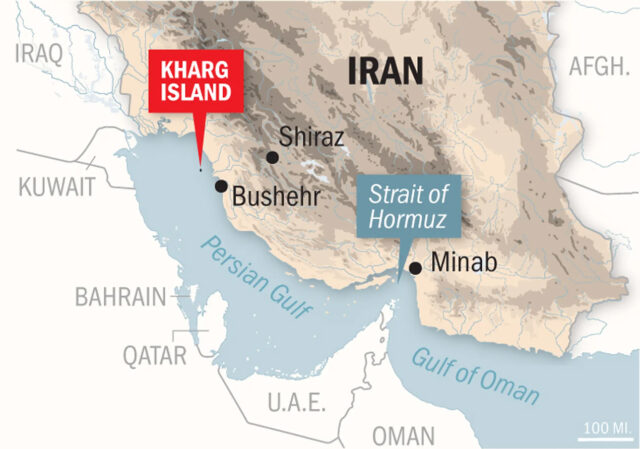
Another plan is to seize or destroy Iran’s highly enriched nuclear material, writes The New York Times. If anything, this plan appears even more desperate. No one is certain where all the material is, and it would be foolish to think Iran stored it all in a single place. More likely it is stored in batches scattered across the country. In addition, Iran’s conventional missile capabilities, in particular its hypersonics, means it can cause devastating damage to the region even without a nuclear weapon – especially in small, dense countries such as Israel.

In parallel, the US – Israel Alliance is giving its decapitation strategy another go – even though it failed to give the Alliance a decisive victory in Gaza, in Lebanon and twice in Iran (July 2025 and February 2026). Yesterday, Israel killed Ali Larijani, head of national security and Iran’s de facto leader since the killing of the ayatollah Ali Khamenei, as well as Gholamreza Soleimani, commander of the Basij paramilitary force, writes Axios. Israeli prime minister Benjamin Netanyahu said in a statement that the operation was part of Israel’s effort to destabilize the Iranian regime. “Our hope is it will give the Iranian people an opportunity to remove it. This won’t happen all at once, and it won’t be easy. But if we persist, we will give them a chance to take their fate into their own hands,” Netanyahu said. 3W notes that a common definition of insanity is “doing the same thing over and over again and expecting different results”.
What this all means is that the progress of the War on Iran is an absolute embarrassment to the US, the largest military power on the planet by far, and (to a lesser extent) Israel, the country with privileged access to advanced US military systems and actively supported by the US military.
What this all means is that the progress of the War on Iran is an absolute embarrassment to the US, the largest military power on the planet by far, and (to a lesser extent) Israel, the country with privileged access to advanced US military systems and actively supported by the US military
Their original plan did not work.
They have had to scramble to deal with the resulting situation, making up new plans as they go along. As many of these new plans have not worked either, the newest of these plans appear ever more fantastical.
They have lost “escalation dominance” vis-à-vis Iran. Iran has severely degraded the Alliance’s ability to deal with Iranian missiles and drones, which now fly through the airspace towards their targets unopposed, as the radar systems designed to identify them are destroyed and the interceptor missiles have run out. As a result, even the USS Gerald R. Ford and USS Abraham Lincoln carrier strike groups have had to move away from their previously “forward-leaning positions” due to the elevated risk of being struck by Iran, writes Defense Security Asia.
And they have effectively been cornered by Iran. Through the closure of the Strait of Hormuz, Iran now dominates the “full spectrum battlefield” that includes not only the military arena but also the global economy. The closure of the Strait is causing economic devastation around the world. In the developed world, higher energy prices are threatening and inflationary push, causing political instability. In the less developed world it is causing energy shortages, which is causing economic circumstances akin to the peak of the COVID pandemic, writes Axios. Beyond energy, the closure of the Strait is also severely limited global supply of helium. Qatar has shut down liquefied natural gas production, which directly impacts the country’s production of helium, which is extracted as a by-product of natural gas processing, writes The National. Helium is indispensable in semiconductor manufacturing and Qatar is the second-largest producer of helium after the US, accounting for about one-third of global supply. Economically, the US – Israel Alliance War on Iran has greatly increased the chances of a global crisis similar to the Global Financial Crisis of 2008, writes The New York Times.
Specifically for the US the embarrassment is made worse by the fact that it was tricked into this war by its supposed partner Israel.
In our original 3W analysis of the US – Israel Alliance latest War on Iran, we noted that Omani Foreign Minister Badr Albusaidi said that Iran had shown willingness to make the compromises on its nuclear program needed to reach an agreement with the US. Recently, Britain’s national security adviser, Jonathan Powell, who attended the final talks between the US and Iran, also said he too was of the opinion that the offer made by Tehran on its nuclear programme was significant enough to prevent a war, writes The Guardian. This made clear that peace was never the objective of the Alliance. War to destroy Iran was always the intended goal.
But why, one should ask…
Interestingly, The Guardian adds that one diplomat with knowledge of the talks in Oman said: “We regarded Witkoff and Kushner as Israeli assets that dragged a president into a war he wants to get out of.”
This assertion was provided further support by the resignation by Joe Kent his position as director of the US National Counterterrorism Center. Kent is longer term supporter of US president Trump, but he nevertheless resigned from his position in protest of the war in Iran, writes The Guardian. “I cannot in good conscience support the ongoing war in Iran,” Kent wrote in a resignation letter posted to X. “Iran posed no imminent threat to our nation, and it is clear that we started this war due to pressure from Israel and its powerful American lobby.”
It is also supported by the revelation that Israel’s defense and security elites knew the plan for the War on Iran would not deliver regime change, writes The Guardian. Israel’s political elite nevertheless pushed for the plan to be executed under the pretext of “regime change” because the real Israeli aim is to get the US into a war with Iran. To use the American military might to destroy the country, to structurally weaken it, by setting its economic development back by decades.
Israel’s political elite nevertheless pushed for the plan to be executed under the pretext of “regime change” because the real Israeli aim is to get the US into a war with Iran. To use the American military might to destroy the country, to structurally weaken it, by setting its economic development back by decades
In addition, the strategy of decapitation, while not delivering “regime change”, does make it impossible for diplomacy to return between the US and Iran for years to come. The New York Times notes, for example, that the recently killed Ali Larinjani was in fact a “pragmatist”, capable of working with both moderates and more hard-line leaders, open to negotiate with the US and finding compromise solutions. A diplomatic solution to the current war is now less likely in the short term, writes Bloomberg. More broadly, as a result of the decapitation strategy any moderate voice inside Iran’s elite circles is either silenced, or drowned out by more hardline voices, says Iran-expert Trita Parsi writing on LinkedIn also.
Together, this strengthens Israel’s position in the Middle East, while it does nothing for America’s interests in the region. 3W noted the difference in the US and Israeli objectives for the War on Iran, and the conflict between US interests and Israeli interests, earlier already.
But this is the reality of the current US – Israel Alliance War on Iran, and it is why this war is such an embarrassment for the US. Not only because the war is not going as planned, and is creating a massive economic problem for the US and the world – which the rest of the world will hold the US accountable for. More embarrassing than that, even, is the fact that the US has been tricked into a war by its so-called partner Israel, with a plan that serves the Israeli interests rather than the American interests.
As was the case during the (ongoing) US – Israel Alliance War on Gaza, through a wide variety of people whose primary loyalty lies with Israel but who work in official positions in the US (people such as Witkoff, and Kushner, and before them Hochstein), coupled with a highly effective lobby that can pressure anyone in elite US circles, Israel can pull influence US policy to align it with its aims, anytime it wants.