

|
Getting your Trinity Audio player ready...
|
Welcome to The Geopolity’s What We’re Watching (3W), our daily look at the interconnected worlds of Geopolitics, Economics and Energy. Curated from the world’s leading sources of information, our analysis and commentary is designed to help you make sense of the events driving the major developments in the world.
In this roundup, we take a closer look at developments in the US – Israel Alliance’s War on Iran.
Iran is pounding the US radar, communications and air defense systems across the Middle East, writes The Wall Street Journal. The strikes are often carried out by Iran’s one-way attack drones, such as its Shaheds, which are a fraction of the cost of the missiles that the sophisticated US systems were designed to defend against. One of the most significant strikes hit a sophisticated early-warning radar system at Qatar’s Al-Udeid, which hosts the largest American military base in the region. The attack damaged the AN/FPS-132 radar, hindering its ability to function. Iran also struck a TPY-2 radar attached to a Thaad battery in Jordan. The radar is a critical component of the ground-based missile-defense system, which intercepts ballistic missiles above the atmosphere. Satellite images also show damage to three radar domes at Camp Arifjan, a base used by US forces in Kuwait, and damage to a satellite communications system at the headquarters of the US Fifth Fleet in Bahrain.
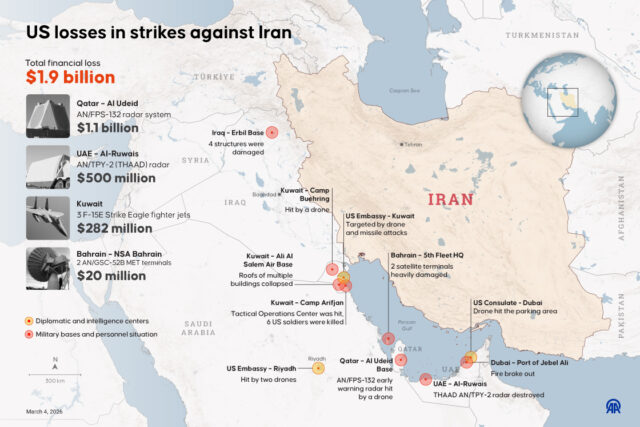
In Saudi Arabia, a satellite image taken on March 1 shows smoke billowing from a building at a radar site at the kingdom’s Prince Sultan Air Base.
Russia has provided Iran with highly precise targeting information, writes The Washington Post. WaPo also notes that Iran is getting through American air defenses quite easily at present. The likely conclusion, 3W notes, is that through Russian support Iran has been able to precisely target and destroy critical elements of the US detection and command-and-control systems across the Middle East.
It appears that Iran has been highly successful in destroying the key nodes in the American military infrastructure in the Middle East, as it has announced it is now broadening its set of targets to include “American capital and interests” in the region, writes Anadolu Ajansi. Iran’s military successes are also evidenced by its position regarding ceasefire negotiations. Iran’s Foreign Minister said on Sunday that it will keep fighting unless the war ends permanently, Abbas Araghchi, on Sunday rejected calls for an unconditional ceasefire, writes The National. “There needs to be a permanent end to the war,” Aragchi said. “Unless we get to that, I think we need to continue fighting for the sake of our people and our security… What we are doing is a legal act of self-defence and we have every right to do that,” he added. Speaking to NBC news, Mr Araghchi accused the US and Israel of attacking civilians and infrastructure and called on President Donald Trump to “apologise to people of the region and the Iranian people for the killings and destruction”. “They are killing our people, they are killing girl students, they are attacking hospitals, freshwater desalination (and) refineries,” he said. Asked what conditions Iran would accept to end the war and return to negotiations, Mr Araghchi said Tehran would not consider a ceasefire until the US and Israel justified their aggression. “They have to explain why they started this aggression before we come to the point to even consider a ceasefire. This is not our war. This is imposed on us by the United States, by Israel,” he said. 3W notes this is a very different Iranian attitude than before the start of this war. Until then, Iran clearly lived in the delusion of being able to cut a deal with the US – for decades, one might add. Clearly, that is no longer the case. And clearly, Iran now feels it is acting from a position of strength.
3W notes this is a very different Iranian attitude than before the start of this war. Until then, Iran clearly lived in the delusion of being able to cut a deal with the US – for decades, one might add. Clearly, that is no longer the case. And clearly, Iran now feels it is acting from a position of strength.
The announcements regarding a broadening of targets and refusal of an unconditional ceasefire came after the US – Israel Alliance on Sunday carried out airstrikes targeting oil storage facilities in and around Tehran. The attacks caused significant damage to several storage facilities, including the Shahran Oil Depot. As a result of the massive attack, Tehran was shrouded in a toxic black smoke on Sunday, writes Time. The city’s residents reported difficulty breathing and oil-tainted rainfall staining everything around them.
According to Iran, the attack targeted Iran’s fuel and energy infrastructure as well as service facilities serving Iranian civilians, writes Middle East Monitor. Iran has threatened to respond in kind. It has urged governments of Islamic countries to warn Washington and Israel against continuing such attacks on oil facilities. “Failure to do so could lead to similar retaliatory measures across the region,” it said. Here it is important to note, in the 3W view, that Iran has so far consistently denied having anything to do with the attacks that have occurred on energy facilities across the Gulf states. See, for example, the Middle East Monitor report on the drone attacks that struck Saudi Arabia’s Ras Tanura refinery. Iran has accused Israel of being responsible, with the goal of bringing the Gulf states into the war on the side of the US – Israel Alliance against Iran.
The US is apparently unhappy with the Israeli attack on Iran energy infrastructure. The US is concerned Israeli strikes on infrastructure that serves ordinary Iranians could backfire strategically, rallying Iranian society to support the regime and driving up oil prices, Axios writes. “The president doesn’t like the attack. He wants to save the oil. He doesn’t want to burn it. And it reminds people of higher gas prices,” a Trump adviser told Axios. This, 3W notes, supports the Iranian argument that Israel in particular is pushing for an escalation in the war, by any means necessary.
The US is apparently unhappy with the Israeli attack on Iran energy infrastructure. The US is concerned Israeli strikes on infrastructure that serves ordinary Iranians could backfire strategically
In the 3W view, the two main stories in the above, which are Iran’s destruction of America’s military infrastructure and the US – Israel Alliance attack on Tehran’s fuel storage depot, are related. Considering the personality of the people in charge in the Alliance (read for example The Guardian’s take on Pete Hegseth following his recent press briefings), we expect that in response to Iran’s battlefield successes, the US and Israel will become ever more aggressive and barbaric in their attacks on the country. Narcissistic psychopaths like Netanyahu and Trump get mad with anger and a lust for punishment when people do not bow down to them. This makes the “escalation scenario” the most likely outlook at present. Unless someone restrains the current political leadership of US – Israel Alliance, they will push for “more, more, more” killing and destruction in response to their inability to achieve their aims in the war so far. Trump already threatened to step up the bombing campaign in Iran, saying it may expand to people and regions that hadn’t been targeted previously, writes Axios. This “vengeful escalation”, we at 3W fear, is most likely behind the US decision yesterday to pull all state department staff out of Saudi Arabia, as noted by The National. We note, also, that according to NBC News, Trump has already discussed the idea of deploying US ground troops to Iran with aides.
Our 3W analysis appears to be shared by the Iran-expert Trita Parsi of the Quinsey Institute. Writing on LinkedIn he says that on Friday last week, the Iranian president Pezeshkian announced that attacks on neighboring countries would cease as long as their territories wouldn’t be used to attack Iran. This statement was designed to create an opportunity for de-escalation. Regional states were then expected to respond in kind, after which Iran could also proceed down the escalation ladder. But before the GCC countries could reciprocate the reconciliatory tone and take regional de-escalation to the next level, US president Trump issued a social media post that declared victory, insulted and humiliated Iran, and even issued further threats of “complete destruction and certain death“. To make matters worse, Parsi says, the US also crossed another red line shortly thereafter by attacking the water desalination plant at Qeshm Island. (A war crime according to Article 54 of the First Additional Protocol to the Geneva Conventions.) Parsi describes Trumps actions as foolish. We at 3W see them as fitting into the pattern we describe above, where Netanyahu and Trump do what they can to prevent a de-escalation.
That brings us to what the objective of the warmongers now is. Last week already 3W explained it was never about Iran nuclear program. This is evidenced by the fact that the decision to go to war was taken before the negotiations on the nuclear subject had even started. It is also not about regime change, as Trump announced following the first wave of attacks, as the US knew that would not be achieved by an aerial campaign against Iran. A classified report by the National Intelligence Council released before the attack found that even a large-scale assault on Iran launched by the US would be unlikely to oust the Islamic republic’s entrenched military and clerical establishment, writes The Washington Post. That leaves as plausible objectives the destruction of Iran as a state, balkanizing it through civil war, for which reason Israel has been pushing the US to bring the Kurds into action, as we at 3W discussed last week. (The most recent information about this is from Axios, which says that the Kurds are hesitant. We at 3W note, however, that Axios’s main reported on the Middle East, Barak Ravid, has a long history of being used by Israel and US intelligence. Ravid, alongside former CNN producers Shachar Peled and Tal Heinrich, is an alumni of Israel’s Unit 8200, a covert operations, spying and cyberwarfare unit, writes Anadolu Ajansi. But in defense of Ravid, Reuters also writes that Syria’s Kurds, who were recently betrayed by their US masters, have also cautioned the Iranian Kurds in Iraq against entering the War on Iran on the side of the US – Israel Alliance.)
All that brings us to the damage the US – Israel Alliance War on Iran is doing to the global economy. Oil prices are by now well above $100 per barrel, writes The Wall Street Journal. Driving the massive price increase is Iran’s closure of the Strait of Hormuz (at least for US – Israel Alliance allied nations, 3W notes, as Chinese vessels have reportedly been allowed through last week…). In addition to oil, natural gas is now in short supply. While under normal circumstances, massive amounts of fertilizer also sail through the Hormuz, feeding crops on every continent. 3W covered the impact the closure of Hormuz is having on economies around the world in more detail last week.
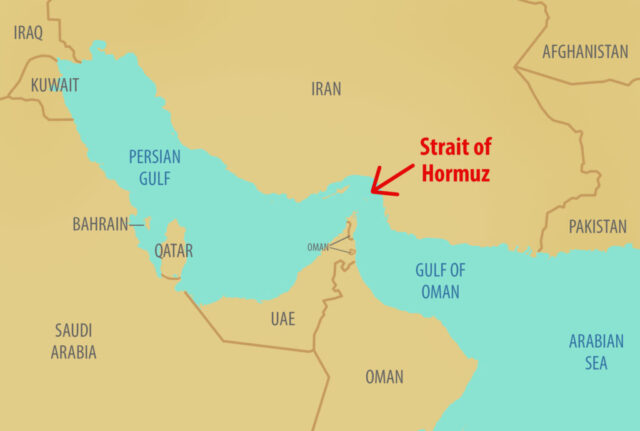
The US is living in denial on the subject. We at 3W say this, as US Energy Secretary Chris Wright told Fox News Sunday that the price run-up “has nothing to do with any shortage of barrels of oil or natural gas”, writes Axios. “It’s just fear and perception”, Wright added. Talking to CNN Wright said more things that are likely to embarrass him in the future. “We’re not too long, I think, before you will see more regular resumption of ship traffic through the Strait of Hormuz”, Wright said according to The New York Times. Wright said that, “worst case,” it would take “a few weeks” for normal numbers of tankers to return to the strait. In the 3W view, Iran has undertaken a calculated move through closing Hormuz. One reason is the vulnerabilities in most western, highly leveraged and financialized economies. Sudden spikes in commodity prices can reverberate through that system and set of chain reactions of defaults and bankruptcies. Another reason is the lack of domestic US support for this war, which will translate into an unwillingness to accept an economic fallout from the war, and thus a further loss of support for Trump administration.
The Financial Times writes that while US consumers will feel pain, the economies of Europe and Asia – net importers of energy – run the risk of being devastated. South Korea has already suspended the market for energy, imposing a cap on domestic fuel prices, writes Nikkei Asia. Bangladesh will close all universities beginning Monday, as part of emergency measures to conserve electricity and fuel, writes Nikkei Assia as well.