
In late January and early February 2026, militants from the Balochistan Liberation Army (BLA) launched coordinated attacks across Quetta, Noshki, Gwadar and other districts, targeting security installations, highways and workers’ colonies. After roughly forty hours of fighting, Pakistani officials said 145 militants, 31 civilians and 17 security personnel were killed — one of the deadliest episodes in years. What appears as a low-intensity insurgency is fast morphing into geopolitical game stretching from the Levant to the Arabian Sea, with China, Russia, India and Israel all in the frame.
At play is America’s grand ambition to reshape the Muslim world to strengthen Israel and India, and at the same time counter China and Russia. The intellectual scaffolding for this project has been in the public record for years. In widely cited remarks, retired U.S. General Wesley Clark recalled being shown a Pentagon memo after 9/11 outlining a plan to “take out seven countries in five years”: Iraq, Syria, Lebanon, Libya, Somalia, Sudan and, finally, Iran.
Two decades later, the US is contemplating the balkanization of Iran—thereby sacrificing the regime that it has been able to have a working relationship with each time its needed them — to achieve new strategic goals.
In fact, in 2006, retired U.S. Army Lt. Col. Ralph Peters published his controversial “Blood Borders” map, sketching a “better” Middle East.
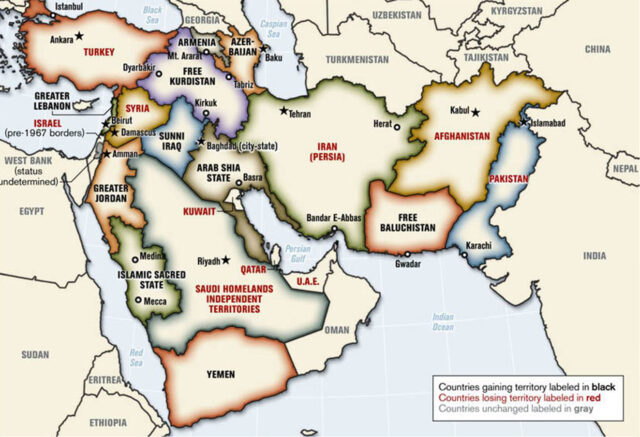
Peters’ map was never official policy, but it captured an enduring temptation in Washington: that redrawing borders might turn unmanageable regional foes into smaller, more pliable entities. America’s pressure on Iran has intensified sharply in early 2026 under President Trump, blending sanctions, military posturing, and strike threats amid Tehran’s protest crackdowns and nuclear defiance. Pakistan, officially tagged a counterterrorism partner, is watching its most strategic province turned into a contested space where every bomb blast near Gwadar scares off capital and undermines confidence in the China‑Pakistan Economic Corridor (CPEC). These developments suggest that Washington could be moving into its next phase to redraw the old European colonial borders by breaking existing power structures and giving birth to new countries.
For American strategists, the concern is not only Iran’s nuclear programme or Pakistan’s instability; it is the possibility that, together with China, they could form a continuous energy and a trade infrastructure spine from the Gulf to Xinjiang. A stable Iran selling large volumes of oil and gas to China, and a coherent Pakistan moving those flows through pipelines and ports linked to CPEC, would give Beijing an overland route that bypasses sea lanes under the control of America. By contrast, a balkanized Iran and an insurgency‑wracked Pakistan are unreliable corridors for energy imports to China and severely undermine China’s Belt and Road Initiative (BRI).
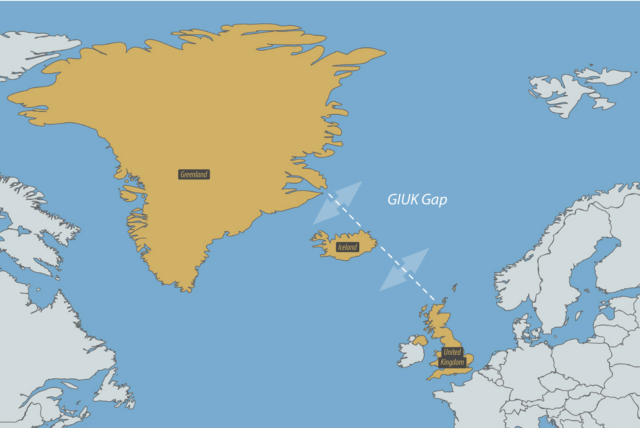
Seen alongside the US backed removal of Maduro in Venezuela and Trump’s push to control Greenland, Balochistan’s insurgency illuminates Washington’s grand strategy. American dominance over Venezuelan oil, and Greenland’s rare earths and critical minerals blocks China’s energy and resource access in the Americas. Coupled with new security ties across the GIUK Gap (Greenland-Iceland-UK), this creates choke points to counter Chinese and Russian Arctic Sea routes, fortifying America’s hemispheric fortress.
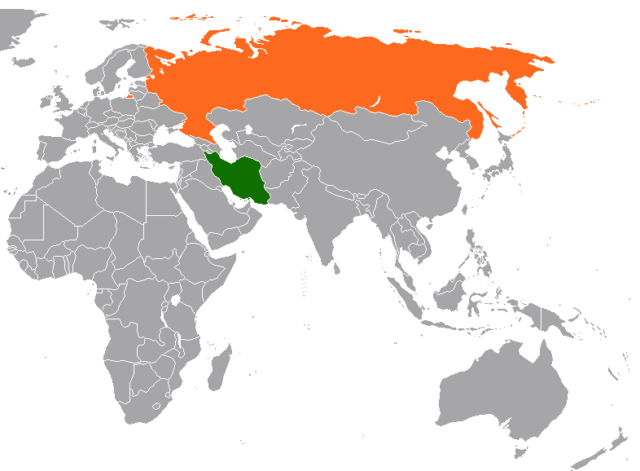
There is also a Russian subplot. A weakened Iran and a Pakistan consumed by insurgency and economic distress converts Russia’s southern flank — from the Caucasus through Central Asia to the Gulf — into a sea of volatility.
Such instability could rapidly engulf Turkey and could fuel independence movements to establish Kurdish and Balouch states amongst others. This nightmare scenario is likely to force the Kremlin to divert military resources from the Ukrainian front to quell the unrest in the South, which provides NATO with the opportunity to gain the upper hand and push for a ceasefire on America’s terms.
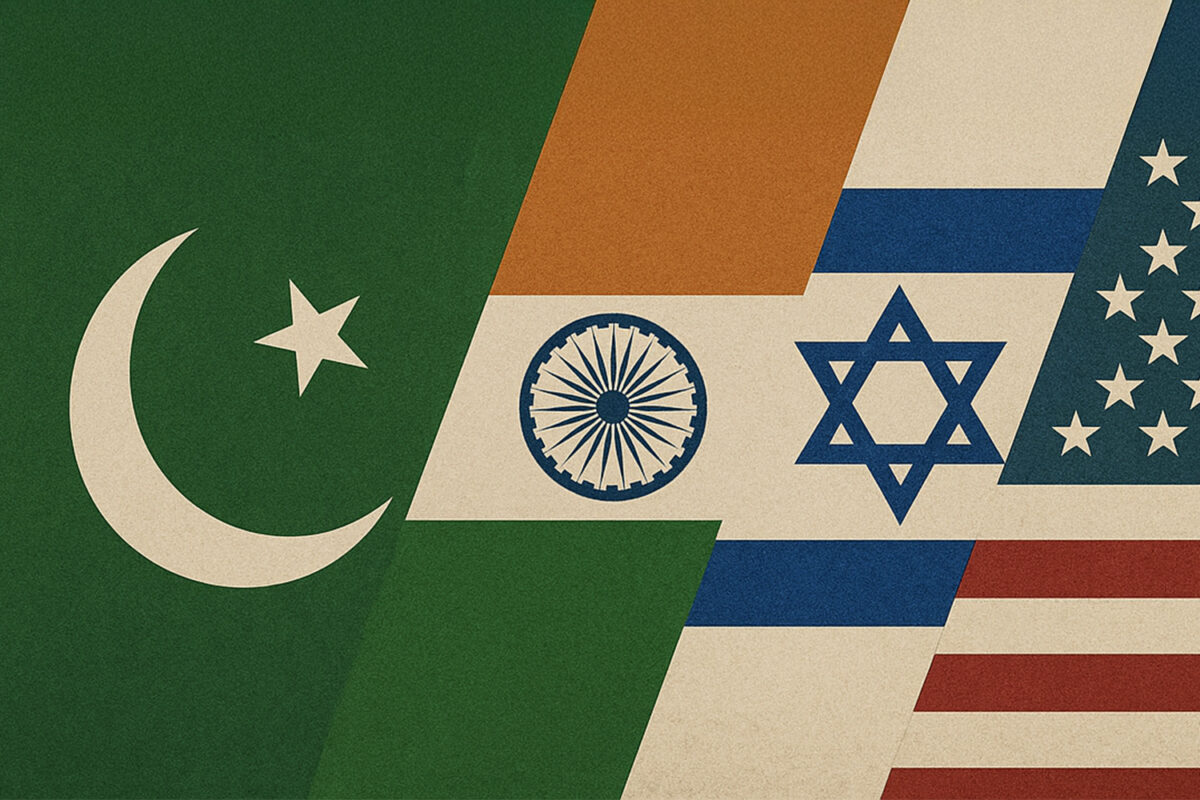
Another important piece in America’s strategy is the quiet triangulation linking Israel, the Gulf countries and India. Over the past decade, Israel has moved from discreet contacts to open security, intelligence and technology partnerships with certain Gulf countries and India. Furthermore, emerging schemes like the India–Middle East–Europe corridor are marketed as connectivity projects but function as partial alternatives to China’s BRI.
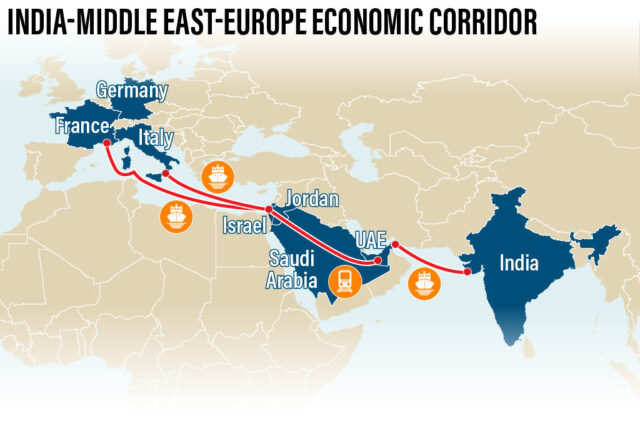
By empowering Israel as Washington’s primary Middle East enforcer—tasked with policing the region—and elevating India as a robust counterweight to China across the subcontinent and broader Eurasia, the U.S. is strategically cementing its long-term dominance over these critical geopolitical theatres.
Trump seeks to leverage this geopolitical reengineering to prevent China from fully decoupling its economy from the dollar system, ensuring continued international trade settlements flow through SWIFT. Simultaneously, Washington aims to trade America’s raw material dominance—securing Venezuelan oil and other hemispheric resources—for uninterrupted Chinese supplies of rare earth minerals (REMs) essential to U.S. industry and military needs, buying time to rebuild its own REM production verticals.
From this strategic vantage, U.S. war drums against Iran beat louder, paired with overt support for Baloch resistance spanning both sides of the Iran-Pakistan border. Some neoconservative circles now advocate for Iran’s total dismantling, echoing what the Mongols did 800 years ago—complete and utter annihilation, leaving nothing but scorched earth in its place.
Back then, the Seljuk, Khwarazmian, and Delhi Sultanates failed to transcend their rivalries, allowing the Mongols to annihilate the Khwarazmians, subjugate the Seljuks, sack Baghdad, and leave the Delhi Sultanate critically weakened and isolated. It remains to be seen if Turkey, Iran, and Pakistan make the same fatal error. Inviting a modern repeat of history’s merciless verdict and enslaving their people to American-Israeli-Indian Khanates.