


On the 20th January 2026, US president Donald Trump completes the first year of his second term. In his first term Donald Trump was a polarising figure who regularly practiced partisan politics and brought to a halt a number of important pieces of legislation. Trump constantly provoked questions of character, ethics and temperament. Before his second stint at the presidency, Trump was found guilty of 4 felony counts of falsifying business records in the first degree, including ‘hush’ payments to a porn star. Trump remains subject to multiple other indictments and investigations over documents and fraud.
Trump has continued from his first term where his government is a vortex of chaos with a record turnover of staff. He surrounded himself with ageing white men and members of his own family, inviting accusations of corruption. Trump has continued to attack the media as ‘the enemy of the people’ while chalking up thousands of false statements.
Whilst the first year of Trump’s second term as the president has seen some changes. Many of the characteristics of Trump’s first term have carried over. Trump’s way of working is causing chaos across the US and much of the world and can be seen from the characteristics that he uses to rule over the US.
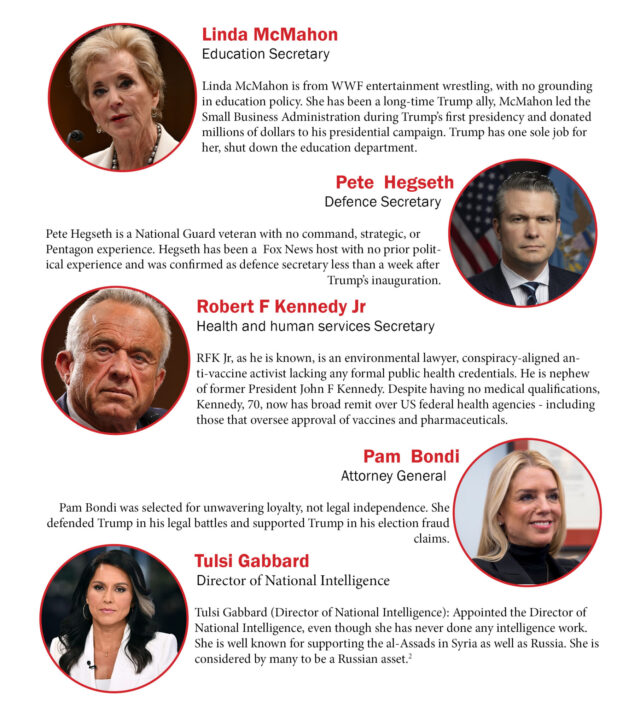
The Strongman – Trump’s ruling style is that of a populist strongman where he prioritises personal over institutional, performative over procedural, and nationalist over globalist. He uses charisma, confrontation, and a sense of perpetual crisis to maintain control, reshaping US governance around his personality rather than policy continuity or institutional legitimacy. This was clearly seen with his cabinet picks. Trump chose ‘Yes’ men and women and most of them lacked any experience or background in the departments they were picked to lead.
Trump ensured he had unconventional people around him and they were ‘Yes’ men and women, who only praise him and do not challenge him on any policy. This consolidation of loyalists, combined with the conspicuous absence of Trump’s family (who declined formal roles this time), has created a decision-making environment defined by personal approval rather than expertise. Trump has effectively reshaped the executive branch into a court, not a cabinet.
The Authoritarian – Authoritarian leaders make themselves the centre of their regime. Their rule is about themselves and not about institutions. Anyone that gets in the way or makes the authoritarian look bad, their days in government are usually cut short. Trump has continued with undermining checks and balances, he questions judicial independence and politicises law enforcement. Trump has also pursued numerous purges.
This was on full display in August 2025 when Trump fired Erika McEntarfer, commissioner of the Bureau of Labor Statistics (BLS), one of America’s most important economic institutions. This was just hours after weaker-than-expected jobs data stoked alarm about Trump’s tariff policy. Trump accused her of having ‘RIGGED’ jobs figures “…to make the Republicans, and me, look bad.”
This episode was emblematic: Trump routinely questions judicial rulings, attacks civil servants, and uses government authority to punish perceived enemies. Checks and balances, in his worldview, are obstacles to be overcome—not constitutional safeguards.
The Monarch – In a monarchy the monarch is above all officials, laws and institutions. For Donald Trump, institutions are not just secondary, but they should be subordinate to him. Trump for long has been speaking about lazy bureaucrats and the need to cut the government down to size.
As a result, when Trump took office in January 2025, he pursued a deliberate political strategy of structural disruption and loyalty tests leading a wave of mass firings of federal staff, combined with the dismissal of Inspectors Generals. Today many government departments remain understaffed and cannot fulfil their departmental work due to this deliberate policy.
Trump targeted career Civil Servants by revving plans to ‘Schedule F,’ a reclassification that would turn tens of thousands of career civil servants into at-will employees, meaning they can be fired and replaced easily. This saw thousands of staff dismissed or resigning pre-emptively when this system was revived. Agencies like the EPA, the State Department and Justice Department have seen major attrition because staff fear political purges and loyalty screening.
All decisions now go through the White House, rather than cabinet departments, this has meant policy is now directed by a small inner-circle of advisors rather than departmental experts.
As the Federal government, Congress department and US trade representative department are hollowed out the Treasury Secretary has been negotiating trade deals with the world over tariff negotiations. There is no team that can negotiate with over 100 countries in the world. In Trump’s view, an understaffed government is not a weakness; it’s proof the “deep state” is being drained. But this is less about efficiency and more about control.
when Trump took office in January 2025, he pursued a deliberate political strategy of structural disruption and loyalty tests leading a wave of mass firings of federal staff, combined with the dismissal of Inspectors Generals
War on America’s Bankers – President Trump has reserved particular spite for the Federal Reserve and its chairman Jerome Powell. Trump has repeatedly demanded that the Fed slash rates, sometimes by as much as 3 percentage points. The Fed has been more cautious: inflation is still elevated, and the Fed must balance between promoting growth and avoiding runaway prices. Trump publicly criticised Jerome Powell’s reluctance to move more aggressively. Trump has attacked the Fed’s internal spending, especially the renovations of Fed buildings, as wasteful and excessive. He uses rhetoric about mismanagement and inefficiency to frame the Fed as not being held accountable.
Trump then turned directly on the Fed’s personnel. Trump threatened to remove Lisa Cook, the Fed’s Governor, over alleged misconduct, asserting he has “sufficient cause” to fire her. Cook responded by suing to block her removal, leading to court battles over whether Trump has the authority to fire her without strong cause. Trump continues to argue the possibility of firing Jerome Powell, though doing so would be unprecedented and face legal constraints.
The Federal Reserve has been an independent central Bank for over a century and like Trump’s other characterises he wants to bring it into line with his direction on the US economy.
The Populist Purger – Trump has systematically gutted US institutions, and in his second term he has been more aggressive. Trump has targeted their independence, expertise, and morale through firings, politicisation, disempowerment, and legal restructuring. All of this has been under the guise of cleaning the swamp and dealing with the ‘deep state.’
At the justice department Trump has been openly antagonistic. Trump appointed as Attorney General, Pam Bondi, who is his long-time political ally who publicly defended him during his impeachments. Internal oversight offices have been stripped of authority. This has led to the longstanding norms of separating the White House from DOJ decision-making, to effectively collapse. This is why legal scholars are calling the US a partisan justice system — one that enforces loyalty rather than law.
Trump has politicised the intelligence community more than any president since Nixon. By appointing Tulsi Gabbard as his Director of National Intelligence, she has removed officers who contradicted the White House line on Russia, China and Iran. The National Security Council has been slimmed down and folded closer to Trump’s personal advisors rather than career professionals. Trump also reduced or censored key briefings to Congress, citing “executive privilege.”
The State Department is one of the most visibly hollowed-out institutions. Career diplomats have left in record numbers, demoralised by purges and political interference. Many ambassadorships remain vacant or are filled by donors and loyalists. Traditional diplomacy has been replaced by leader-to-leader transactional deals, often announced by Trump personally via social media or press events. US soft power — cultural and diplomatic influence — has sharply declined as traditional partnerships fray.
The Socialist – Trump has long argued for US nationalism over globalism and his America first mantra refers to placing US interests before all else. But what Trump has shown, despite all his anti-communist mantra, like the USSR, the Trump regime has been buying stakes in US companies, which are effectively nationalisations.
In August 2025, the US government became Intel Corporation’s, America’s premier semiconductor company, largest shareholder, buying a $9 billion stake. This effectively nationalised the chip manufacturer. Ostensibly this was to help the ailing company that was considering exiting the US manufacturing sector. The US government also has a “Golden share” in US Steel giving the US government veto powers over key decisions. Similarly, the US government effectively nationalised Lithium Americas and Trilogy Metals by taking stakes in the private corporations.
Trump and his MAGA base constantly accused the Democrats of being communist and if they were in power they would make the country a communist nightmare. But like Trump’s Ukraine policy, he’s doing exactly what he accused Joe Biden of.
Trump and his MAGA base constantly accused the Democrats of being communist and if they were in power they would make the country a communist nightmare. But like Trump’s Ukraine policy, he’s doing exactly what he accused Joe Biden of
The Unilateralist – Trump has for long been calling for the US to disengage from global issues, not get involved in foreign conflicts and focus on America’s domestic issues. But rather than the US reducing its global role, under Trump it’s just become more unilateralist, sidelining allies and excluding them from its political solutions.
Once Trump entered the White House again in January 2025, Trump officially cancelled the role of the Quartet Committee in Sudan, which included Britain and Norway, even though Trump engaged it in his first term. Trump also abandoned the Minsk Group, which had been responsible for resolving issues between Armenia and Azerbaijan, for more than five years, and included Russia and France. Instead, what Trump did and what has become a characteristic of his second term is he pursued peace talks between the two countries alone, sidelining the Minsk groups members.
When it came to Ukraine, Trump completely ignored international partners. Trump met with Putin in Alaska in August 2025, without even consulting the Europeans.
The Transactionalist – Trump has always viewed politics as a series of deals rather than moral or ideological commitments. Trump judges his allies and rivals on what they offer the US and even him personally and not shared values or historical partnerships. In his second term Trump has not disappointed.
Trump has pursued a foreign policy that sees him gain material benefits, through extortion and outright pressure, in exchange for managing their conflicts. In managing the conflict between Rwanda and Congo, American companies gained access to rare earth resources in eastern Congo, which is essential for the manufacture of microelectronics.
When it came to managing the conflict between India and Pakistan, Trump got Pakistan to agree to a deal where American companies will develop and extract Pakistan’s huge oil reserves.
Similarly, when it came to the Thailand–Cambodia conflict, whose agreement was signed in Malaysia with Malaysian mediation, Trump declared that he had stopped the war between the two countries. In return, major trade agreements were announced that benefited US companies in both countries, while Cambodia announced its nomination of Trump for the Nobel Peace Prize.
In the conflict between Armenia and Azerbaijan, the peace agreement signed between the two presidents was accompanied by the announcement that the Zangezur Corridor would be renamed the “Trump Corridor.”
In the Russia-Ukraine war, the US already secured Ukraine’s agreement to grant American companies half the profits from the extraction of rare minerals across all Ukrainian territories.
The Tariff Man – Trump’s sole strategy to solve America’s economic problems and fix the US is by imposing tariffs on the world. Whilst Trump has imposed tariffs this is being challenged by numerous court cases.
According to the US constitution, Congress has the authority to set tariffs, and Congress has over several decades given small pieces of that power to the president, but never to the extent that Donald Trump is now asserting. This now means Trump will have to go to the Supreme Court, throwing everything about the Trump tariff policy in doubt.
The tariffs are the core of Trump’s economic and foreign policy, there is nothing beyond the tariff strategy, which is now in doubt.
The Zionist – Like all US presidents, Donald Trump, despite his claims of putting America first, has given Israel everything it wants. Trump has continued arms exports to Israel as it continues its genocide and even provide it cover.
Trump’s MAGA support base includes pro-Israelis and one of his largest donors is Miriam Adelson who contributed over $100 million to Trump’s election campaign. She openly advocates for the West Bank to be annexed by Israel.
The dependency has proven problematic for Trump as Netanyahu has wanted to expand the Gaza war to a regional war and called for the US to support Israel’s war with Iran. US involvement led to discontent within Trump’s MAGA base.
Despite this, Trump has provided support and cover to Israel, despite its atrocities and despite Israel becoming a global pariah.
The Pacifier – Trump has deployed the National Guard into several US cities, drawing a round of legal challenges by state and local officials. Trump has argued the use of federal troops is necessary to quell violence, crack down on crime and support his deportation initiatives: which all seem to be in Democratic-controlled cities.
In June 2025, Trump took control of the California National Guard to respond to protests against immigration raids in Los Angeles, even though California Governor Gavin Newsom objected. California filed two lawsuits against the Trump administration. In the summer, hundreds of National Guard troops arrived in Washington, DC because of what Trump called a “…situation of complete and total lawlessness.” Trump cited homelessness and crime rates as justification.
Trump is using the national guard to circumvent governors who are placing obstacles to Trump’s deportation endeavours. Trump’s deployments of the military to urban areas mark a shift towards a domestic security presidency — using federal forces to manage internal dissent, immigration, and urban disorder. These are tactics used by Egypt, North Korea and most dictators.
The Retributionist – Trump’s personality driven leadership means when you fall out with him he will never forget and it’s likely he will use whatever laws or powers he has to come for you. Trump has been using the justice department to target his enemies for revenge.
John Bolton was the national security adviser during the first Trump administration. But after seeing how incompetent Trump was, he left the administration and became a critic of Trump and everything he does. In August 2025, the FBI was ordered to raid his business and personal residence. Bolton was accused of improperly handling classified materials. This is coming from a president whose officials regularly leak classified information and are caught discussing such matters on social media apps.
Donald Trump’s targeting of James Comey, the former FBI Director, has been one of the most consistent and personal crusades of his political career. Comey led the FBI’s investigation into Russian interference in the 2016 election and potential ties to Trump’s campaign. Trump fired Comey in May 2017. Ever since, Trump has accused Comey of being a symbol of the deep state conspiracy against him.
Trump targeting James Comey is because he represents the origin of the investigations that nearly ended Trump’s presidency. In Trump’s worldview, punishing Comey is both personal revenge and political necessity — a way to rewrite history, delegitimize oversight, and consolidate control over the justice system. Using the FBI as a hit squad for political opponents is something the United States has never done. This is something China or Russia do. But now the US has joined the list.
The Imperialist – The isolationism that President Donald Trump seemed to espouse in his first term has taken a backseat to an unbridled machismo on the world stage. In the first year of his second term, Trump vastly expanded the use of US military force abroad, culminating in the successful Jan. 3 operation to remove Venezuelan President Nicolas Maduro. According to data from the Armed Conflict Location and Event Data Project, the Trump administration oversaw at least 626 airstrikes through the end of 2025 (a figure that does not include the Venezuela strikes), compared to the 555 strikes conducted during former President Joe Biden’s entire four-year term
This uptick in US strikes around the world fits into Trump’s self-described “peace through strength” strategy, which frames aggressive actions abroad as crucial to supporting US national security and political objectives. Donald Trump wants to make imperialism great again. The president has moved on from the isolationism of his first term. “America First” is now a call for global domination.
Trump’s second term is not ideological. It is not nationalist, populist, or conservative in any consistent sense. It is a presidency defined by one central organising principle: Donald Trump is the institution.
All else is subordinate—law, bureaucracy, diplomacy, allies, even the constitution. The first year of his second administration shows a system moving toward personalist rule, where governance is driven less by policy and more by loyalty, vendetta, and the centrality of a single individual.