

|
Getting your Trinity Audio player ready...
|
Public discourse around Artificial General Intelligence (AGI) continues to emphasise breakthroughs in algorithms, model architectures, and venture financing. While these factors matter, they increasingly obscure a more consequential reality. The trajectory of AGI is now shaped less by software innovation and more by access to energy, critical minerals, precious metals, and physical geography. As AGI systems move from research environments into operational deployment, their scalability is constrained by material inputs rather than intellectual ones.
It is in this context that the reported kidnapping of Nicolás Maduro has assumed strategic significance. The episode abruptly repositioned Venezuela within the orbit of United States power projection. This shift is not best understood through the lens of ideology or regime type. Rather, it reflects Venezuela’s role as a concentration of physical resources that are increasingly central to AGI scalability within the United States.
AGI as an infrastructural system
AGI in practice refers not to conversational interfaces or benchmark performance, but to systems capable of autonomous planning, decision making, and execution across domains such as intelligence analysis, cyber defence, logistics, advanced manufacturing, and military command support. These capabilities require vast compute infrastructure operating continuously and reliably. Compute at this scale is inseparable from electricity generation, transmission capacity, and the hardware supply chains that support it.
As AI systems transition from experimental to operational, the principal constraints shift away from model design toward physical infrastructure. This transformation places resource rich geographies back at the centre of strategic competition.
Rare earth elements and strategic leverage
Venezuela sits within the Guayana Shield and Orinoco Mining Arc, a geologically rich region associated with rare earth elements including neodymium, praseodymium, dysprosium, terbium, and yttrium. These materials are essential for high efficiency electric motors, industrial robotics, precision manufacturing tools, sensors, and semiconductor fabrication equipment. Each of these components underpins the physical deployment of AGI across civilian and military systems.
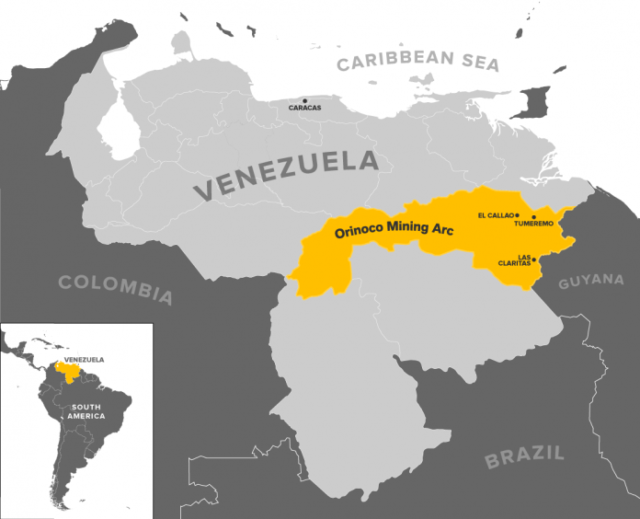
Rare earth elements are also integral to advanced weapons platforms. Radar arrays, electronic warfare systems, hypersonic guidance mechanisms, and space based surveillance architectures all depend on these inputs. As military capability and artificial intelligence increasingly converge, the supply chains for rare earth elements assume a strategic character that extends beyond industrial policy.
Importantly, the significance of rare earth access lies not in absolute volume but in leverage. Global supply chains are already highly concentrated. Even incremental sources in the Western Hemisphere reduce dependency risks and enhance strategic optionality for the United States and its allies.
The broader mineral base behind applied AGI
An exclusive focus on rare earth elements understates Venezuela’s relevance. The country is also associated with gold, bauxite, coltan, and diamonds, and produces non fuel minerals such as aluminium, gold, and iron and steel. It is further identified as having nickel endowments and documented copper occurrences. These materials collectively form the industrial substrate of an AGI enabled economy.
Copper is fundamental to grid expansion and data centre electrical infrastructure. Nickel and related battery metals support electric vehicles and grid scale storage systems that stabilise power supply for compute intensive workloads. Aluminium enables lightweight structural components, transmission hardware, and thermal management solutions essential for dense computing environments. Gold and coltan are critical for high reliability electronics where failure is not tolerable.
This mineral profile aligns closely with the requirements of an economy seeking to industrialise AGI rather than merely experiment with it.
Energy security and compute endurance
Venezuela’s oil reserves further reinforce its strategic relevance. With approximately 303 billion barrels of proven reserves, much of it heavy and extra heavy crude, the country anchors an energy profile compatible with existing United States refining infrastructure. Heavy crude supports petrochemicals, industrial fuels, and grid stability, all of which underpin large scale compute operations.
Energy security rarely features prominently in discussions of artificial intelligence, yet it determines whether compute capacity can scale sustainably. Training frontier models, operating hyperscale data centres, and embedding AI across national infrastructure depend on predictable and affordable energy inputs.
Electricity as the binding constraint
Industry forecasts indicate that AI and hyperscale data centres could require an additional 30 to 50 gigawatts of power capacity in the United States by 2030. This expansion is equivalent to adding dozens of large power plants within a single decade and faces constraints related to generation build out, transmission bottlenecks, and regulatory permitting.
This reality reframes the AGI debate. Progress does not stall because algorithms fail to improve. It stalls when power systems cannot keep pace. Electricity availability, rather than model sophistication, increasingly defines the tempo of AGI deployment.
Strategic and market implications
Securing access to Venezuelan energy and mineral resources does more than support industrial resilience. It also shapes expectations within capital markets. Reduced input volatility and improved supply assurance encourage continued investment into AI infrastructure, utilities, data centres, and compute supply chains. In doing so, they sustain aggressive capital expenditure assumptions and reinforce the investment cycle surrounding AI.
Venezuela therefore appears less as an isolated case and more as an early indicator of a broader strategic approach. The United States may be moving toward a hemispheric strategy that prioritises control over critical resource corridors to underpin long term AGI leadership.
AGI dominance is no longer an abstract technological aspiration. It is becoming territorial, grounded in mines, oilfields, grids, and geography. Venezuela may represent one of the opening moves in this shift, but it is unlikely to be the last.