

Welcome to The Geopolity’s What We’re Watching (3W), our daily look at the interconnected worlds of Geopolitics, Economics and Energy. Curated from the world’s leading sources of information, our analysis and commentary is designed to help you make sense of the events driving the major developments in the world.
In this roundup, we take a closer look at the kidnapping of Venezuelan president Nicolas Maduro and his wife, at the hands of US soldiers, to provide insight into the “why?” and “what’s next?”.
On Saturday the US conducted a “large-scale strike” against Venezuela, and sent in troops to kidnap Venezuelan president Nicolas Maduro and his wife, Cilia Flores, writes The Associated Press. The two are now aboard a US warship on their way to New York, where they are to face criminal charges over “cocaine smuggling.
The operation was named “Absolute Resolve” and had been trained extensively over recent months, writes The Associated Press. Apparently, the US had agents in Maduro’s inner circle, as general Dan Caine, chairman of the Joint Chiefs of Staff who led the operation, said at Trump’s news conference that the US for months had been learning everything about Maduro, including where he was at certain hours as well as details of his pets and the clothes he wore.
As to what will now happen next, during a press conference US president Trump said the US would now run Venezuela, at least temporarily, and tap its vast oil reserves to sell to other nations, writes The Associated Press. “We will run the country until such time as we can do a safe, proper and judicious transition,” Trump said, according to Reuters. “We can’t take a chance that someone else takes over Venezuela who doesn’t have the interests of Venezuelans in mind.” Trump added that “The people that are standing right behind me”, referring to secretary of state Marco Rubio and secretary of defense Pete Hegseth, would be in charge of running Venezuela for the time being. Trump also said as part of the takeover, major US oil companies would move into Venezuela. For that reason a potential physical occupation of Venezuela by US troops “won’t cost us a penny” because the US would be reimbursed from the “money coming out of the ground,” Trump said.
As part of our coverage of Venezuela over recent months, 3W explained why all the talk of drugs smuggling and “narco-terrorism” are quite clearly narratives designed to hide the simple fact that the US wanted to use military power to force its will upon a sovereign country. Maduro should not, in response to the US operation, be made out to be a hero. He was an incompetent and corrupt government official. But the US operation is not about that. It is imperialism, plain and simple.
In support of the 3W fundamental perspective on the event, Reuters notes the clear contradiction between the “official” justification for the US military operation, which is the case against Maduro over drugs smuggling, and Trump’s statements during his press conference where he blamed the country of Venezuela for stealing US oil interests, and said the US would now take them back and planned to run the country of Venezuela for a period of time. “You cannot say this was a law enforcement operation and then turn around and say now we need to run the country,” said Jeremy Paul, a professor at Northeastern University specializing in constitutional law. “It just doesn’t make any sense.”
The Associated Press notes that Maduro will now be tried in the same court that earlier convicted Honduran president Juan Orlando Hernández to 45 years in US prison for helping drug traffickers to safely move hundreds of tons of cocaine north through his country to the US – and who has since been pardoned by Trump.
The Associated Press further notes that in the view of legal experts, even if Maduro were involved in criminality, the US operation would still be illegal according to international law. “This is clearly a blatant, illegal and criminal act,” said Jimmy Gurule, a Notre Dame Law School professor and former assistant US attorney. Michael Schmitt, a former Air Force lawyer and professor emeritus at the US Naval War College, said the entire operation — the boat strikes as well as the apprehension of Maduro — clearly violates international law. Reuters writes that according to Matthew Waxman, a law professor at Columbia University specializing in national security law, “A criminal indictment alone doesn’t provide authority to use military force to depose a foreign government”.
The “occupation and oil stealing” part of the Trump plan is another obvious crime against the principles of international law that the US supported the development of. “An occupying military power can’t enrich itself by taking another state’s resources”, the Associated Press quotes again Matthew Waxman of Columbia University as saying on this specific subject.
Then turning to what really is the US plan. In the 3W view, the thing that angered the US most about Venezuela is that it refused to submit to US dictates. This goes back to Venezuela’s former president Hugo Chavez. In a famous 2006 speech at the UN, Chavez publicly accused the US of being an evil, imperialist empire by saying that the UN podium still smelled of sulphur after then-US president George W. Bush spoke. In other words, Venezuela acted independently. Because it also has the world’s largest oil reserves, through which the country can play an important role on the world stage, this Venezuelan position was simply unacceptable for the US.
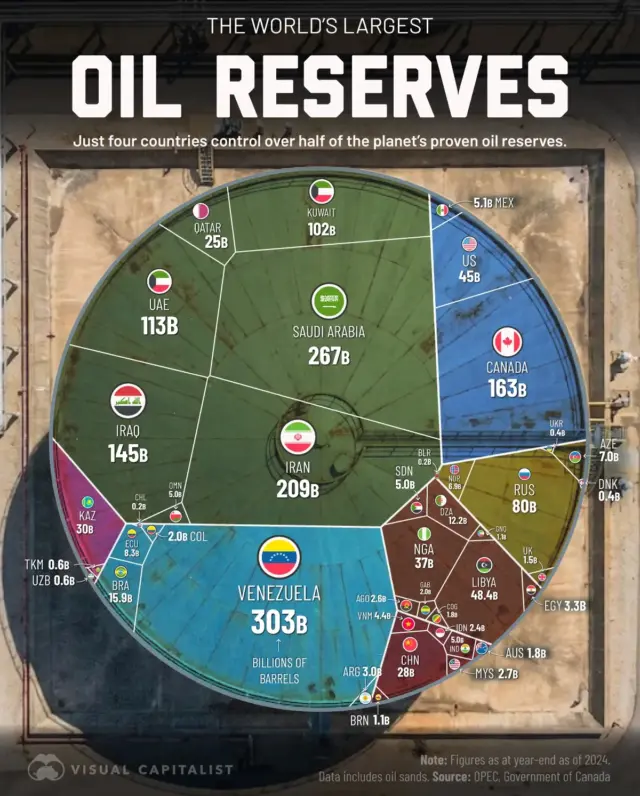 Venezuela has some of the world’s largest oil reserves, through the Orinoco heavy oil belt, notes Bloomberg. US oil companies were the main architects of Venezuela’s oil industry starting a century ago, building the country into a leading US supplier. Venezuela became a founding member of OPEC in 1960. The industry was nationalized in the mid-1970s and reopened to foreign investment in the 1990s. but Maduro’s predecessor Hugo Chávez expropriated major US oil projects in 2007. Venezuela currently produces just a million barrels a day, about one-third of its 1990s peak and less than 1% of global output, due to the mismanagement of the Maduro government and the US sanctions on Venezuela. Most of Venezuela’s oil goes to China, between 500,000 and 800,000 barrels a day. China’s state-owned CNPC produces this Venezuelan oil in a long-standing joint venture with PDVSA, Venezuela’s national oil company.
Trump says US oil companies will now spend billions of dollars to rebuild Venezuela’s energy infrastructure, writes Bloomberg. “We’re going to have our very large United States oil companies — the biggest anywhere in the world — go in, spend billions of dollars, fix the badly broken infrastructure — the oil infrastructure — and start making money for the country,” Trump said. “They will be reimbursed.” This vision for Venezuela is in line with Trump’s broader vision of US global energy dominance, under which American companies not only driving record oil and gas production domestically but exerting their influence globally. In the 3W view, tis is a key part of the real reason the US did to Venezuela what it did. It is about bringing the centers of global oil production under direct US control. The Gulf countries are already under direct US control. Venezuela is now being brought back into the US controlled hemisphere. Russia and Nigeria are a work in progress. As is Iran, of course.
China probably realizes this and for that reason released a statement saying it’s “deeply shocked” by the US’s military strikes, writes Bloomberg. China “strongly condemns the US’s blatant use of force against a sovereign state and action against its president,” a Foreign Ministry spokesperson said in a statement late Saturday. “Such hegemonic acts of the US seriously violate international law and Venezuela’s sovereignty, and threaten peace and security in Latin America and the Caribbean region. China firmly opposes it.” “We call on the US to abide by international law and the purposes and principles of the UN Charter, and stop violating other countries’ sovereignty and security,” the ministry in Beijing said.
Columbia has requested an emergency meeting of the United Nations Security Counsil. The request was supported by Russia and China, and will now take place on Monday, writes The Associated Press. But, 3W notes, this is largely symbolic. In the real world only hard power decides, not rules, principles or morality. We note, for example, that US secretary of state Marco Rubio already hinted that Cuba could be the next target of the Trump administration’s push to “restore American dominance in the Western Hemisphere”, writes The Associated Press. “If I lived in Havana and I was in the government, I’d be concerned at least a little bit,” said Rubio. In addition, Axios writes that Trump indicated Colombia and Mexico are also possible targets of US military intervention. “I think Cuba is going to be something we’ll end up talking about, because Cuba is a failing nation right now,” Trump said
This means that China will very simply be kicked out of Latin America by the US. This will include Panama and the Panama-Canal, but also the broader economic interests China has built up in the area over recent decades, as summarized by the Council of Foreign Relations. Unless if China is “willing and able” to militarily confront the US to protect its interest, that is. In the 3W assessment, China is not able nor willing to go down this route. And as such we expect a US operation in Cuba next, as well as a hard and aggressive US position to end China’s business relationship across Latin America.
While this might appear to make the US stronger, there are soft power implications of this US military operation that are detrimental to the US geopolitical strategy. Not only China but also Brazil, Colombia, Mexico, Russia and Iran condemned the US operation, writes Axios. Brazilian President Luiz Inácio Lula da Silva wrote on X: “Bombings on Venezuelan territory and the capture of its president cross an unacceptable line.” Colombian President Gustavo Petro shared on X what he described as “deep concern” about the reports of explosions. He said Colombia “reiterates its conviction that peace, respect for international law, and the protection of life and human dignity must prevail over any form of armed confrontation.” French Foreign Minister Jean-Noël Barrot also accused the U.S. of violating international law, saying on X “no lasting political solution can be imposed from the outside.” Short term this means nothing. But medium to longer term, this means countries will seek to distance themselves from the US and become less dependent on it, thereby limiting the US ability to influence or drive world affairs.
The US has now further undermined the idea that “sovereign nations should be allowed to make sovereign decisions”, which is the moral basis used to muster support for Ukraine and Taiwan. Effectively, therefore, the US operation in Venezue4la has completely legitimized a Chinese military operation against Taiwan – more so since unlike Venezuela, Taiwan is actually historic Chinese territory.
One comment
ߛߋߞߎߓߊ߫ ߛߌߛߋ߬
5th January 2026 at 10:23 am
ߊ߬ ߛߌߦߊ߫ ߕߊ߫ ߘߊ ߕߌ߫ ߟߋ߬߸ ߞߎߡߊ߫ ߟߊ߫ ߛߕߎߦߊ߫ ߕߐ߫ ߥߎߟߊߟߊ߫ ߟߊ߫ ߟߊ߲ߘߊ ߥߊߙߊ߲߬ ߛߌߟߏ ߟߋ߬߸ ߛߍ߲ߓߍߡߊ ߟߎ߬ ߟߋ߬ ߞߊ߬ ߓߊߟߎ߫ ߛߍ߲ߓߍߒߕߊ߲ߢ߭ߏ ߟߎ߬ ߟߊ߫.
Beyond words to describe, is pretty much the peak of colonialism in short the law of the jungle, survival of the fittest.