

|
Getting your Trinity Audio player ready...
|
Welcome to The Geopolity’s What We’re Watching (3W), our daily look at the interconnected worlds of Geopolitics, Economics and Energy. Curated from the world’s leading sources of information, our analysis and commentary is designed to help you make sense of the events driving the major developments in the world.
The US president on Tuesday withdrew his plan to levy tolls on ships passing through the Strait of Hormuz, writes The Hill. “Based on highly productive conversations with Middle East leadership, I have decided to replace the 20% United States Reimbursement Fee with Trade and Investment Deals that the various Gulf States will be making into the United States,” Trump wrote on Truth Social. “Those Investments will be MASSIVE but, at the same time, extraordinarily good for them, and their future.” On Tuesday 3W explained why the idea was a strategic blunder by the president of the US.
On Wednesday and Thursday, the US again attacked Iran, with Iran again responding in kind, writes The Associated Press. The US has begun striking deeper inside Iran. American strikes hit Tehran, but also further north of the country. Iran retaliated with missile and drone fire targeting Bahrain, Jordan and Kuwait. The National adds that Iran’s coastline across the Strait of Hormuz remains the primary target, however.
As to what Iran is trying to achieve through its counter-strikes, among other things, it is preparing the ground for stronger retaliations in the direction of Israel, writes The National. In particular the attacks on Jordan serve this purpose, as they are targeting air-defence sites that protect Israel. Jordan is now working closely with the Israeli military to co-ordinate their defences in case Iran launches an attack on Israel.
Jordan is now working closely with the Israeli military to co-ordinate their defences in case Iran launches an attack on Israel
As to what the US is trying to achieve, anonymous US military officials told Reuters the US strikes should be seen as “shaping operations” that are degrading Iranian defenses in case the US military was ordered to carry out more intensive operations in the future. Reuters in March reported on U.S. military planning to create options to deploy US troops to Iran’s shoreline to better secure the Strait. At the time, officials said the Trump administration had also discussed sending ground forces to Iran’s Kharg Island, the hub for 90% of Iran’s oil exports.
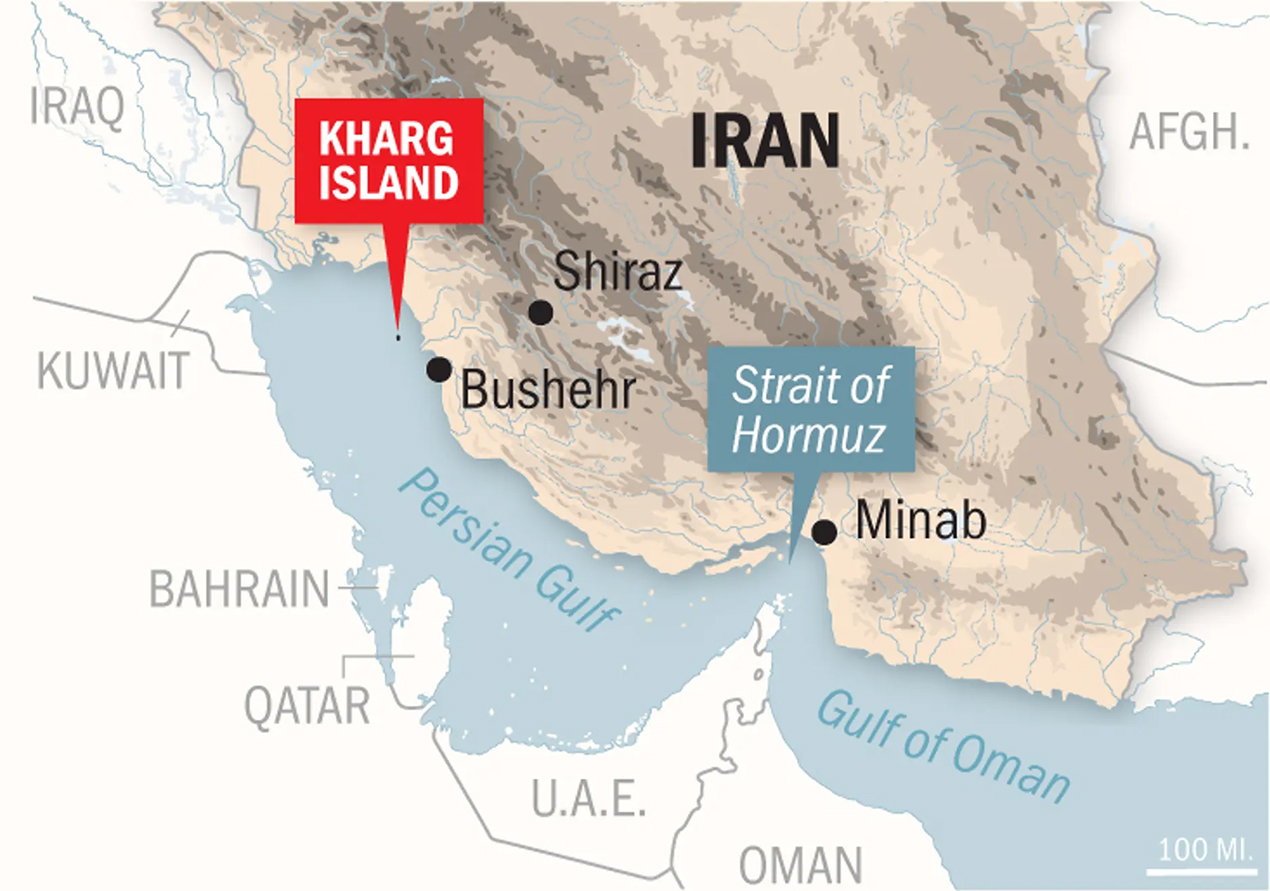 Iranian army spokesman brigadier general Mohammad Akraminia said this US military operation against Iran would be fruitless even if it succeeds, as Iran’s military is able to control the Strait of Hormuz from anywhere in the country, writes The National. “The Americans imagined that by attacking some of our bases on the southern coasts of the country, they could seize control of this strategic strait, whereas the Islamic republic of Iran has the capacity to exert control over the Strait of Hormuz from every single point of its territory, and this matter is never dependent on the coasts and islands,” he said
Mark Esper, US defence chief during Trump’s first term, also told The Financial Times that an air campaign alone would not be sufficient for the US to achieve its objective of bringing the Strait of Hormuz back under US control. “I’m not confident that, if we picked up the bombing the way we did months ago and sustained it for a period of time, that that would have a big change,” Esper said. If the US wanted Iran to hand back control over the Strait to the US, it would need to be forced through military and economic means, he said. “How do you pressure them?” Esper said to the FT on Wednesday. “One option is you resort to full military onslaught. The other one is you strangle them economically.” But this would require “time, patience [and] discipline” as well as international support to be effective, he said during the panel discussion. “And the cost for us is going to be higher gas prices for a while.” Esper also warned of the cost to the US’s military budget of a prolonged war, as well as its defence posture in the face of threats such as that from China.
This brings into focus the effect the uptick in fighting is having on the global economy. If the issue of the renewed closure of the Strait of Hormuz is not resolved within weeks, the global economy will again be in major trouble, writes Bloomberg. “If the Strait of Hormuz remains closed we may again have some difficulty for global economies, including those in the region and developing nations and Asia,” Fatih Birol, head of the International Energy Agency, said. “It is not months, it is weeks” after which the strait needs to be “fully open, unconditionally open.”
This is a good moment for 3W to bring back into focus the economic impact of a closure of the strait of Hormuz. The Arabian Gulf produces 15% of global oil. More than 6,000 products rely on crude oil derivatives, notes Project Syndicate. These inputs are essential for plastics, lubricants, waxes, tars, asphalt, synthetic textiles, and life-saving medical devices like MRI machines and pacemakers.
But beyond economics there are also other important consequences from the US – Israel Alliance War on Iran that deserve attention.
As 3W previously discussed, the war is strengthening the view that the US – Israel “special relationship” requires a fundamental reset. This “trend” in US domestic politics was on display this week as the House debated military aid to Israel. More than 100 Democrats backed a House measure to block all military aid to the country. The motion still did not pass, but the increase in support is notable. “It used to be that just a small number of House Democrats would vote against sending taxpayer dollars to weapons for the Israeli military,” Congressional Progressive Caucus Chair Greg Casar of Texas said after the vote, adding that Wednesday’s vote “is enormous progress. That is a victory for our movement, for security, peace, and justice for all people.”
Jordan is now working closely with the Israeli military to co-ordinate their defences in case Iran launches an attack on Israel
Another development is that due to the war, US soft power is further eroding at a rapid pace. China is now viewed more favorably than the US in most of the 36 countries surveyed by the Pew Research Center, writes Axios. The US remains its lead in only six countries: India, Japan, the Philippines, South Korea and two others. The fall in US standing has been rapid over past years. US favorability in Canada, for example, fell from 57% in 2023 to 33% this year, while China’s has risen from 14% to 44%. The pattern is similar among other U.S. allies, including France, Germany and the UK. Pew surveyed people living in Argentina, Australia, Bangladesh, Brazil, Canada, Chile, Colombia, France, Germany, Ghana, Greece, Hungary, India, Indonesia, Israel, Italy, Japan, Kenya, Malaysia, Mexico, the Netherlands, Nigeria, Pakistan, Peru, the Philippines, Poland, Singapore, South Africa, South Korea, Spain, Sri Lanka, Sweden, Thailand, Turkey, the U.K., and the West Bank and East Jerusalem.
Taking this all in, the 3W perspective is as follows. The US has engaged in another attempt to force its will upon Iran, deploying essentially the same tactics as during the 40 days of war over March and April. The outcome of this phase should therefore be expected to be the same as the outcome of the 40 days war. This further defeat will only increase support for the view inside the US that the country needs to distance (much) more itself from Israel, and withdraw militarily from the Middle East. And while the US debates this, its global standing will further deteriorate, weakening its soft power at the moment it is expending all its military power.
Longer term, the outlook for the empire of the US – Israel Alliance is looking extremely weak.